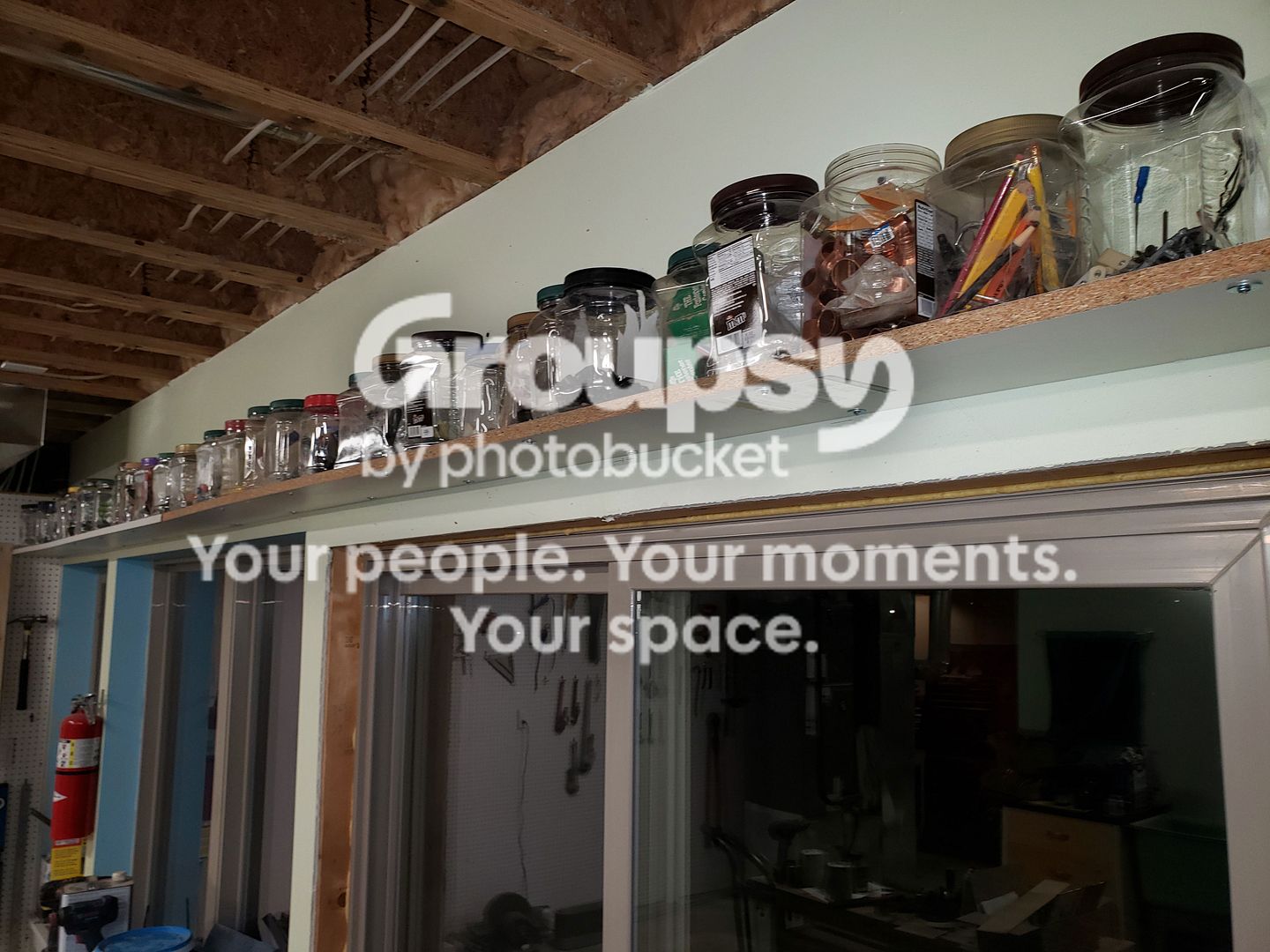
Still working on organizing my new shop (studio?) with the admirable goal of being able to find a "thing" without hunting through 6 cabinets. I've determined that I have a fine collection of "miscellaneous" storage places that seem to collect various disparate items that I didn't (or couldn't) decide on where to put them.
Example: How did 3 casters, 4 ragged pieces of sandpaper in different grits, a bent screw driver, and part of a raisin bagel wind up in the dowel drawer? (I swear the bagel was an accident)
It is just me or do others here have a similar situation?
Thanks for the good laugh Mark. The question is, when is a bagel too good or old to throw away? What brand do you recommend, and did you eat it when you found it? ;-)
I thought you were commenting on the quality of the drawers I was building. You mean those junk drawers. Well, don't look at me. I don't have any. I don't have any drawers
Now if we want to discuss "junk shelves" we could have a detailed conversation. But, I am unwilling to type all that would be necessary to describe the residents coexisting on my shelves.
Ten seconds in the microwave and that bagel is as good as new. Just eat it with somebody else's teeth.
I have been trying to reorganize (actually organize) my shop. I have slowly realized that I put new things in the only available space. Build a new storage cabinet....put whatever needs putting away in it. No rhyme or reason other than this random stuff needs a place and Ah Ha!, there's an empty spot. Sometimes there is slightly more logic. The cabinet under the lathe has mostly lathe-ish stuff in it, but then why are my spare planer knives in there? One corner has sort of tall slender things, pipe for clamps, other pipe, ratchet strip, long dowels, long piano hinges, etc.
But then there are several drawers that have electrical junk in them. Boxes, switches, circuit testers, breakers, Cover plates, soldering gun, and files. Like mill cut bastard files. In the bottom of the drawer, don't know why but at least I know where.
I have drawers organized along the lines or things like screwdrivers or at least things with screwdriver like handles...you know, nut drivers, snap plug removers, awls, icepick, glazing point driver, etc, and I forgot, etc.
Below that drawer is the drawer with pinchy wrenchy things.... pliers and wrenches. My J roller lives in that drawer. And my sockets.
One of many problems is trying to organize a packrat. I should throw away half of my screwdrivers. They are worn out and I have many duplicates. But you never know when you might need a phillips screwdriver missing one of the little wings to stab an intruder.
I recently realized that one problem I have is I tend to lay anything down on any flat surface and leave it until next time. It slowly occurred to me that the problem problem is the drawers.
If you store your tools in drawers, to use one becomes a multistep process. Open the drawer, fetch the tool, close the drawer, use the tool, open the drawer, return the tool, Close the drawer. It's so much simpler to leave the tool laying around. So I have made a little rack on the end of a shelf that has holes for various frequently used tools and amy trying to be more vigilant about putting them away.
I was also laying my frequently used power tools on the floor, based on the idea they can't fall off the floor. In my tiny shop I was constantly stepping over them, and walking on the cords and dust hoses. So I have made a shelf on the side of what passes for a workbench and moved the dust extractor under the bench. Not sure this is better. The tools do fall off the shelf and they tend to shower each other with sawdust.
I made a storage wall outside the shop for my tool cases, Festool Systainers and the like. I have reached the same conclusion about the systainers as I have for storing tools in drawers.
I think you should give considerable thought to setting up your shop. And then move on. I would rather work in my shop than on my shop.
has spent the last week or two or three trying to clean up their shop and at every step of the way uncovered margarine or similar containers of assorted nails and screws from projects ranging from patching the old van, shelves in the garage and several places in the shop. Of course, tools are spread from the shop to the garage too.
I thought a bigger shop would let me organize better but it just increased the number of places I have to look for things.
Sometimes it seems that junk, in some degree or another, is all I own. I still haven't cleaned up my shop properly. In fact I made it worse by cleaning up my "back" room which is the result of trying to dress up and prettify a mid-60s basement rec room. The room was about 25X25 and had an off-center fireplace that bugged me no end so I put up a non-structural wall to divide off part of it and the resulting ~8-foot by 25-foot room became the repository of, well, everything. In cleaning it out I recycled and trashed literally hundreds of pounds of miscellaneous material dating back before my time in Alaska but among that being removed was box after box after bag of hardware of every type along with caulk, paint, tiles and .... All of this were dutifully taken to the shop and put on the bench, on the floor, on the drill press, on the bandsaw, on the table saw etc. Sadly none of it was ever sorted so now I'm left with all of that detritus to go through and I'm not up to throwing anything out that might conceivably be used later so most of the hardware will be dumped into boxes that could be labeled "mixed". Not to mention all that was in the shop to begin with. Sigh...
This is a confession not a boast, we went from adding a 270 sq/ft shed , to a 1000 sq/ft heated shop to a a 650 sq/ft cold building for storage. Getting more room does not alleviate clutter, it just gives you licence to keep/acquire more stuff.
About 3-4 years ago I started a routine to clean out the shop every year as I just got tired of moving excess and at times not finding what I was looked for. "SCOD" -- shop clean out day -- usually happens sometime in November or March.
So far SCOD has been very successful at cutting down on the clutter, inc. keeping wood scraps/cut offs. Also found that cleaning up and putting tools at the end of the day and after finishing a project keeps things organized and at hand when needed.
I built a 16 foot 32 drawer cabinet/extension to my Radial Arm. The drawers were assigned according to the kind of thing they were to hold. However, there were more than 32 kinds of things, and orphan things multiplied over time, so many drawers housed various disparate things. Finding any particular thing often took searching two or more drawers. Give up; organization is futile.
The junk drawer thing never worked for me. Things would get to the bottom of a drawer and I would forget what drawer or that I had that item. My solution is transparency Put similar items in the same see thru container. I would be unlikely to have this many drawers and I can find the most likely container at a glance.
I don't usually eat bagels in the shop, but I have lots of granola bars stashed in various drawers, in case I have a hypoglycemic episode. They are very effective sawn for a faux burl effect. Another one to try for oystering is a loaf of swirl rye pumpernickel bread, especially if you can find one with an interesting pattern of blue stain spalting.
True for a closed system. Fair to say woodworkers are a closed system. Hence, for all you tidy persons that organize you shop the rest of us proportionally become less so. We know who you are by the shop pictures you post. So STOP it!