WoodCentral Forums

Est. 1998 — 27 years of woodworking knowledge

Wasteing away the half blinds

Posts

Wasteing away the half blinds

#1

Wasteing away the half blinds

Bill Tindall, E.Tn.


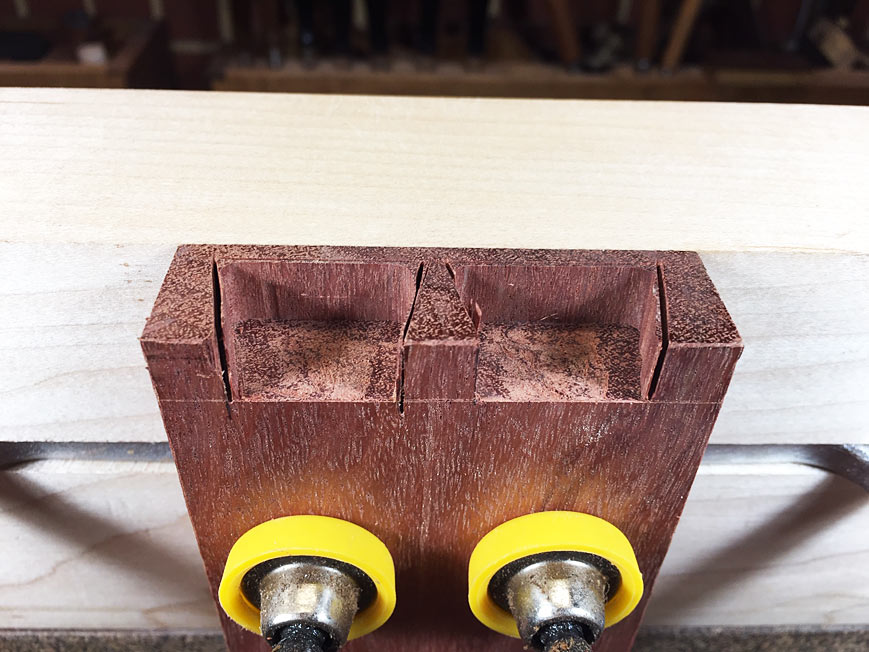
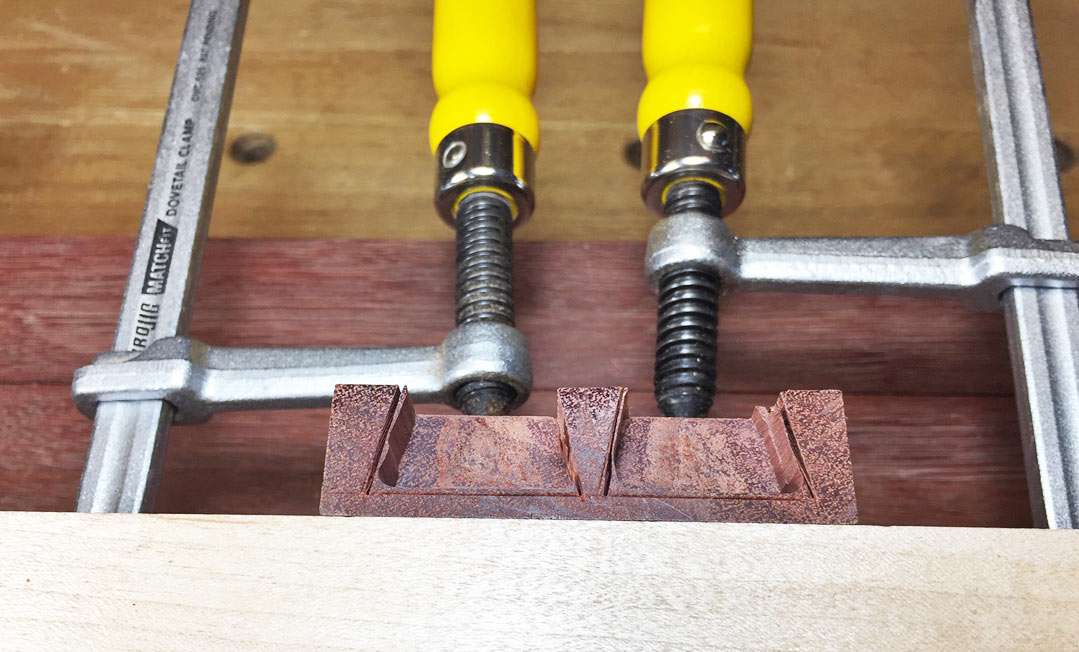
I overcut the pin board in a case piece where this joint doesn't show. Makes being rid of the waste easier.


I routed away most of the waste as usual, which for me means the orientation shown and not orthogonal, with the router on the end of the board. While some claim this other approach superior, in this case it would mean routing 7/8" deep. 1/4" bits can acquire worrisome vibrations at this depth of cut. In my case the cut is 9/16" deep. It all went smoothly, and only 7 more of these joints to go

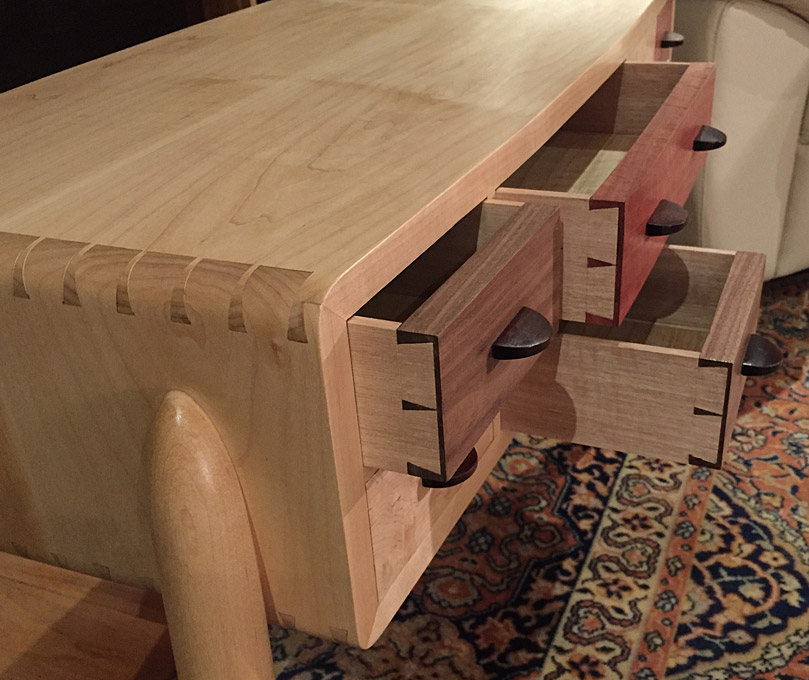
Next will be cutting the sockets for the drawer dividers.

Re: Wasteing away the half blinds

#2

Re: Wasteing away the half blinds

Virgil Johnson

Nice job. Did you clamp the tail board while marking the joint..?.:-)

Re: Wasteing away the half blinds

#3

yes

Bill Tindall, E.Tn.

Did you clamp the tail board while marking the joint......

with my left hand

Re: Wasteing away the half blinds

#4

Re: Wasteing away the half blinds

Derek Cohen (in Perth, Australia)

While some claim this other approach superior, in this case it would mean routing 7/8" deep. 1/4" bits can acquire worrisome vibrations at this depth of cut. In my case the cut is 9/16" deep.

Bill, your reference is to my method. I am not going to knock your method - whatever we find easier is good by me. However I do wish to correct you on one point:

I use half blind dovetails for drawer fronts. Typically, the drawer fronts are 20mm thick. Drawer sides, however, are around 6-7mm thick. Your 7/8" depth is 22mm, and 9/16" is 14mm. Where do these figures come from?

Here is the result of routing in the vertical ...


6mm drawer sides ...


Article with jig: http://www.inthewoodshop.com/Furniture/PowerRemovingWaste.html

Regards from Perth

Derek

Re: Wasteing away the half blinds

#5

Re: Wasteing away the half blinds

roger lance

To any purist who would object to the use of a power router to do the bulk of the wasting, I recently saw a video of Frank Klausz, no less, use a router in this manner.....the pin board was held in the vertical.

Making an argument, with inflated numbers that you supply, is a time honored tactic.....referred to as a "red herring" I believe.

If you did have to remove considerable material with a router that would deflect the bit.....do it in steps.....and then complain about the extra work involved after.....another time honored tradition.

Re: Wasteing away the half blinds

#6

where 7/8" came from

Bill Tindall, E.Tn.

I'm dovetailing a case together with 9/16" long dovetails made from 7/8" thick lumber. Typical Period Furniture construction. Seems this all should have been obvious from discussion and pictures. Nothing looks like a drawer and drawers don't precede case construction.

Re: Wasteing away the half blinds

#7

Inflated numbers?

Bill Tindall, E.Tn.

Making an argument, with inflated numbers that you supply, is a time honored tactic.....referred to as a "red herring" I believe.

What are you talking about? Argument? I have spent the day building two cases for a chest of drawers about as traditional as it gets. What the hell got inflated?

Re: Wasteing away the half blinds

#8

Yet another way for Wasteing away the half blinds

Bill Tindall, E.Tn.


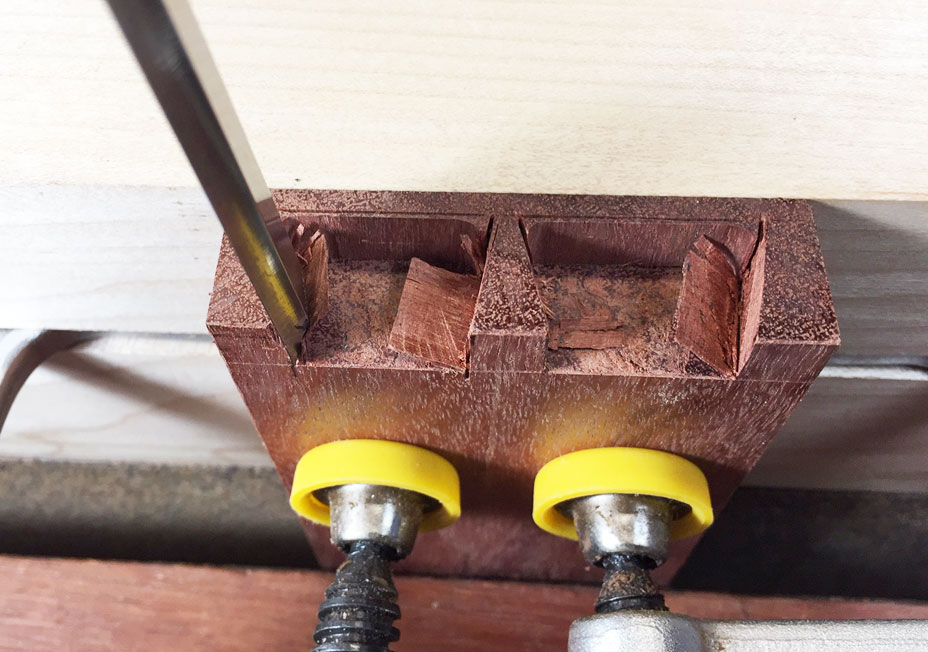
The Headley shop way overcuts the pins as is Period Correct for middle Virginia furniture. The base line at the depth of the socket is established with a hollow chisel mortiser, as seen in the picture. The waste in the corners is chiseled out (as seen in picture) much like I do, which is probably where I picked up chiseling this way. What I don't like about this approach is the same reservation I have about routing on the end of the pin board. One is left with a pleasant with-grain paring to the other base line......providing the grain is straight. And when it is not this paring can be troublesome.

The hollow chisel mortise method is quieter and less messy than using a router. Now that I have a good machine I may go back to it.

Re: Wasteing away the half blinds

#9

Re: Inflated numbers?

roger lance

And this would be the tactic of playing the victim......

Re: Wasteing away the half blinds

#10

Re: I'm having trouble

Hank Knight

I'm having trouble envisioning how the hollow chisel method works. The bottoms of my mortises coming from my hollow chisel machine are ugly. The cutting end to the bit that extends a tiny amount below the chisel tears up the bottom of the mortise. The ends of the dovetail sockets in the photo look clean as a whistle. If the answer is that you have to chisel the socket ends to remove the mess left by the hollow chisel, what's the advantage of this method?

Re: Wasteing away the half blinds

#11

Re: I'm having trouble, Exactly, I 2nd this quest 


Re: Wasteing away the half blinds

#12

Re: I'm having trouble

Bill Tindall, E.Tn.

A good place to start is to assume a technique used in a 4th generation shop that actually makes stuff, a lot of stuff, has merit.

A case where a picture would be worth a thousand words. It has been awhile since I used this technique in the Headley shop and I am having to recall details.

baseline 1- the baseline that matches the length of the corresponding tail.

baseline 2- the baseline that matches the thickness of the piece

As best as I remember.....

The hollow chisel, employing a stop. chops a square hole where one side of this hole establishes baseline 2. One can see the pattern of the hollow chiseler in the picture. The bored depth stops some short of the final length of the tail.

The remaining waste is removed and the other baseline (1) established by chiseling. This chiseling is long grain chiseling that goes quickly if the grain is straight.

The struggle for making the long grain chisel cut in wood that isn't splitting straight is what led me to go to the route-it-out flat technique.

Make enough half blinds in cases and drawers and everyone will figure out what works best for them.

Disclaimer: recognize the difference between providing information and advocating. I reported what I did to build a case (not a drawer) in this thread, or in the case of the Headley shop, what I recall was done. I provide information. Nowhere did I suggest, or imply, someone else should do what I did. Information is based, to the best of my ability, on my experience or what I have observed or in this case what I actually did. I really was faced with the need for removing 7/8" by 9/16" waste. I will defend my information's accuracy but not its application to other's needs.

Re: Wasteing away the half blinds

#13

Re: Wasteing away the half blinds

David Weaver

I chop a 20th of the dovetails you do, I'd guess, and often chisel and saw only.

But I've been forced to use a router more as I'm cutting templates on electric guitars, and I've come to appreciate the trim router a lot more than I did larger bulky routers.

I have a bunch of Half blinds to cut for a piece of furniture (two pieces, I guess) and the lumber that I have for the tops isn't that great at one end - which leads to suffering when paring the half blind sockets...suffering and tearing.

It may be a good time for me to experiment with a trim router in this case since straight stock is already out (I'm done dimensioning and sizing the stock and don't have interest in doing more).

Re: Wasteing away the half blinds

#14

router bit of choice

Bill Tindall, E.Tn.

I do this operation with sufficient frequency that I searched for a router best suited for the task.

The bit needs to be accurately adjusted for length to +/- 0.002-3".

Routing to almost touch the scribe line makes final chisel paring to the line easy. This goal requires good ergonomics and exceptional lighting. I think the larger Bosch trim router would be ideal but have not tried it myself.

Solid carbide bits are a different, more durable carbide than brazed tips.

Re: Wasteing away the half blinds

#16

Re: Yet another way for Wasteing away the half bli

Derek Cohen (in Perth, Australia)

One is left with a pleasant with-grain paring to the other base line......providing the grain is straight. And when it is not this paring can be troublesome.

Bill, this is not my experience ... and I work with particularly interlocked and hard woods.

This 20mm wide Jarrah board was routed with a 5/32" carbide upcut bit. The shoulder line is clean, and there is about 1mm at the outer line ..


The outer line (is there a name for this?) comes away cleanly and safely.

It is relevant to not that the important line in a half blind socket is that outer line. That is why I would rather leave this line with a smidgeon to remove with a chisel,

The line that is less important is the shoulder line since this is not a strong glue area (being end grain). A joint will still be strong if this area is cut a little too deep (and the socket given a shaving to level up).

Regards from Munich

Derek

Re: Wasteing away the half blinds

#17

I have dual use..

David Weaver

...I have dual use for a bit like this.

There's an extra bonus for small bits like this (I think I may already have one that I got eons ago and never used), that they don't have much carbide in them so they ultimately aren't that expensive.

I have the makita fixed base trim router that I use for this on guitars and have gotten to the point that I feel even relatively safe. Haven't used the plunge base yet, but have it and could.

Re: Wasteing away the half blinds

#18

Re: I'm having trouble

Hank Knight

Bill, I wasn't criticizing the hollow chisel technique. I just didn't understand it and asked for a clarification. Personally, I think the router method makes more sense.

Re: Wasteing away the half blinds

#19

Power carving

Bill Tindall, E.Tn.

In the Headley shop a moving band saw blade or a router is used as a power carving tool. Once I accepted that each could be used to remove wood to a scribe line it opened possibilities for wasting away stuff that might be slower by other means.

Re: Wasteing away the half blinds

#20

Spiral or straight flutes?


👍 This page answered my questions

Your vote helps other woodworkers quickly find the answers and techniques that actually work in the shop.