WoodCentral Forums

Est. 1998 — 27 years of woodworking knowledge

The Last Moxon Dovetail Vise

Posts

The Last Moxon Dovetail Vise

#1

The Last Moxon Dovetail Vise

Derek Cohen (in Perth, Australia)

Many of my projects involve bow fronts, which result in compound angle dovetails ...


I do enjoy building furniture with dovetailing challenges.

Between furniture pieces, I find time to build a new tool. This time it is the Moxon dovetail vise I have been promising myself for a while. My first and only one was built in early 2011, after Chris Schwarz helped put it on the map. I immediately modified this design, and have been making modifications since. (Link: http://www.inthewoodshop.com/ShopMadeTools/MoxonDovetailVise.html). This new Moxon incorporates the best ideas.

Ironically, this design is not geared for compound angles. I decided to heed my own advice and keep it as simple as possible, and cater for the 90% of the dovetailing that is likely to be done.

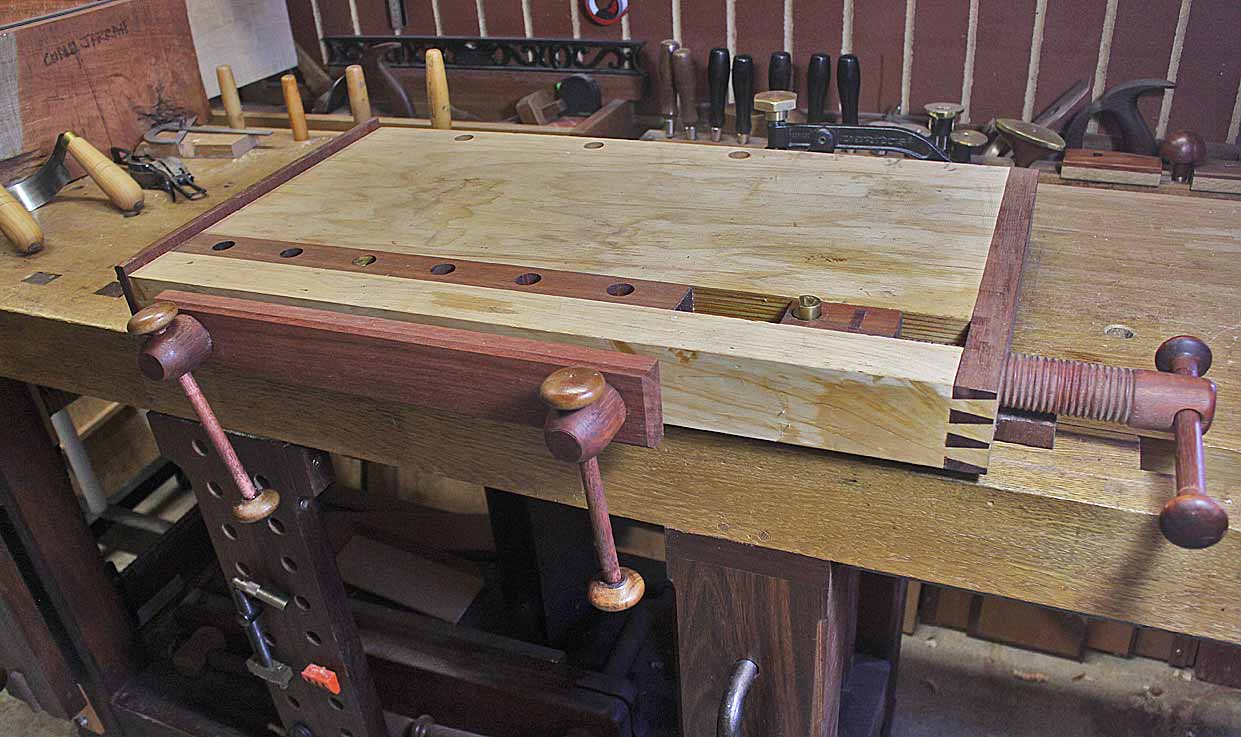
The width of the vise is narrower than my previous one, but capable of 450mm (17 3/4")between the screws. Most cases I built are between 350 - 450mm deep. My previous Moxon could do 560mm (22") between the screws. This is unnecessary, and just makes for a very large fixture.

Where the old Moxon used wooden screws, which I turned, this uses steel Acme screws and iron wheels ala BenchCrafted ... except that these came via Tom Bussey (thanks Tom), which amounted to a large savings. The wheels are 5" in diameter on a 3/4" screw.

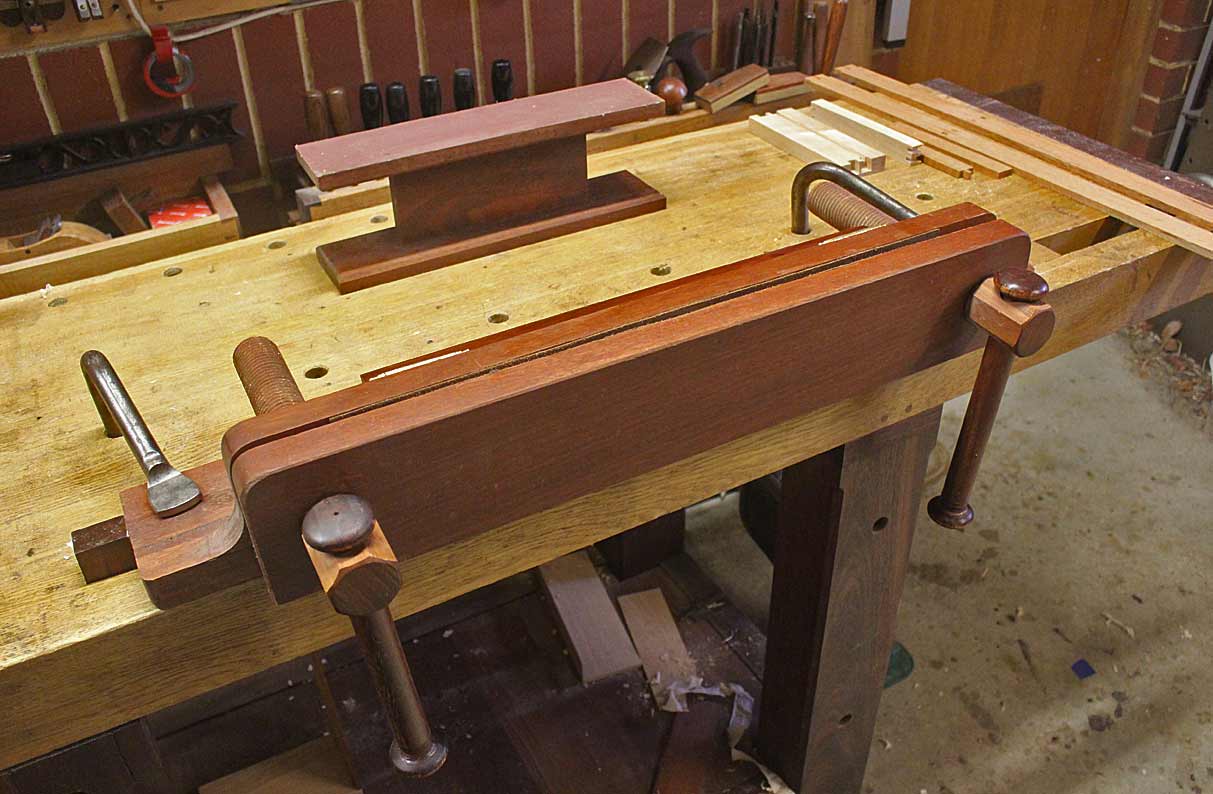
The front chop is 5 1/2" high, and the Moxon is built in Jarrah ... what else do you expect! :) I went a little OTT in this build, but it was fun, and I admit I did become a little carried away :)
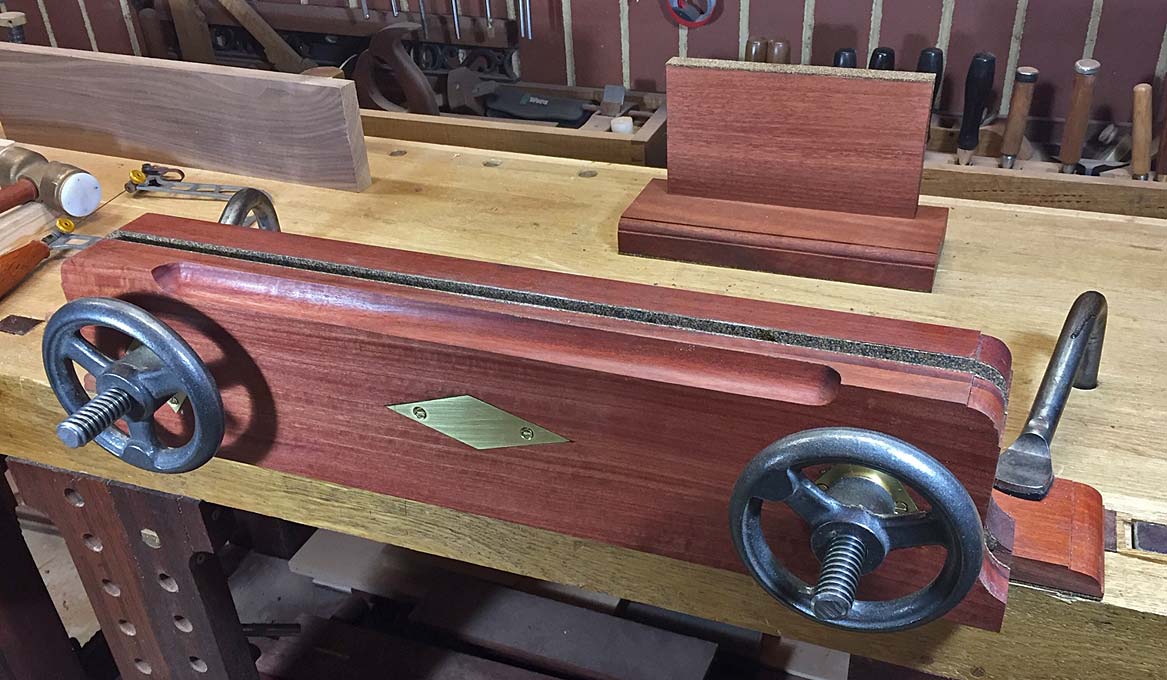

Brass inlay ...


The chop runs on bronze bearings ...
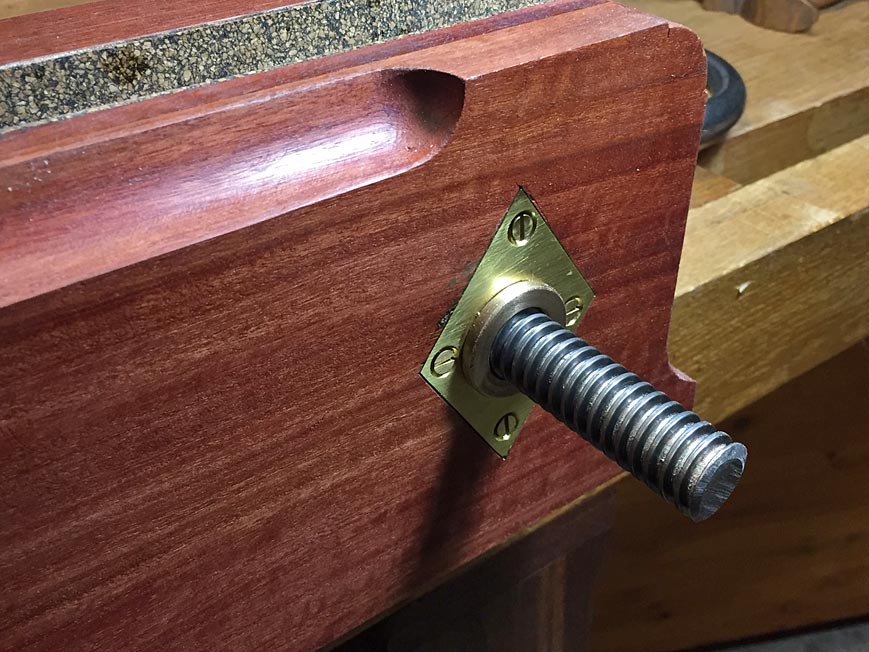

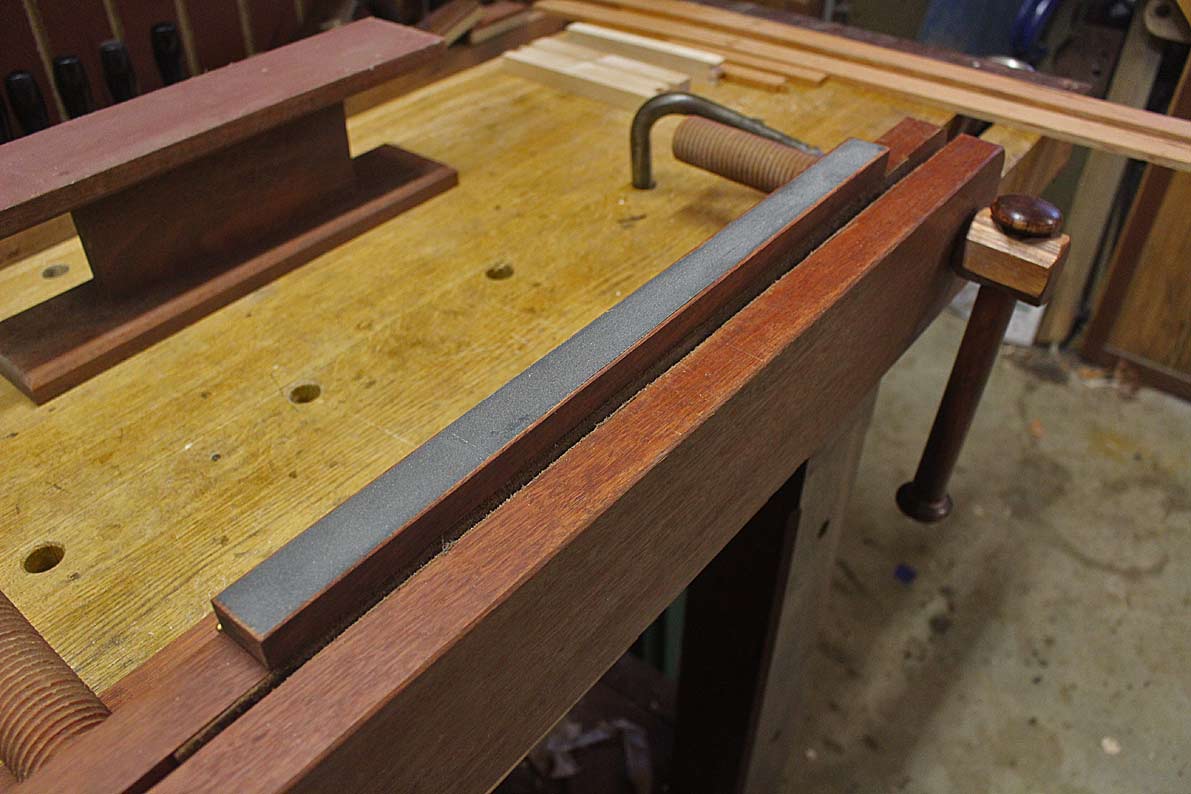
Lining the inside of the vise is rubberised cork. This makes a great non-slip (not my idea - this comes from BenchCrafted, who call it "crubber". Simply search eBay for "cork rubber").


This vise is a good height for sawing ...
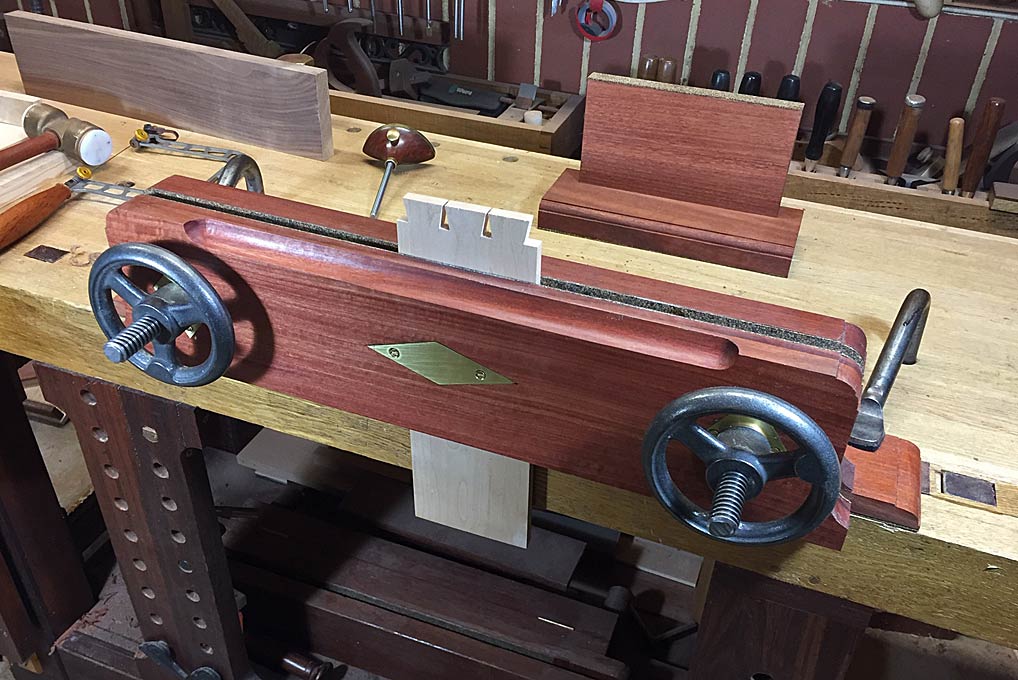

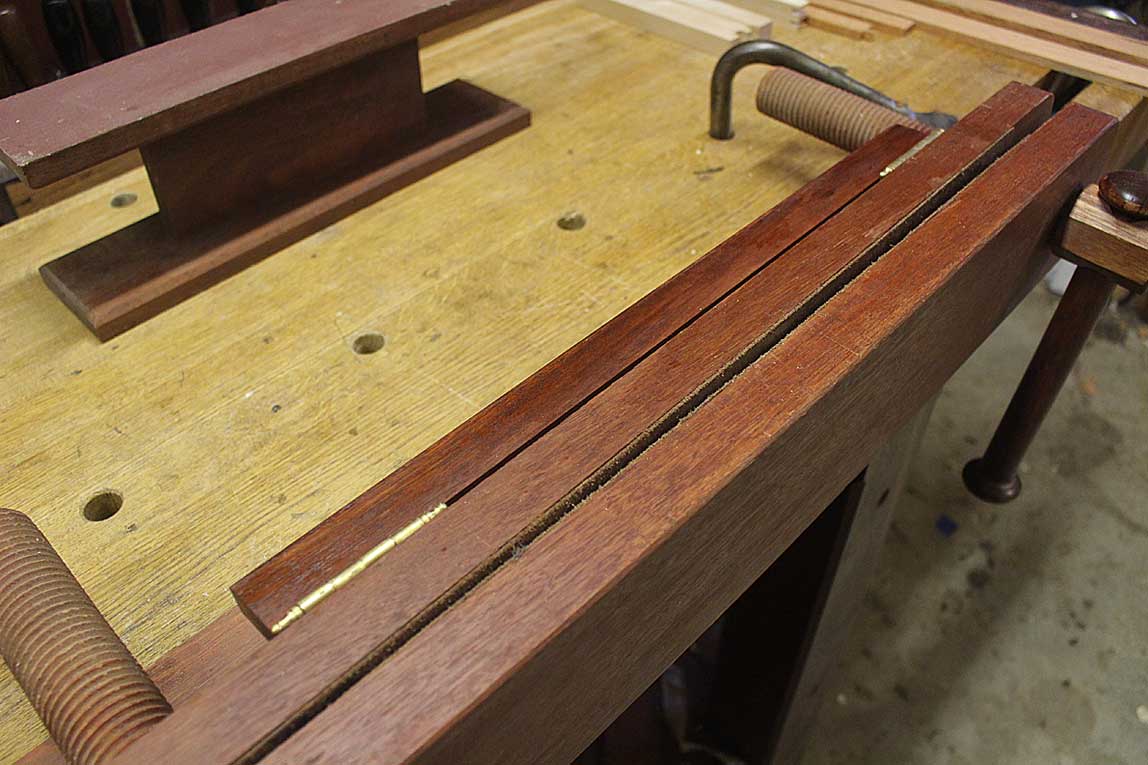
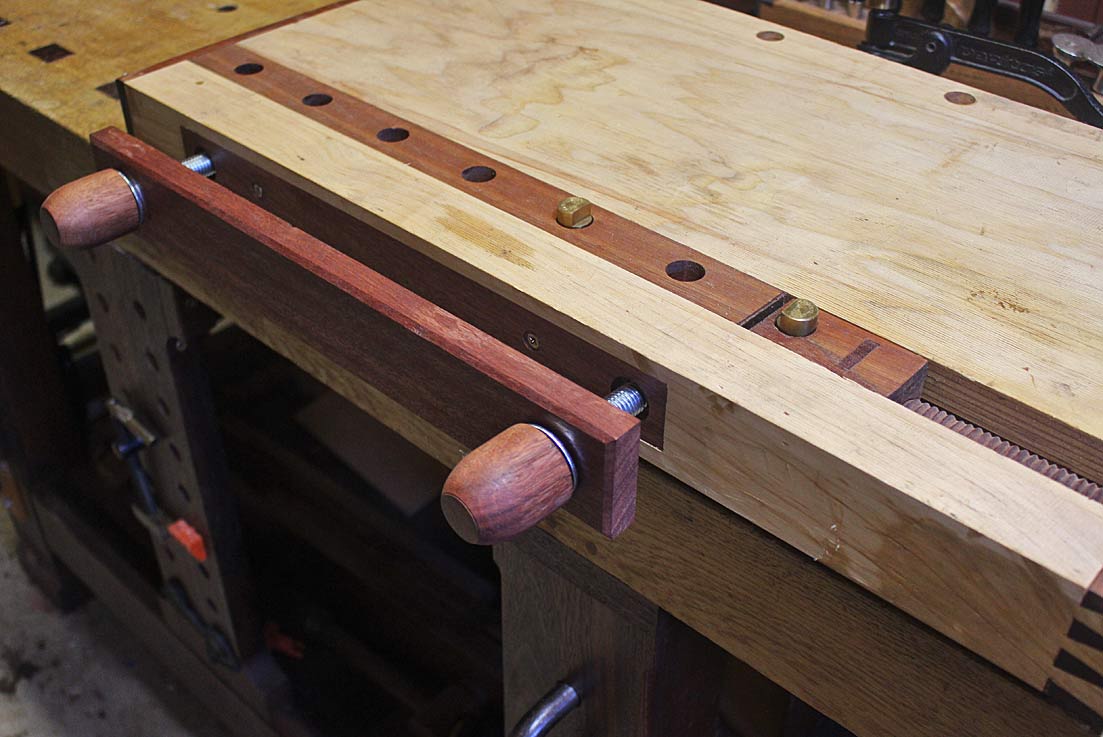
There are a few innovations. The rear of the vise ...
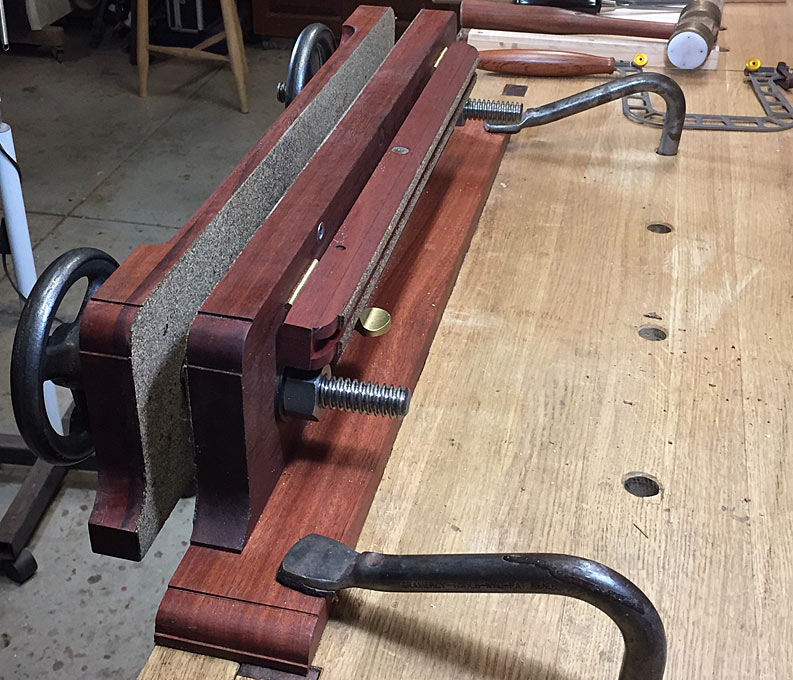

This is a spacer, and it can be locked into the up position ...
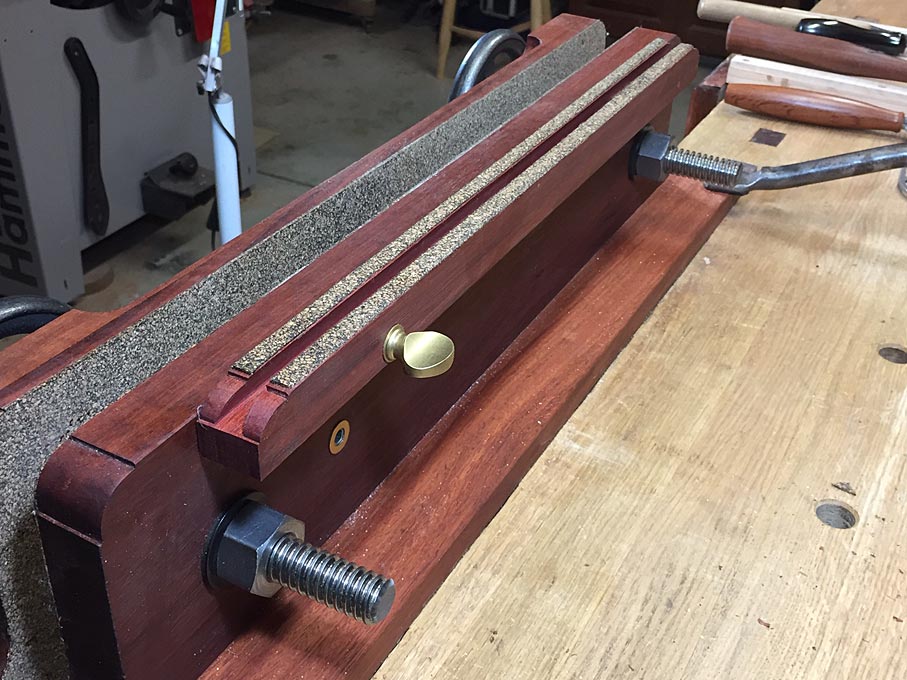

The spacer has two functions. The first is setting the pin board (10mm) above the chop to prevent scoring the chop when transferring tails to pins with a knife (this is more of a danger with through dovetails). Also, by lifting the work, there will be light behind the pin board, and this makes it easier to align the edges.


The crubber makes a great non-slip.

The spacer may be dropped out of the way, once the height is set ...
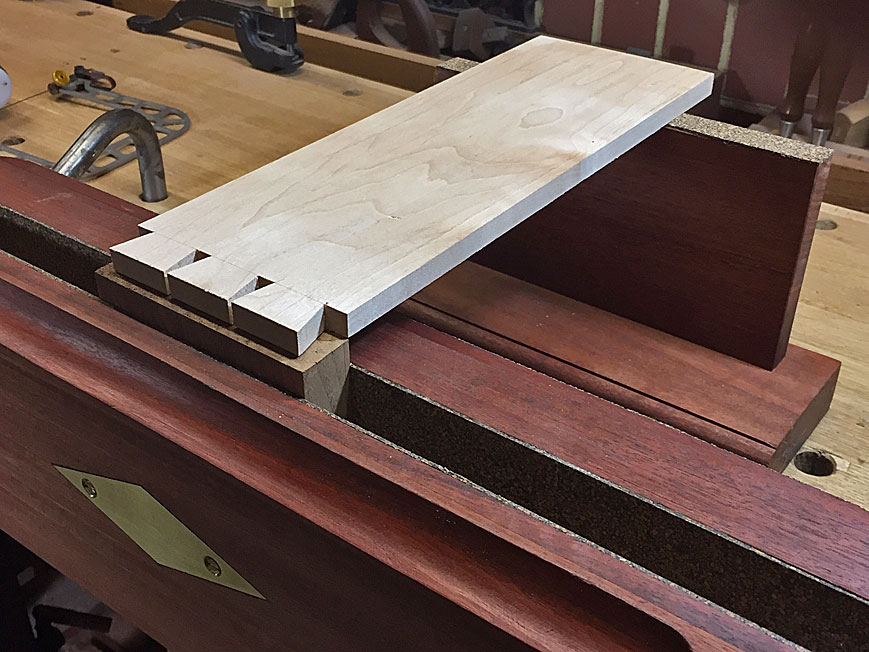

The second use of the spacer is that it has a sliding dovetail at the top, and this allows for the use of MicroJig clamps. This would be especially useful for holding wide boards, or tail board which have developed a slight bow ...
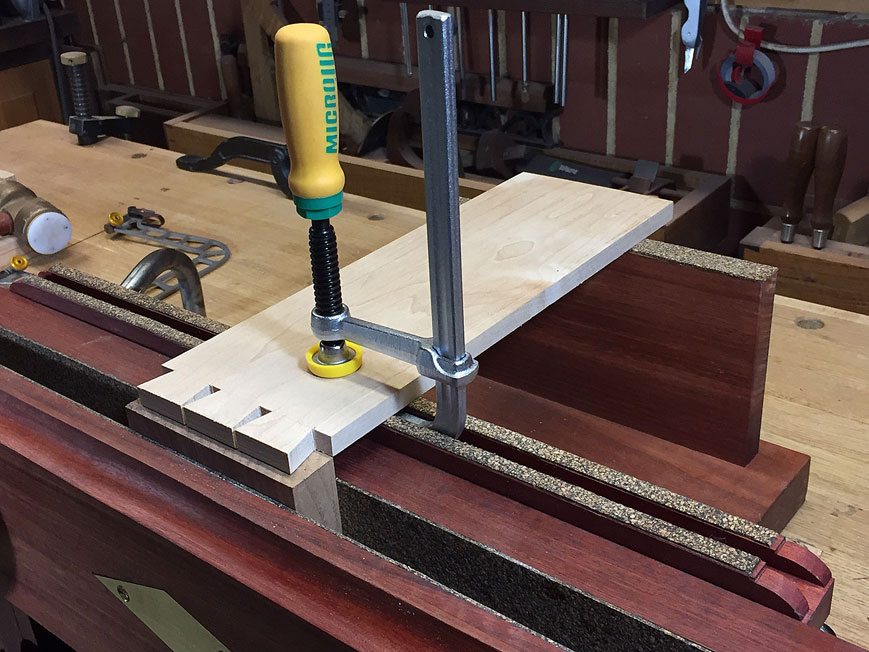
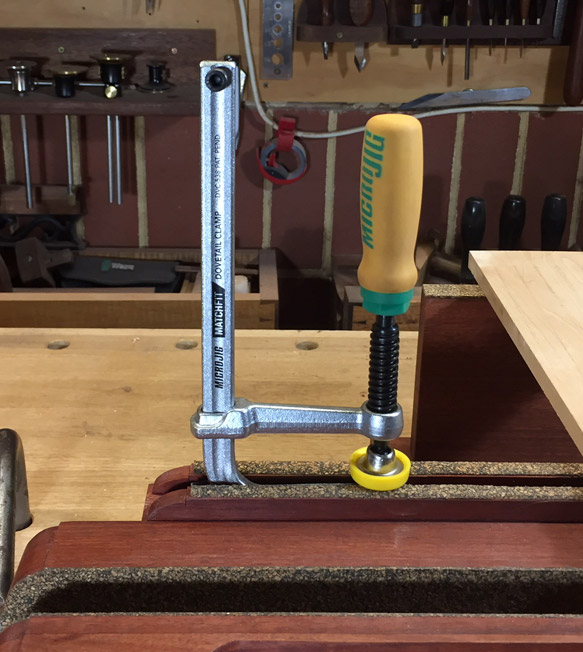

I have used this on other fixtures, such as a morticing jig.

For aligning the tail- and pin boards, I prefer a simple wide square I made from wood ...
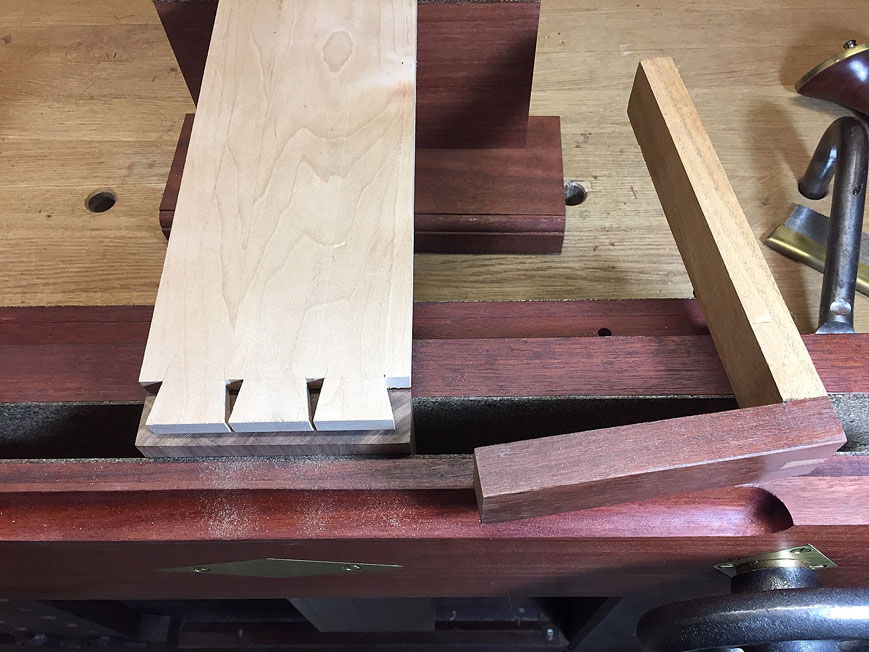

The spacer needs to be dropped out of the way for this ...
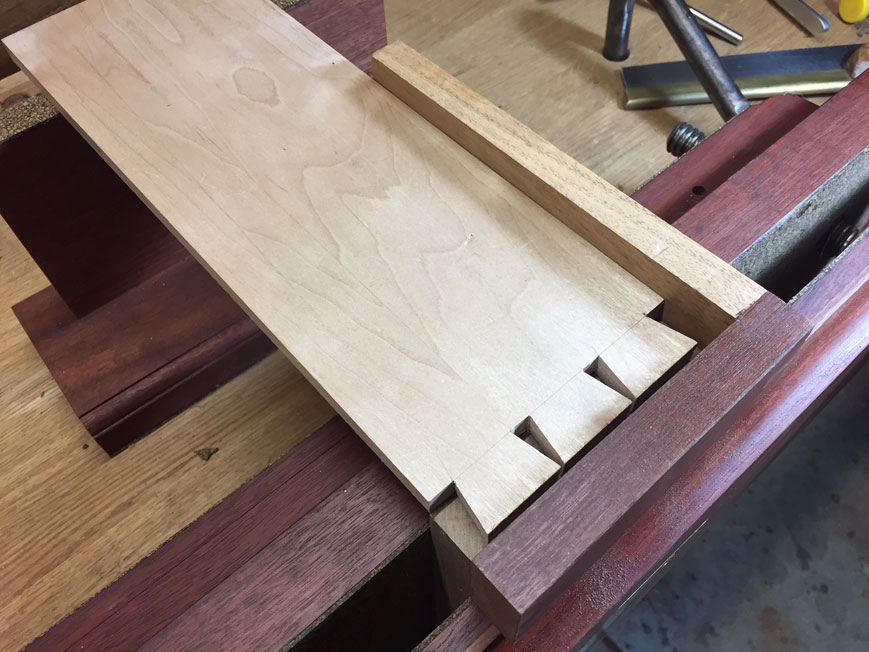

Once transfer is made, reverse the board and saw the pins. This is where you will recognise that the cove is not simply decoration, but allows the saw to angle and get closer to the work piece. The lower the work piece in the vise, the less vibration when sawing ...


And thats it ... the last moxon dovetail vise ...
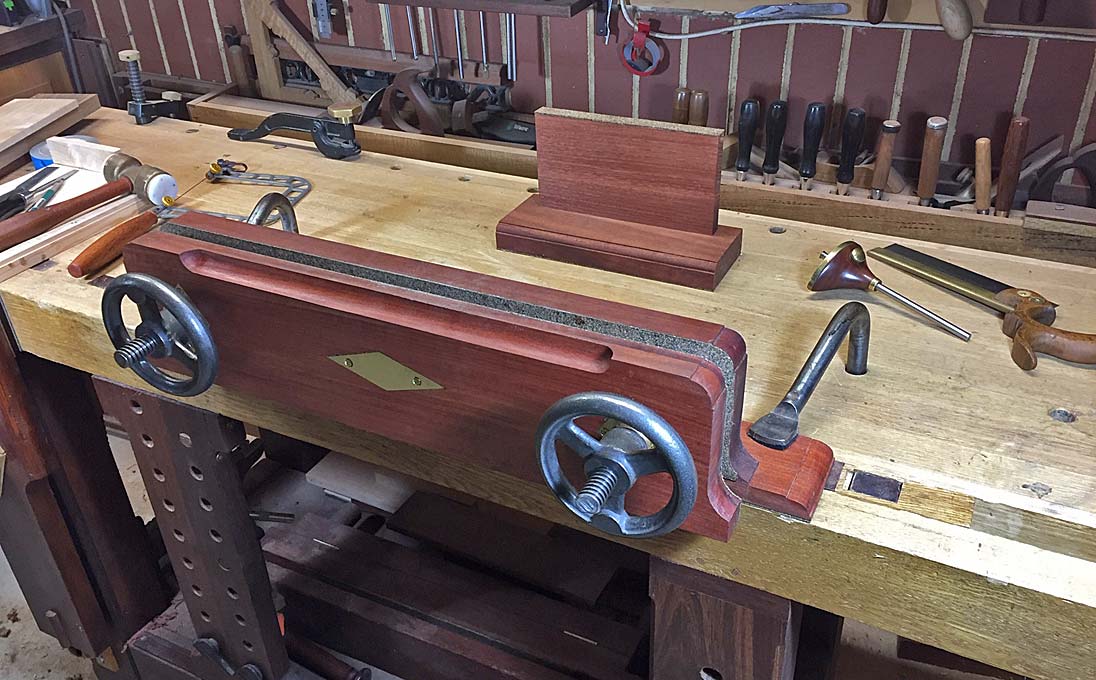

Regards from Perth

Derek

Re: The Last Moxon Dovetail Vise

#2

Re: The Last Moxon Dovetail Vise

Virgil Johnson

Very nice work.

Re: The Last Moxon Dovetail Vise

#3

Re: The Last Moxon Dovetail Vise

Barry Irby

That's a beauty. I have been ruminating on one for a year or more. Don't know why, but perhaps I am sneaking up on hand cut dovetails. Thanks for posting, yours has several features I had not considered. Nice piece of work.

Re: The Last Moxon Dovetail Vise

#4

Re: The Last Moxon Dovetail Vise

Don Stephan

Always interesting and informative to see how jigs can be modified to improve efficiency and ease of use. Thanks DC.

Re: The Last Moxon Dovetail Vise

#5

Ellis Walentine

Nice article, Derek

Ellis Walentine

Your woodworking journalism quotient is OTT, as you would say. I know how much effort goes into planning, setting up, photographing each relevant step, and then adding properly descriptive copy, not to mention laying it all out on the page. Your articles are a treasure chest for woodworkers who want to achieve their highest potential. Thank you for your many contributions here. I look forward to many more.

Best regards,

Ellis Walentine

Re: The Last Moxon Dovetail Vise

#6

Thanks Ellis

Derek Cohen (in Perth, Australia)

There is a history of writers in my family, and this makes it hard to resist the embedded urge to document. I have found that the process has improved my woodworking, since it forces one to be aware of the sequential demands.

So there, folks, a good reason for all woodworkers to pour your thoughts onto the pages of WoodCentral! :)

Regards from Perth

Derek

Re: The Last Moxon Dovetail Vise

#7

Re: The Last Moxon Dovetail Vise

Bill Tindall, E.Tn.

I would like to make one of these vices. This design incorporates all the necessary features into something easy to use that "does it all". And it's elegant which is something to be appreciated. You should consider submitting to some magazine as an article.

But I started adding up parts and my frugality is having problems with its cost. The device would only be used a couple of times a year at the rate I make stuff. The expense comes from the means of holding the jaws together. In its essence it is two jaws that ride on rods that get held together. I'm thinking replace the threaded rods with dowels and use two F clamps for holding it all together. From your experience using this vice is there something about this frugal plan that is flawed?

Re: The Last Moxon Dovetail Vise

#8

Re: The Last Moxon Dovetail Vise

Derek Cohen (in Perth, Australia)

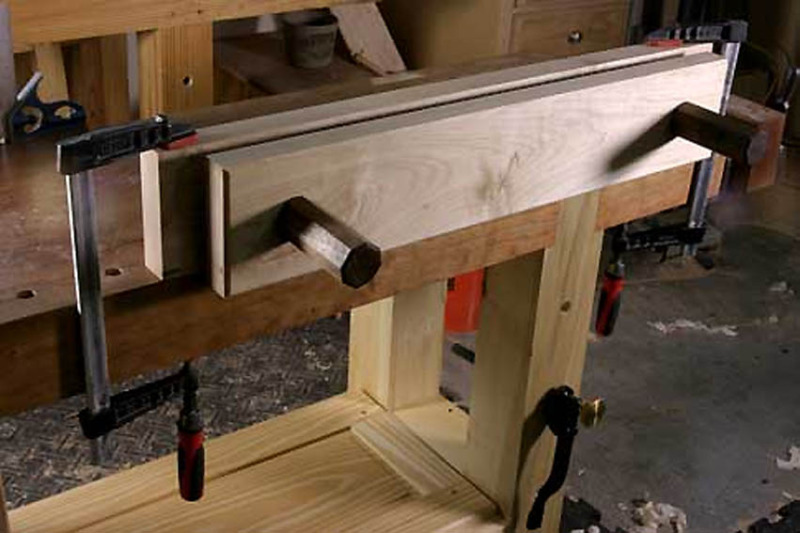
Bill, a good Moxon should not require a costly build, just thoughtful design. The Moxon dovetail vise which Chris Schwarz first published (early 2011 I believe) was this ...


I loved the concept from the outset. It was also at the time I was building a new bench, and the Moxon complimented my choice of leg vise and wagon vise. What I did not like was the way the vise was held with clamps to the bench top. It looked clumsy and unstable. My response was to redesign it this way (it has since been copied by many) .

As you may notice, this was before I built my current bench ...


This Moxon did not cost anything other than scrap wood. I turned the screws ...


That is a MUCH better idea than using F-clamps, which will be finicky to set up and micro adjust. The whole point of a good design is to reduce effort.

My original article is here: http://www.inthewoodshop.com/ShopMadeTools/MoxonDovetailVise.html

Eventually, the Moxon was tweaked and the flip down spacer was added ...


Again, the cost here is a set of brass hinges.

This is a perfectly good Moxon dovetail vise. It does everything one could consider important. The new one has a few new features, but by-and-large it is an extravagance ... just built in fun.

Frugal is fine by me - just find cost-effective alternatives. But do not lose the essence of good design by choosing cheaply.

Regards from Perth

Derek

Re: The Last Moxon Dovetail Vise

#9

Re: The Last Moxon Dovetail Vise

Henry Wynands

Bill

At the risk of pointing out discussions on other sites, there is one on NCWoodworkers.net that might interest you. Not sure how to make this a link, but here is the text you can copy:

https://www.ncwoodworker.net/forums/index.php?threads/yet-another-dumbbell-screw-moxon-vise.67297/page-3

By possibly combining Derek's excellent work with hardware ideas from this link, you might be able to achieve your desired vise, but with less expense. If I recall correctly the screws and hardware in this plan come from a inexpensive dumbbell set. I am too lazy to read through the details, but I believe there is a set of plans available on NCWW (free, Sketchup based I believe; if interested I can root through the site to find a link for you). Not sure the plans are critical though if you are making Derek's vise with modification.

Henry

Re: The Last Moxon Dovetail Vise

#10

Re: The Last Moxon Dovetail Vise

Barry Irby

Bill, I have been thinking of making such a vice for several years.

I have accumulated some things that might apply. I have several large threaded rods. Maybe 7/8 or 1" and a few matching nuts. These rods are 30" long, maybe 3'. If you are interested I would be happy to get details and would send you a rod and nuts, free. It appear that at my age I may not live long enough to use them so free to a good home seems like a good idea. You could make knobs to fit on the nuts, or buy nifty handles or have someone weld handles on the nuts.

I also have a kit for threading wood, also maybe an 1". If you like the idea of wooden threads, I would LOAN that to you. Again, ask and I will get the details. I am too lazy to walk down to the shed and shop for details unless you are interested.

Re: The Last Moxon Dovetail Vise

#12

Re: The Last Moxon Dovetail Vise

david weaver

That's a fantastic design, not because of the cost of speed of building (both of those are nice), but because it's quick release and will involve minimal turning of handles, and the hardware is super light weight.

I've got a 1/2 router fence and 1/2 moxon vise of relatively large size (router table is long gone, so now it's the latter). It seemed sensible at the time because it would prevent me from having to have both taking up space in the shop, but it's monstrously heavy (8/4 oak, 35 long for the router table part) and the handles are threaded maple, which feel like work to turn.

After seeing that design, it's about to be cut down to a fraction of its original size and turned into that.

Re: The Last Moxon Dovetail Vise

#13

Re: The Last Moxon Dovetail Vise

William Duffield

The BenchCrafted hardware is expensive, burt works superbly. I built my own that I find works very well, but is much easier to pay for. You can buy Acme threaded rod and nuts from many suppliers, the easiest to find is probably Fastenall. Another step away from elegant, but still quite functional, and that I find works efficiently enough, is 3/4" UNC threaded rod and nuts from you local home center. Instead of the cast iron wheels from Benchcrafted, you can make your own if you have a lathe. I started with the densest wood I could find (bloodwood, Brosimum rubescens ), embedded and epoxied nuts into the wheels and turned them on my lathe. All the hardware cost me a few dollars, but definitely less than 20.

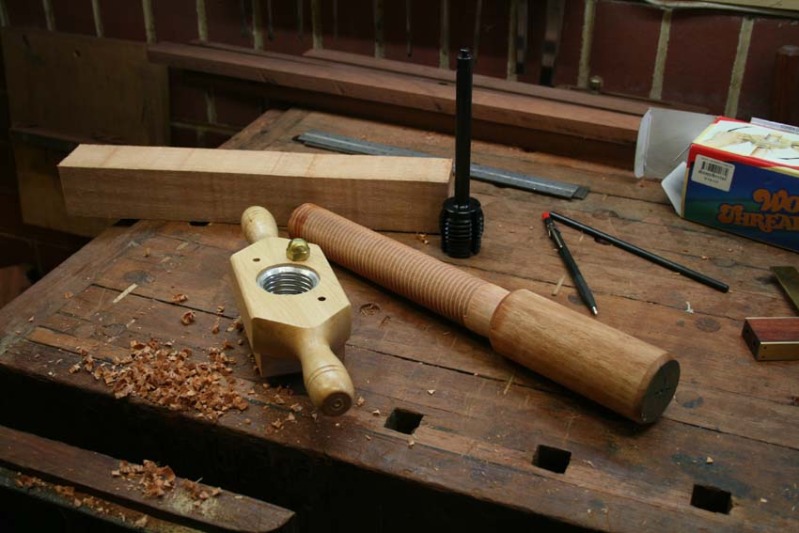
Here is a pic of one wheel with hardware installed:


and a pic of all the hardware needed. Note that at this point, I was replacing my second generation hard maple wheels with third generation bloodwood. The smaller diameter, lighter maple wheels worked well enough, but the bloodwood made the vise operation a bit quicker. Of course, cast iron wheels would be even faster. Also note that I had already built a bench-on-bench, so I didn't need a rear Moxon jaw for elevation.


Note also that my Moxon jaws and hardware spacing allows holding a board that is 26" wide. This is probably not necessary in Australia, because they may not have a tradition of dovetailed blanket chests or Anarchist's tool chests. I don't have ready access to jarrah, so I settled for a front jaw and bench top of hard maple.

Later, I added a bevel to the top front of the jaw.

If you like Decek's feature enhancements (I do. Some day I may add some of them to mine), you can adapt them to my design. I'll follow up this post with some construction pics and a plan for the wheels and pics of my mounting method. Stay tuned.

Re: The Last Moxon Dovetail Vise

#14

Re: The Last Moxon Dovetail Vise

William Duffield

The issue with Jenny's design, and also with Chris Schwarz original design, which used small diameter threaded rod and small diameter handles, is that they operate very slowly and clumsily. I was surprised when I made one, just how many times I was clamping and unclamping boards in the course of laying out, sawing, chopping and fitting sets of dovetails. Jenny's clamp, being behind the jwas are even more inconvenient. They do work and are definitely inexpensive and easy to build.

This was my first Moxon vise. Not only were the handles and hardware inefficient, but the front jaw was too flexible I think it was 15/66" hard maple, but it's not worth our time to go find it and verify. To attempt to counteract that, I drilled several sets of holes to accommodate different board widths. My final jaw is 1-15/16" thick hard maple.


Here is the retired obsolete hardware: turned, ferruled handles with 5/18" UNC or 3/8" UNC threaded rod glued into holes bored in ends. The bench pups were drilled and tapped to match, and mutually perpendicular hole pairs were drilled into the front and top of the bench-on-bench. That allowed me to insert the dog through the top of the bench and the threaded end of the vise handle through the front of the bench.


Note that if you want to use Acme threaded rod, I think 3/4" ø is sufficient, but you can make it even faster if you use 1" ø. Also, if you choose 2 starts instead of one start, you can turbocharge it even more.

Re: The Last Moxon Dovetail Vise

#15

now we are talking

Bill Tindall, E.Tn.

What could be more simple.

Re: The Last Moxon Dovetail Vise

#16

Re: The Last Moxon Dovetail Vise

William Duffield

Here are the 'back of a napkin" plans, hard maple hand wheel blank, and three forstner bits I used to make the turning blank for the second generation wheels.


I used a short piece of threaded rod and a nut to scribe the socket for the nut. You will use the threaded rod later as a mandrel when turning the handles. Note if you use Acme nuts, they are larger and will require a different sized bit for the second step.


Chop out the nut profile with a chisel and glue it in place with epoxy.


The larger third generation wheels were done the same way. Here is a measured drawing.


This is how the mandrel is attached, with two nuts, both for scribing the pocket for the nut and for turning the blank on the lathe. The mandrel will appear again later, for attaching the threaded rod to the rear vise jaw or the bench-on-bench legs.


I use a scroll chuck to hold the mandrel and blank while I'm turning the wheels.


Turning the third generation bloodwood wheels and mounting the hardware to the rear jaw will follow in a while. Stay tuned.

Re: The Last Moxon Dovetail Vise

#17

Some thoughts on requirements

Bill Tindall, E.Tn.

I have never built a drawer wider than 8 1/2 inches and never intend to. I need to dovetail a case side so seldom that it makes no economic time sense to build something that makes doing it 5 minutes easier. That said, I don't mean to take away from the handsome device Derek built. If someone gave me one I would cherish it. But I can't force myself into spending more time on shop furniture than it will save.

So what would be useful to have in my case? Simply a means of holding a 13/16 to 1/4" thick drawer side higher than my bench vice allows, for the purpose of making sawing easier. And simply attaching the device to the bench, a problem Derek has solved. 10" between the screws is plenty enough. To get the drawer stock in and out the jaws need to move conveniently no more than 1/16". These are requirements easily met in a number of inexpensive ways.

Re: The Last Moxon Dovetail Vise

#18

Re: The Last Moxon Dovetail Vise

William Duffield

I like your square. It looks like it is easier to use and more generally applicable that the little tabs that fit in the drawer bottom grooves that some people promote. I also like the idea of your spacer(s) for layout. I've just used a couple of boards the same thickness, one on the bench-on-bench top and the other on the rear stand. Mine are easy to lose, but because I don't have a rear Moxon jaw, there is no convenient place to screw a flip-up spacer.

My back stand is a lot cruder than yours, made from 2x4s and joined with Dominos, and I built it at the same height as the bench-on-bench, so it needs a spacer whenever the Moxon needs one. But, I can also use it to support long boards across the bench top whenever the bench-on-bench is attached to the bench, and the work flies right over whatever junk has accumulated on the bench.


Instead of clamping work down to the front spacer, I clamp it to the back stand. Instead of a dovetail slot, I used a rabbet and a section of t-track. Being thrown together from clunky materials, the rear stand also has dog holes to accept holdfasts. My bench-on-bench top is too thick for the clamps to drop into the dog holes, but since it has lots of dog holes, the holdfastss can secure boards to the top of the spacer.

Sorry, no walk-on dovetails this time. I'm working on something else, and just moved enough stuff for the illustration.

As you can see, the back stand and the bench-on-bench attach the same way as yours, with either holdfasts, K-body clamps, or F-clamps.

Re: The Last Moxon Dovetail Vise

#19

Re: Some thoughts on requirements

William Duffield

I think Jenny Alexander's elegant and simple design should meet those requirements. (See Larry Barrett's link.) But, if you think you will dovetail some cases, it wouldn't be any more complicated to make the jaws a little wider. The work, hardware and design would be the same. The only changes might be to make the boards a little longer, at very minimal expense, especially since you have a barn full of Appalachian hardwoods and plenty of clamps. There is no need to even permanently dedicate any clamps to the vise, as long as you can extract some drywall screws. :D

Re: The Last Moxon Dovetail Vise

#20

Re: Some thoughts on requirements

Derek Cohen (in Perth, Australia)

I have never built a drawer wider than 8 1/2 inches and never intend to. I need to dovetail a case side so seldom that it makes no economic time sense to build something that makes doing it 5 minutes easier.

Bill, this was my thinking as well. It seems as it everyone wants to build these very wide Moxon vises, somewhere around 24" (or more). My earlier Moxon came close to this, being close to 21" between the screws. In the current build, I resolved to make one for drawers, and the widest (height, that is) drawer is really not more than 8" ... so why make the Moxon wider than this?

I eventually built one to accomodate 450mm (17 3/4"), since I do also dovetail cases. The extra width is still well short of the previous Moxon, and does not take up much space under my bench.

With regard to using a F-clamp in place of a screw, as I mentioned earlier, while this would work, it is not a design I want to keep using. It would be fiddly to adjust. The whole idea behind a Moxon vise is to make work holding better, easier, and quicker. Do it once and do it right. You will be thankful later.

Regards from Perth

Derek

Re: The Last Moxon Dovetail Vise

#21

agree and a question

Bill Tindall, E.Tn.

I am not smitten by the clamp solution to closing the jaws either. But I wonder if the robust "vice" screws commonly employed are necessary. I am considering a 3/8" bolt- 16 TPI and a 2 1/2" plastic knob for closing with bolt running through a bushing. One rotation will tighten/loosen. With the grippy cork it seems that little pressure would hold.

Re: The Last Moxon Dovetail Vise

#22

Re: agree and a question

Derek Cohen (in Perth, Australia)

Bill, it should work. I did this (minus the bushings) on my travel bench (for demos at wood shows and club meetings) ...


Regards from Perth

Derek

Re: The Last Moxon Dovetail Vise

#23

Well, that gave me an even better idea

Bill Tindall, E.Tn.

I will just turn some knobs. I like that shape. So, how many of these vices do you have :)

Re: The Last Moxon Dovetail Vise

#24

Re: Some thoughts on solutions

AZ in Colorado Springs

I've been thinking about building a Moxon vise since I saw Schwartz's article on the Moxon vise. Along the way I built a new work bench -- a roubo bench using the plan in the first edition of Schwartz's work bench book. My bench is 36" tall (doubles as an outfeed table for my table saw). The legs and aprons are flush/in the same plane as the edge of the top.

For dovetailing (and for other purposes) I can clamp a board in the leg vise and it's rock solid. I have a 36" Irwin squeeze clamp that holds the far end of the board against the edge of the top. Straight and rock solid

Now, I realize that not everyone has the pleasure of using a roubo bench (ha, ha) but it's one of my most useful tools. I'd still like to build a Moxon vise .. maybe someday.

Also, I had a new roof put on the house last month. There were two bundles of shingles left behind. They're now excellent ballast on the lower shelf. That bench ain't goin' no where.

Re: The Last Moxon Dovetail Vise

#25

Re: Some thoughts on requirements

John Pappas

So what would be useful to have in my case? Simply a means of holding a 13/16 to 1/4" thick drawer side higher than my bench vice allows, for the purpose of making sawing easier.

Perhaps...two hand screws clamped on the front edge of the bench top. Not elegant, but functional.

👍 This page answered my questions

Your vote helps other woodworkers quickly find the answers and techniques that actually work in the shop.