WoodCentral Forums

Est. 1998 — 27 years of woodworking knowledge

request router recommendation

Posts

request router recommendation

#1

request router recommendation

Bill Tindall, E.Tn.

The need: make mortise for hinge

I don't live near anything but Lowes so pursuing tool stores to get my hands on some to try is not an option. I have a DeWalt trim router. The depth adjustment is near useless and there is no safe way to hold it for this task. I am sufficiently exasperated with this tool that I am using the slow but sure router plane, but the large one I have is not ideal for this job.

I like to waste out most of the mortise with a router. Full sized routers are not ideal or even a possibility. They are hard to teeter on the edge of the door and they may not fit in the case to excavate the case stile.

The ideal router:

1. small base like a trim router.

2. good way to hold it that provides accurate control

3. depth adjustment that enables tiny increments of adjustment, reliably.

4. good visibility of the bit to guide cutting to scribe lines

5. Overall good ergonomic combination of weight and grip

6. Power irrelevant. Only taking light cuts with 1/4" bit.

Re: request router recommendation

#2

Dremel

Mark Mandell - Gone Round In New Jersey

Borrowed a friend's "3000" for the same job. Hi pitched noise, but did a good job on hinge mortices

Re: request router recommendation

#3

Question

Bill Tindall, E.Tn.

I have a naked one, but......

Dremel alone will not function as a router. Yours must have had some accessory that provided a base, and handles? What was the accessory?

I searched. "Search" has become near useless. Pages of ads of no relevance. Took a while to find the Dremel web site and it was not helpful. Never saw a base.

Re: request router recommendation

#4

Re: Answer

neal in SC

Lee Valley, of course. I have their "Dremel" plunge router base. The LV base isn't exactly inexpensive, but probably comparable to a new router. I don't remember what task I bought it for, but I've found it to be very handy. LV also sells teensy router bits, down to 1/16 that are useful for inlay, etc.

Re: request router recommendation

#5

Re: Answer

Chuck

Look on Amazon

tps://www.amazon.com/s?k=dremel+tool+accessories&crid=26TTQVBLF4CS&sprefix=dremel+tool+a%2Caps%2C152&ref=nb_sb_ss_i_1_13

Re: request router recommendation

#6

Re: request router recommendation *LINK*

Jesse Cloud

Here's a link to the Stewart Mcdonald site. They sell tools for guitar makers, including some cool router bases for dremels or power carving tools. The bases come in lots of styles with options for lights, blowers, edge guides and plunge bases. The visibility is superb.

Main limitation is that you need to use small (say 1/8th inch) router bits.

Still have the awful Dremel noise though.


Dremel router base

Re: request router recommendation

#7

Re: request router recommendation

David Yoho

have a look at the Bosch Colt 1-HP Variable Speed Fixed Corded Router at Lowe's. Sounds like the depth adjustment is what you're looking for. Might be on sale. Website shows special price when placed in cart - below $100.

Re: request router recommendation

#8

Re: Dremel Base

Mark Mandell - Gone Round In New Jersey

The friend had a "kit" in a case with a couple of cone-shaped attachments that fit on the end of the handle. Those guy make so many models you might try to pull a manual for the model number you have and then scroll through to the accessory/attachments page to get part numbers. Of course, if they don't offer attachments for your model, you're s.o.l. anyway. ;)

Re: request router recommendation

#9

Re: Dremel Base - PS

Mark Mandell - Gone Round In New Jersey

There's a router base cone for $9 on the second page of the Amazon listings for Dremel accessories.

Re: request router recommendation

#10

Re: request router recommendation

Derek Cohen (in Perth, Australia)

Bill, I have a Makita trim router. This is likely not that different from your DeWalt. It does not have a fine adjuster, but I can move the "coarse" adjuster in fine enough amounts to set the depth of cut.

The dust collection from the Makita is excellent. I use the 27mm hose from a Mirka Ceros, and this not only fits the housing well, but it is a very light and flexible (and antistatic) hose.

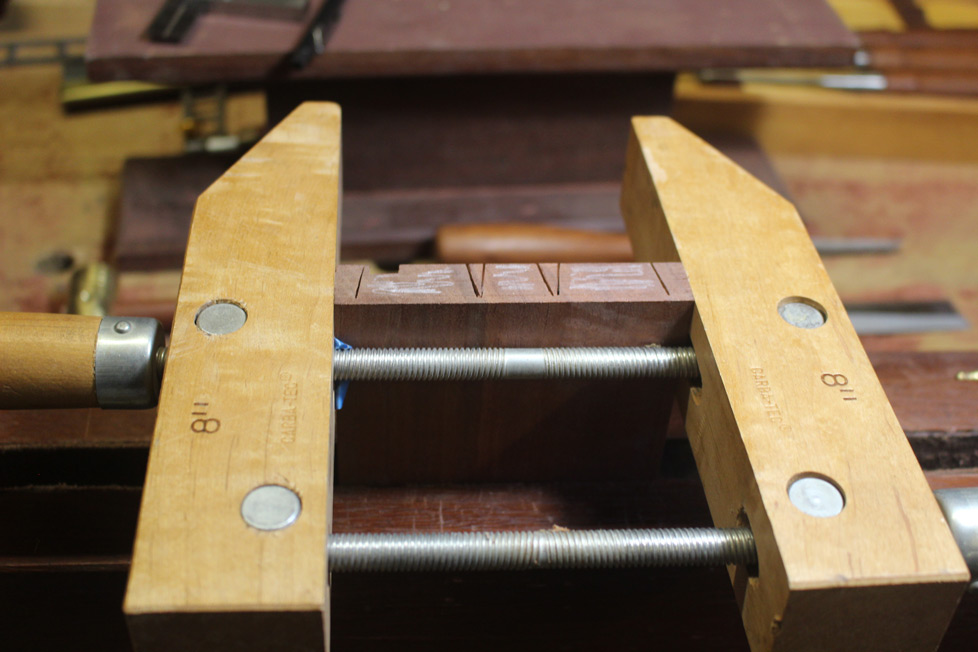
The important first step is to add support around the pin board ...


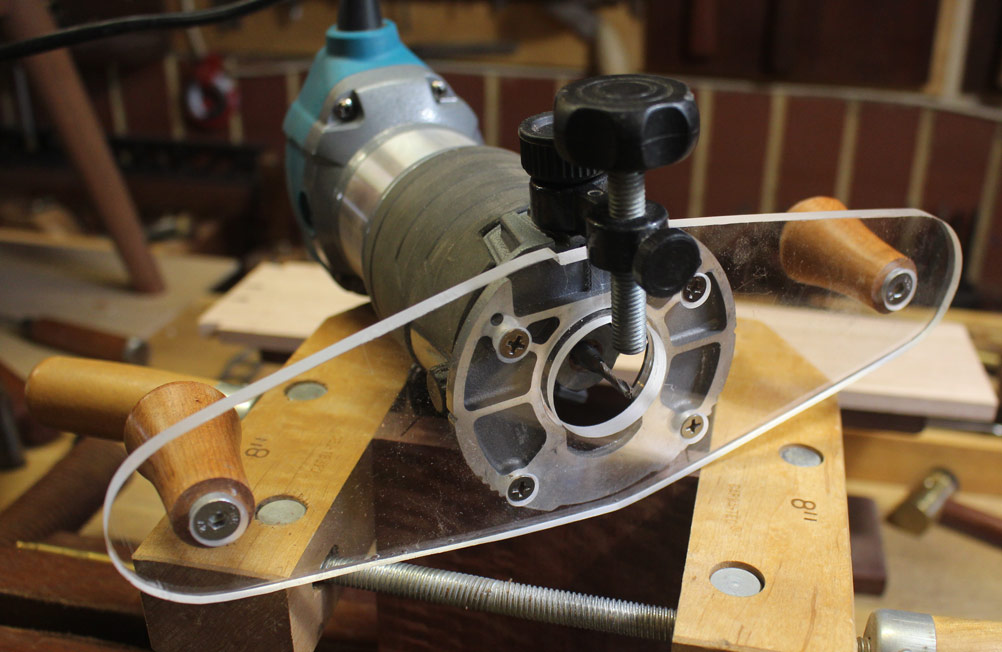
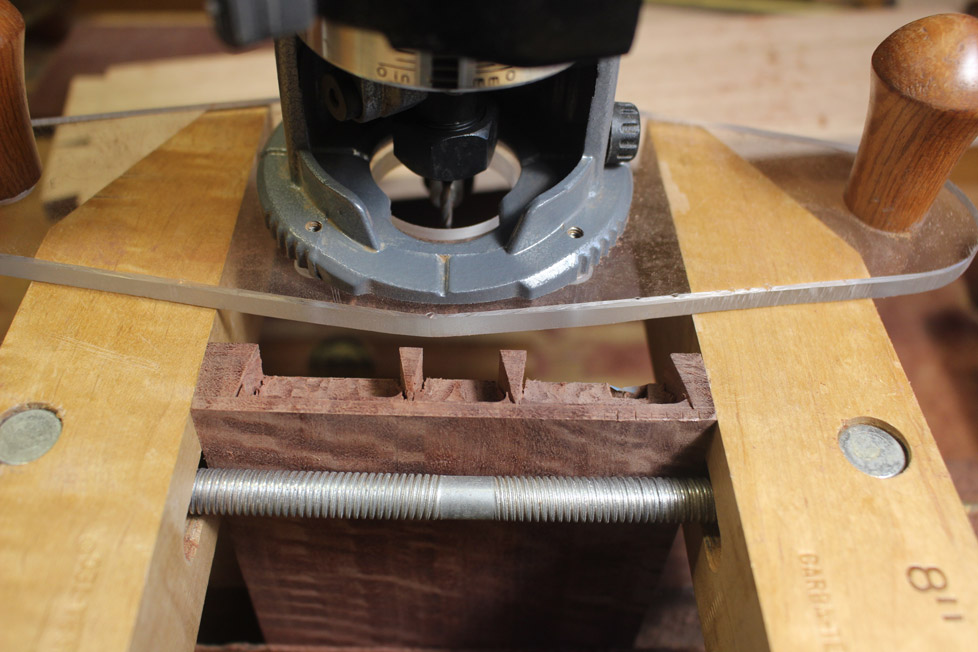
Then you need a wide sub-base for the router. I made this from Lexan ...


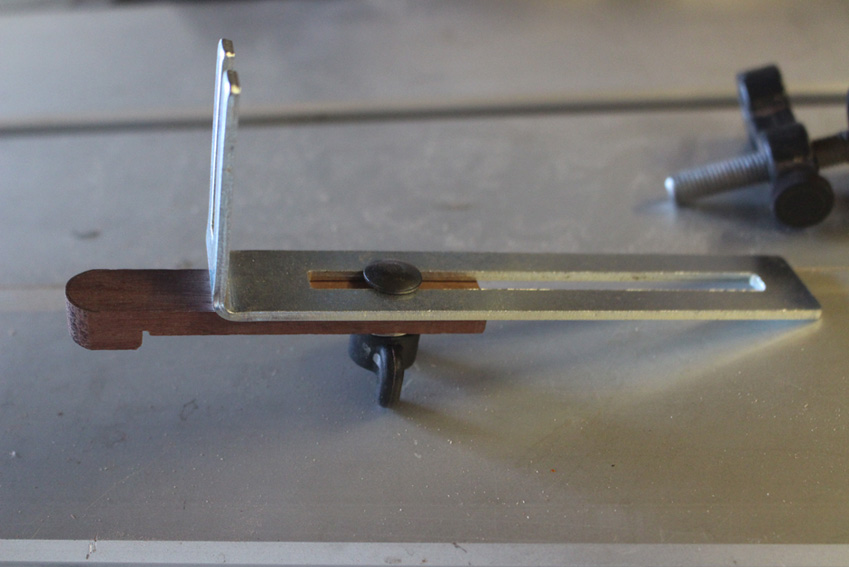
Here's another sub-base. Also note the shopmade single point fence ...


Here is another single-pint fence ...


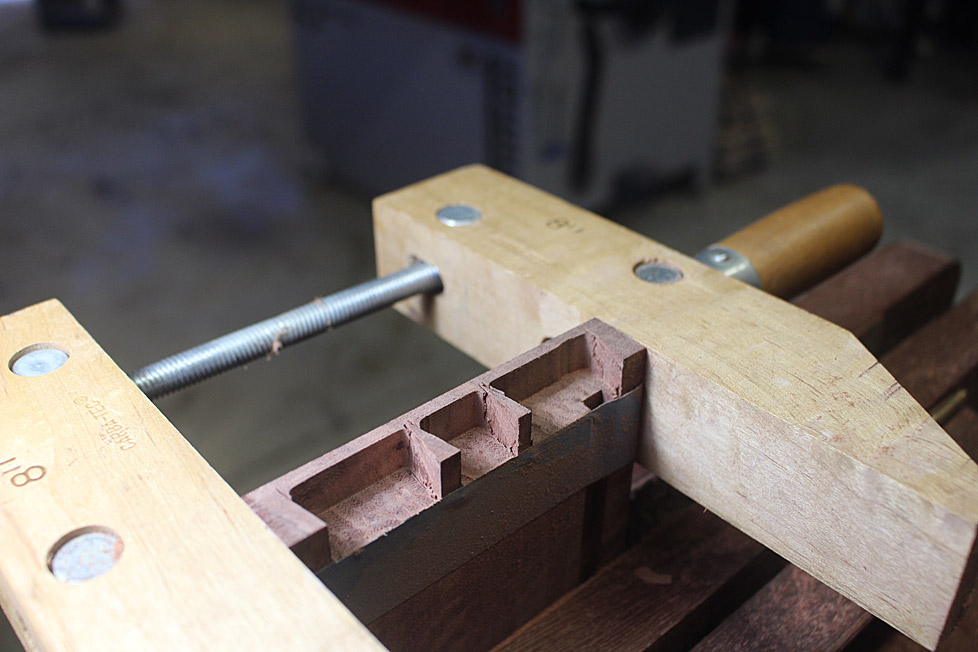
I use a 1/8" carbide bit and freehand it close to the lines (noting that I have already deepened the kerfs with my kerfing chisel) ...


Incidentally, there is also a plunge base available, which does have micro adjustability. I prefer the simple trim fixed base for this task.


Regards from Perth

Derek

Re: request router recommendation

#11

Re: request router recommendation

Bill Tindall, E.Tn.

models with desirable handles not so cheap!

Re: request router recommendation

#12

Re: request router recommendation

John in NM

I've used a Porter Cable 7310 for decades to do this task as well as 1/16" and 1/8" roundovers. I use it one handed, usually holding a hinge template with the other.

The only trouble is that the depth adjustment is not great, adequate, but not great. The motor is excellent though. My preference is to use a top bearing flush trim bit and an exact template. Only downside is that the bit is thus 1/2" diameter rather than 1/4" so there is more corner to trim - an annoyance, nothing more.

The main problem with the depth control is that loosening the locking screw allows the base to tilt relative to the spindle. I'm sure someone clever could fix it, but I just make do, you get used to working around it, and I've yet to see a good router in this regard.

I have an extremely dim view of Dremels. They are not powerful enough to last under the stress of routing - maybe a hinge mortise, but I kinda think even that will kill the speed control. I've burned up about 5 Dremels in my early days before moving to a more properly sized tool (Foredom) for their niche after college. Come to think of it, I'm not wild about any router style tool with a speed control - that is usually the part that fails.

Re: request router recommendation

#13

Re: request router recommendation

Mark Nowicki

I have the Ridgid. No complaints.

Micro adjust for the depth, quiet, variable speed.

Re: request router recommendation

#14

Re: request router recommendation *LINK*

Hank Knight

Bill, if money is no object (which it is, of course), take a look at the Micro-Fence plunge bases. I've wished for one of these for years. One day .....


Micro-Fence Plunge Bases

Re: request router recommendation

#15

P.S.

Hank Knight

I have the Stewart MacDonald plunge base for my Dremel and it works well for what it is. The Dremel is fine for inlay and the light work, but I agree that it is too lightweight for serious router work.

Re: request router recommendation

#16

question for trim router recommenders

Bill Tindall, E.Tn.

My DeWalt trim router has a safety deficiency. I wonder if it is avoided in the recommended trim routers.

For routing hinge mortises one holds the router at the base. On the DeWalt there isn't much to hang onto down there and a lot of open space between fingers and bit. This trim router seems to be designed to hold around the motor. Ideally, I need some handles or at least a place to hold that is below the center of gravity, ie near the base. How do the other router options fare in this regard?

Re: request router recommendation

#17

Yikes!

Bill Tindall, E.Tn.

I only paid $25 more for my Powermatic Floor mortise machine, or son-in-law's Powermatic Table saw.

Re: request router recommendation

#18

Make a base.....

roger lance


Re: request router recommendation

#19

Re: Yikes! *LINK*

Jim Dillon

Bill, it's only money :D . And as long as it is YOUR money... . Anyway, your point about the lower center of gravity is a good one. That is why I sprung for the Lee Valley base. You grab the base just above the base plate so you have tremendous control over the router. Depth adjustment is also very precise. Plus, think of the Federal inlay work you could get into! I think Dremel makes a constant-speed model but I don't know if it fits the LV base. I still use my PC 610 trim router (discontinued) and Dewalt 611 mid-size router. The Dremel is definitely not for hogging out a lot of wood and for that I would turn to my 610 or 611 with larger bits, but the newer LV fills a need for smaller hinges. Derek makes excellent suggestions for improving on the precise control of various routers and temporary expanding the platform that the router sits on when routing a narrow piece. Jim


Veritas Plunge Base

Re: request router recommendation

#21

Duh!

Bill Tindall, E.Tn.

Why didn't I think of that >( Problem solved.

Re: request router recommendation

#22

What is the advantage of routing that orientation

Bill Tindall, E.Tn.

The joint that shows is between the end of tails and pin board. This surface can be a challenge to chisel if the grain of the pin board is not straight. I take advantage of the router to make this surface accurate. It will be created by the depth of the 1/4" carbide bit I use. Hence, I route with the board laying flat on the bench. This orientation provides adequate surface to support the router. The surface that shows less (bottom of socket) is chiseled to the scribe line like the tails. No risk of the chisel running out on this end grain no matter how figured the pin board is. The remaining waste is long grain and it is both quick and trivial to remove.

Re: request router recommendation

#23

Re: What is the advantage of routing that orientat

Derek Cohen (in Perth, Australia)

The joint that shows is between the end of tails and pin board. This surface can be a challenge to chisel if the grain of the pin board is not straight. I take advantage of the router to make this surface accurate. It will be created by the depth of the 1/4" carbide bit I use. Hence, I route with the board laying flat on the bench. This orientation provides adequate surface to support the router. The surface that shows less (bottom of socket) is chiseled to the scribe line like the tails. No risk of the chisel running out on this end grain no matter how figured the pin board is. The remaining waste is long grain and it is both quick and trivial to remove.

Bill, I do it my orientation it is possible to get closer to the socket walls, which are vertical now (with you they are angled).

I set the depth of cut to the floor of the socket. Don't forget that I use a kerfing chisel to deepen the socket walls, which creates a release cut for paring with a chisel. I can freehand along the side walls within the kerf distance from the side walls. On the other hand, I am always a little wary of routing on the boundary line, and rather leave 1mm to pare away. It is easy to simply place the chisel in the scribe line and push down.

The photo below shows why I also now set a fence to limit the cut to 1mm, and not just freehand along this line: the boundary line on the right has been cut over. The single-point fence enables the bit to move into angled corners.


I think that is may be 6 of one and half a dozen of the other. Both methods/orientations have pros and cons. I like the extra registration you have in your orientation. I think that I will try it again and make some more comparisons.

Regards from Perth

Derek

Re: request router recommendation

#24

Discontinued Porter-Cable 3102

Steve Elliott

The trimmer in Roger's picture is my favorite due to its low center of gravity and accurate depth adjustment. It hasn't been manufactured for at least ten years but I've bought two on eBay since then, unused new old stock but at premium prices.

For some reason I've started having trouble getting the collet to release the bit on all three of my trimmers--no idea why this didn't happen earlier or why it has started now.

For stability and ergonomics this this one is the gold standard for me.

Re: request router recommendation

#25

Re: request router recommendation

DizD

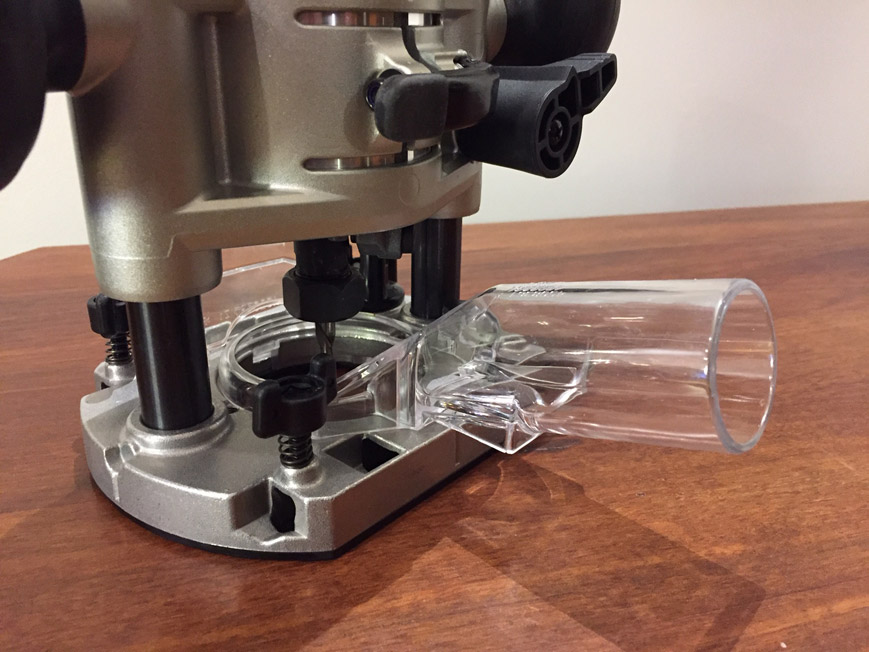
The Harbor Freight trim router works for me. The base and sleeve that holds the motor is clear plastic, which lets light in from all sides. Looked online and see they also have a clear plastic router base with two handles. I keep one with 1/8" straight bit dedicated to the hinge size I use most cause adjustment is not easy or reliable.

👍 This page answered my questions

Your vote helps other woodworkers quickly find the answers and techniques that actually work in the shop.