Home Articles Forums Gallery Marketplace Videos

WoodCentral Forums

Knowledge You Can Build On — Est. 1998

ADVERTISE HERE - FREE TRIAL

Marking gauge questions....

Posts

Marking gauge questions....

#1

Marking gauge questions....

Barry Irby

I went to a tool auction and bought a box of marking gauges. Well at least I think they are marking gauges.

Can somebody tell me what the ones with little pins are called and the ones with little knives. I got six of them. some are Japanese and one appears to be English. Some have two beams and some have one. Some have metric markings.

Can anybody give me a brief tutorial? How about some Idea of value?

Re: Marking gauge questions....

#3

Re: Marking gauge questions....

Sgian Dubh

Of the standard western style marking gauges then the ones with pins are either marking gauges (single pin) or mortice gauges (two pins, one fixed and the other adjustable on [usually] a brass slide with some sort of threaded mechanism attached to a thumbscrew at the end of the gauge's stem). Both are for marking with the grain. Combination marking/ mortice gauges are also quite common - I've got a few of this type I must admit.

Gauges with a wee knife instead of a pin are cutting gauges for marking across the grain, e.g., to set the shoulder line for various dovetails such as through, lap, secret mitred, secret lapped, etc. They can also be handy for setting out grooves and the like for stringing in both solid wood and veneered pieces. Slainte.

Re: Marking gauge questions....

#4

Re: Pictures

Barry Irby


Re: Marking gauge questions....

#5

Re: Pictures

Barry Irby

Sorry the pic is so small, but I am struggling with file sizing and what all.

Brian, I saw some gauges in your post that reminded me of these, but I wonder about the quality of these. I suspect yours are of higher quality, but I don't know.

I will be happy to send larger files directly to you.

Re: Marking gauge questions....

#6

Re: Marking gauge questions....

Barry Irby

I have one made by Crown Tools That has about a 6" beam and a brass adjustment screw that sets the distance between a par of pins and a single pin on the opposite side. I decided to keep that one.

The darker wood one in the picture has about a six inch beam and you can set the distance between the pins, but it uses the single knob to set the beam and distances. Also has a single pin on the opposite side.

The others have either one or two knives.

Perhaps I should keep one or two of them.

Thanks for the help.

Re: Marking gauge questions....

#7

Re: Marking gauge questions....

roger lance

Perhaps, you should keep all of them....you may have gotten a great deal.

The Crown gauge may actually be the less desirable of the lot.

Re: Marking gauge questions....

#8

Re: Pictures

Brian Holcombe

The Japanese gauges look pretty basic machine made examples, the beam gauge possibly a little nicer than the others.

I have one beam gauge that is pretty similar, look for a lamination line on the blade and that'll tell you if it is of a decent quality.

Re: Marking gauge questions....

#9

Marking gauges

Derek Cohen (in Perth, Australia)

Can somebody tell me what the ones with little pins are called and the ones with little knives. I got six of them. some are Japanese and one appears to be English. Some have two beams and some have one. Some have metric markings.


Can anybody give me a brief tutorial? How about some Idea of value?

Gauges may either have pins (called pin gauges) or knives (called cutting gauges). They may also be single pin/knife gauges (for marking single lines, such as dovetail baselines or tenon baselines), or double pin/knife gauges (for marking mortice and tenons).

Single knife for a tenon (same process for a dovetail) ...


Pins gauges tend to be better scoring a line with the grain, as knives can often follow the grain and go off track. There is a simple rule that prevents this occurring, and indeed it should be followed with any score with any gauge: always may the first stroke very gently, barely marking the wood. Use several strokes to score a line rather than a single heavy stroke.

I own several gauges, some I built and some I purchased. Below are two Japanese cutting gauges. To the left is a single cutting gauge, which I built/modified. To the right is a double cutting gauge by Kinshiro, considered by many to be the best of all. They are no longer available by this maker ...
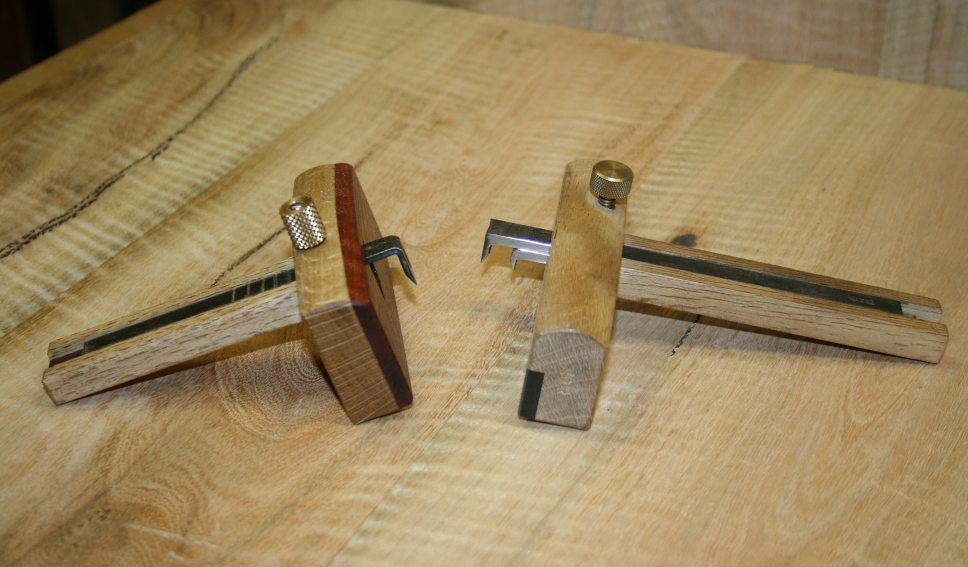

To use a mortice cutting gauge, first position the cutters on the wood ...


Close up the fence/head ...


You can now score the lines for both the mortice and the tenon. That is the advantage of these gauges, especially when working with hand tools - work from a reference side and maintain consistency with marking.


An example of a pin gauge is this Stanley #65 ...
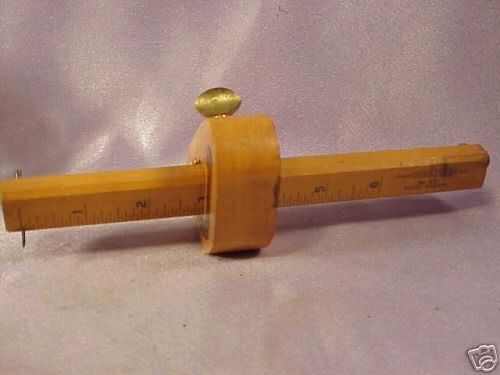

More frequently, these are reshaped into knives with a file or grinder, thus ..


This is one of several gauges I have built patterned on the Kinshiro, which is very comfortable to hold ...


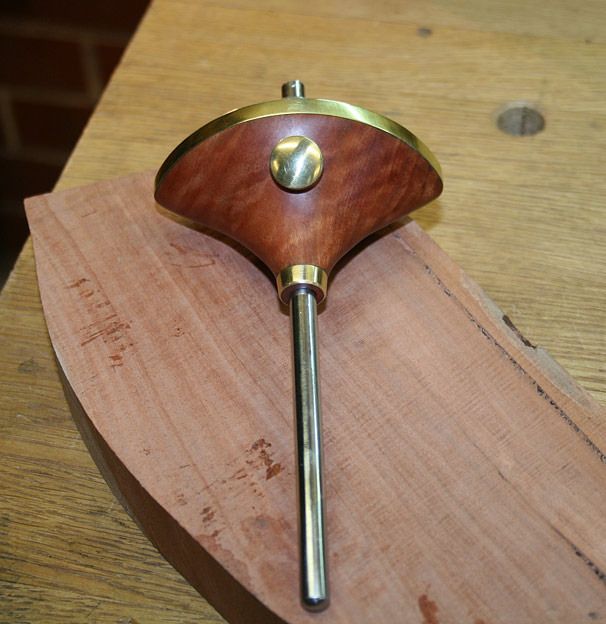
There are many other types of cutting gauges, and I do like the wheel gayges of Veritas and Tite-Mark ...


Here is one I made ...

Lots of choices. They do not have to be expensive or fancy (but why not :) ). All have in common that they score a line a specific distance from a fence/head.

Regards from Perth

Derek

Regards

Re: Marking gauge questions....

#10

Re: Marking gauge questions....

AZ in Colorado Springs

It's good to have more than one marking guage. Sometimes you need to switch the setting as you proceed through a project then need to return to the earlier setting. It's nice to be able to keep that first setting intact. And, as Derek mentioned, be sure to identify reference faces so your work is consistent.

Re: Marking gauge questions....

#11

Re: Marking gauges

Barry Irby

Thank you Derek. Very kind of you to take that much time to answer my question. I am not a hand tool woodworker and will never reach anywhere near your level of skill and workmanship. I'm 68 and I don't think I have time to learn a whole new career.

The gauges I have look similar to some of yours but are clearly not as well made or heavy duty. I have made it this far without one, so I thought I might keep one or two and sell the rest.

I might even donate them to the cause. I could be convinced to "sell" them for an appropriate to Wood Central.

Re: Marking gauge questions....

#12

Speeding up your work

Derek Cohen (in Perth, Australia)

Hi Barry

You're welcome. I must say that at 68 years young you are now old enough to learn how to use a marking gauge! :) I'm 67, by the way (I started with power tools about 40+ years ago, and only moved to using hand tools about 25 years ago).

It pays to have a couple of marking gauges for different settings. For example, when dovetailing drawers (with a backsaw) you need a gauge for each mating board.

There is a technique that one learns when using hand tools, which may be missed if only using power tools: Dimensions are transferred with a gauge rather than measured with a rule. Mark by scoring one board, then a second, and a third, etc.

I don't see why this cannot also be used in a predominantly power tool workshop. It will speed up build time and reduce errors. For this reason, practice using a couple of gauges. Within a short time you will be converted to this method.

Regards from Perth

Derek

Re: Marking gauge questions....

#13

Re: Speeding up your work

Barry Irby

Who is the person I see in your photos from time to time? Have you hired a model? Or did you take those pictures back when you worked with power tools? I need to know what lense you are using.

Reminds me of the women Realtors who give me their card with the glamor shot on it. I wonder if they picture is fifteen years old or it's their younger and better looking sister.

I will keep some of the gauges and sell the rest. I don't really need to go from none to seven or eight. I understand about keeping the "setup". Good idea. Its a matter of solving the problem with the tools and skills you have. Hard to think about using a marking gauge to solve the problem if you don't have one. Hard to think outside the box when building a box.

Incidentally, I came into a Gifkins Dovetail Jig. And since it comes from Australia, you MUST be familiar with it. I am selling it. Its new old stock, never used. Any thoughts?

Re: Marking gauge questions....

#14

Re: Speeding up your work

Derek Cohen (in Perth, Australia)

Hi Barry

I'm not sure whose photos you are referring to, but unlikely to be me, as I rarely include myself in a picture. There is one on my website: http://www.inthewoodshop.com/index.html

The Gifkin Dovetail Jig? I know of it. Never actually seen one as I handsaw all my dovetails. I have no idea what they are worth.

Regards from Perth

Derek

Re: Marking gauge questions....

#15

Hmmmm?

Barry Irby

Wonder who I had you confused with? Senility can be wonderful if you can just remember not to care.

I bought the Gifkins Jig "because it was there". Hope somebody wants it more than I do. It is an interesting gadget.