Home Articles Forums Gallery Marketplace Videos

WoodCentral Forums

Knowledge You Can Build On — Est. 1998

Fast and affordable laser cutting – so you can make the parts you can’t find anywhere else

Thoughts on Ash wood

Posts

Thoughts on Ash wood

#1

Thoughts on Ash wood

Grant Smith

A number of counties in Iowa have now been infested by the Emerald Ash Borer (EAB) insect, which is known to largely wipe out Ash trees.

Historically, we know that whenever a tree becomes scarce, its value, and often its desirability goes up, sometimes through the roof. True, in this case, a glut of ash wood is on the market (I think), at least in areas where the EAB has done its damage. At some point, however, the glut will run out.

So open question to the group: Is ash the next cuban mahogany or chestnut? Most will agree that ash has always been seen as a secondary wood for furniture, but will that attitude change as it becomes scarce? should we be stashing ash up to our ashes, so to speak?

We do know that some municipalities and individuals are seeking to save their ashes by treating for the borer tree by tree.

Does anyone know if the tree is now permanently under threat, or if it will rebound and be more or less safe once the wave of beetles passes through and the supply of ash trees dwindles? Will the borers still be around once the trees are gone?

Interested in perspectives of those who were hit early on, and anyone who would like to offer insight.

Regards,

Grant in Iowa

Re: Thoughts on Ash wood

#2

Re: Thoughts on Ash wood

Sgian Dubh

"Most will agree that ash has always been seen as a secondary wood for furniture ..."

I've never before heard anyone describe ash, whether American or European, as a secondary furniture wood. In both cases its uses have long been prized in sports goods such as baseball bats, cues, polo mallets, hockey sticks, oars, etc; for striking tools such as hoes, spades, hammers, and so on, and as a high class furniture wood used in cabinetry, panelling, chair making, for steam and laminate bending, as well as providing decorative veneers and the like. In my opinion to relegate ash to merely a secondary wood role is quite extraordinary. Slainte.

Re: Thoughts on Ash wood

#3

Re: Thoughts on Ash wood

Grant Smith

Sgian,

I think I have miscategorized ash as you state. Apologies. I guess I am coming from the perspective of a region abundant in Black cherry, walnut, and oaks. I generally don't pursue ash logs for milling, though I have some in the racks that has been used for bent projects, and where durability is desired. Thanks for providing a more worldly opinion.

Any thoughts on my questions?

Regards,

Grant in Iowa

Re: Thoughts on Ash wood

#4

Re: Thoughts on Ash wood

Dick Coers

I love working with ash, but in my opinion, it's always been the red headed step child of wood in commercial applications. Often stained or dyed to blend into non descript oak furniture. I can't see the species ever recovering, nor reaching a high demand for existing lumber. I think it's just going to fade away. As far as baseball bats, I see them going to all aluminum when enough law suits happen from shattering maple bats. College baseball already uses aluminum.

Re: Thoughts on Ash wood

#5

I disagree

Bill Tindall, E.Tn.

"Most will agree that ash has always been seen as a secondary wood for furniture"

When we began selling lumber the wholesale price of ash and cherry were essentially identical. Once popular, it fell out of favor to darker woods and never returned to its former glory, but it never ceased to be a primary furniture wood. It was often stained in furniture and mistaken for oak. However, it remains a furniture wood whose price is distorted by the ash borer. Foreign import bans have collapsed its price.

There is no other light wood other than maple. The birch supply is so limited that I doubt it will ever return as a significant furniture wood. Both are plain as dirt. When a light colored wood becomes desirable I predict ash will command a premium price. If I was 30 years younger I would be stashing away what ever I could store. However, stash it treated. There is no wood that powder post beetles like better.

BTW, I'm looking for just the right logs to lay in a additional supply for my needs.

Re: Thoughts on Ash wood

#6

Re: I disagree

William Duffield

The only down side to ash as a furniture wood was when the interior decorators decided it would be fashionable to pickle it, i.e., rub white paint into the pores and then try to rub off the excess.

Re: Thoughts on Ash wood

#7

Re: Thoughts on Ash wood

Keith Newton


Grant, I'm not sure what you mean by durability, but Ash is neither resistant to decay or insects, so if you are planning on storing some, you need to keep it inside in an insect free zone.

Re: Thoughts on Ash wood

#8

Re: Thoughts on Ash wood

Yonak

Ash wouldn't be tops on my list for oars as its resistance to water is almost nil. However, it would seem logical that oars are heavily finished.

I probably work ash more than any other species, however, and I like working with it. It has many fine qualities such as shear and tensile strength, beautiful grain, above average workability and, depending on the density of the particular boards, perhaps the hardness of oak without the flakiness.

Re: Thoughts on Ash wood

#9

Re: Thoughts on Ash wood

Yonak

I don't think Major League Baseball will ever go to metal bats. With the strength and size of Major League players, it will always be dangerous for pitchers. The next development in bat composition, I believe, will be composites and engineered wood products, plastics and combinations.

Re: Thoughts on Ash wood

#10

Re: Thoughts on Ash wood

Yonak

Grant, I had the same decision last year when I had the opportunity to get several ash trees for speculation. I chose to decline because I don't believe the value of ash wood will increase significantly any time soon. As my age and short investment time was my deciding factor, your circumstances may be different depending, on your age.

Re: Thoughts on Ash wood

#11

you must not do water sports

Bill Tindall, E.Tn.

Ash is the traditional wood for canoe paddles and oars where strength or druability is critical, for example white water. I have, and have made, numerous ash canoe paddles and my favorite small boat oars are ash. But even flat water wood canoe paddles are ash. They hold up to pushing off in sand and rock. The rot resistance as tested by putting a post in the ground is irrelevant to paddles and oars.

And there are snow shoes. Every frame I have ever seen is ash.

Re: Thoughts on Ash wood

#12

Re: Thoughts on Ash wood

Sgian Dubh

Grant, no problem with the "mis-representation". We all mis-speak from time to time. I was simply very surprised.

As to Emerald Ash Borer, it's not yet a problem here in Europe, but we are seeing the spread of ash dieback caused by the fungus Hymenoscyphus fraxineus, which first appeared in Poland in the early 90s. Recent hopeful news (earlier this week, and if I heard it correctly) indicates that many of the ash trees here in the UK have a slightly different genetic make-up to those on mainland Europe and may offer better resistance to the fungus.

As to ash becoming like American chestnut or Cuban mahogany, i.e., hard or impossible to get hold of, I really can't say, but I do hope not. Maybe those UK based ash trees have the potential to regenerate ash stocks in Europe, North America, and elsewhere, especially they happen to have a resistance to emerald ash borer too, but I suspect that last hope a bit of a fantasy. Slainte.

Re: Thoughts on Ash wood

#13

European Ash research

Bill Tindall, E.Tn.

There is a research group in England working on the genetics toward an effort to develop resistant trees.

Re: Thoughts on Ash wood

#14

Re: Thoughts on Ash wood

Marc in Mass

This is ash. It speaks for itself.

Re: Thoughts on Ash wood

#15

Re: I disagree

Brian Holcombe

Ash remains popular with Danish furniture enthusiasts, along with white oak. It is one of the more enjoyable woods to use for furniture, strong and not especially difficult to work. I find it preferable to maple or oak.

Danish furniture was never really made in dark woods for their market, more for the American and Japanese markets.

Re: Thoughts on Ash wood

#16

Re: Thoughts on Ash wood

William Duffield

If I were an interior decorator, I might paint that pink. :b

…and another color next month.

Marc, that is stunning! Every time I go to a hardwood sawyer, I ask them if they have any curly ash. Usually, I don't find any, or at least not enough for any serious piece of furniture. :( I try to make good use of whatever small scraps I can find. This towel hook refrigerator magnet is about 3" x 4-1/4" x 4-1/2".


I have a curly ash mallet that I am turning, but it's going to be too pretty to use for pounding on carving gouges.

Re: Thoughts on Ash wood

#17

light colored wood

John K Jordan

Interesting!

When in the far north of Italy last spring a friend took me to visit his furniture-maker friend, here making something from olive to make my suitcase heavier:


This guy showed me a stack of photo album pages nearly 1 foot high with home and office furniture and things he as made over the last 30+ years. The wood he uses most: pine!

The olive plank he pulled down for me may have been the darkest wood in the shop. This area of the country is largely German culture and language.

JKJ

Re: Thoughts on Ash wood

#18

If that piece of wood disappeared......

Barry Irby

Where would his hand be?

Re: Thoughts on Ash wood

#19

I didn't know that....

Bill Tindall, E.Tn.

"Danish furniture was never really made in dark woods for their market"

Maybe why Krenov pieces are usually light.?.

Re: Thoughts on Ash wood

#20

Re: I didn't know that....

Brian Holcombe

It's certainly possible, it's my understanding that he spent some time in Sweden making architectural models and furniture. I'm sure Scandinavian enjoyment of their local woods can grow on one pretty quickly.

Re: Thoughts on Ash wood

#21

Re: If that piece of wood disappeared......

John K Jordan

>>>Where would his hand be?

Scared me. It would have done no good to say anything, especially with no common language.

And no dust collection, eye or ear protection. We must be a bunch of wimps.

JKJ

Re: Thoughts on Ash wood

#22

second growth ash

Tom dun

As an arborist who has to whack lots of ash I pay attention to EAB issues

A good friend of mine is an arbo in Detroit, Ground Zero for EAB, has unique insights about how the infestation runs it course

In the fifteen to twenty years the ash population has gone down to low double digits and even single digits of its previous population. There are a lot of stumps have resprouted and started to grow into trees.

My friend along with urban foresters think that some of the ash that make it through will continue to grow even as the EAB population plummets. Some of the stump sprouts will thrive too

Pure luck in most cases. There's a chance that the surviving trees might have some genetic signal that confabulates the beetles

Here in Minnesota the southern edge of the infestation is moving close to the central part of the state where black ash is a major tree. At the same time the beetle is now moving west out of Duluth. Most foresters, urban and woodland, expect start seeing EAB in the woods. When that happens there is no hope of containment.

I've liked working with ash for decades. Even before EAB I found a LOT of nice logs in the urban forest

Which became wonderful lumber

The department i work for will continue to preemptively remove about 8,000 ash each year. In time the trees on residential properties will start to show up dead and be removed

Re: Thoughts on Ash wood

#23

Re: second growth ash

Marc in Mass

I sure wish the elm was as resilient. Where I am from in the UP of Michigan there are no more elms. I have heard about some king of regrowth being manipulated there, but I have not seen a elm sapling there or around here in Ma. since the 80's. There actually are a few really old elms that did escape the blight, but really few. A bit cantankerous for woodworking but strong, beautiful, and durable.

Re: Thoughts on Ash wood

#24

Re: Thoughts on Ash wood

Larry Clinton At Frankfort, (Central) Indiana

Richard, I agree that in this area (central Indiana / midwest USA) I have never heard it relegated as a secondary wood,. however it has been regarded as a lower value wood often used in furniture as a "fake" Oak.

It has always commanded quite a bit lower cost than Oak (at least here) so a lot of factory furniture builders did /do use it. Obviously when finished properly Ash does closely resemble White Oak but does not exhibit the "rays" prominent in Oak, nor have the hardness or resistance to rot, and is quite a bit lighter in weight.

Personally I would / will not purchase a lot of it as I do not consider it one of the more desirable woods in appearance.

As slow as I am in building something I consider material costs a very low priority when planning a project.

I have already stockpiled a quantity of what I consider prime woods, Cherry, Walnut, Oak etc. and secondary woods, sufficient to last me (and probably my only son interested in woodworking) for our lifetimes.

Re: Thoughts on Ash wood

#25

Re: Thoughts on Ash wood

Sgian Dubh

Larry, even here in the UK, American ash as well as European ash is a cheaper material to buy than several others, including both many imported American hardwoods, such as those you named, as well as European hardwoods. Your point concerning the cost of materials as a percentage of overall cost in a craft furniture project is largely true for both the hobby woodworker and the professional - it's generally the labour that forms the greatest investment in making a piece.

As to which material to use in a furniture project, it very much depends on a wide range of factors, so the choice for the show wood(s) relies very much on such things as the style (of the furniture or of the overall room ambience), personal preference, customer preference, technical or construction challenges, and so on. Whether or not to use ash in preference to any other wood choice is usually decided on some or all of the factors above, and perhaps others I've not listed.

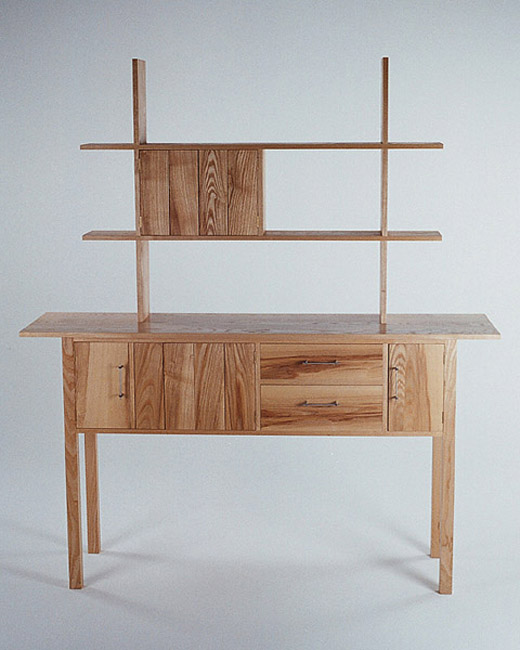
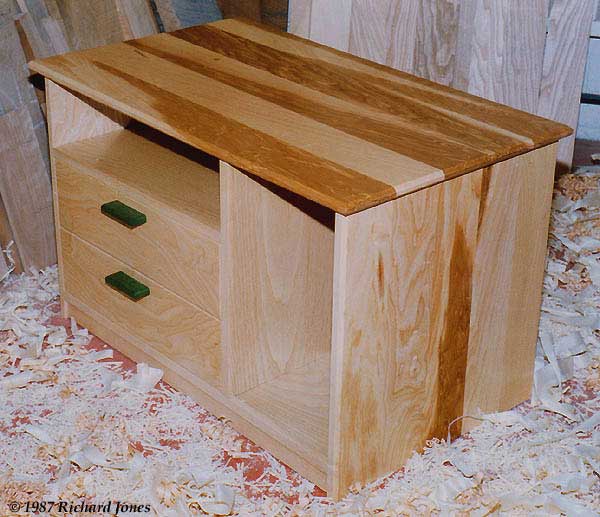
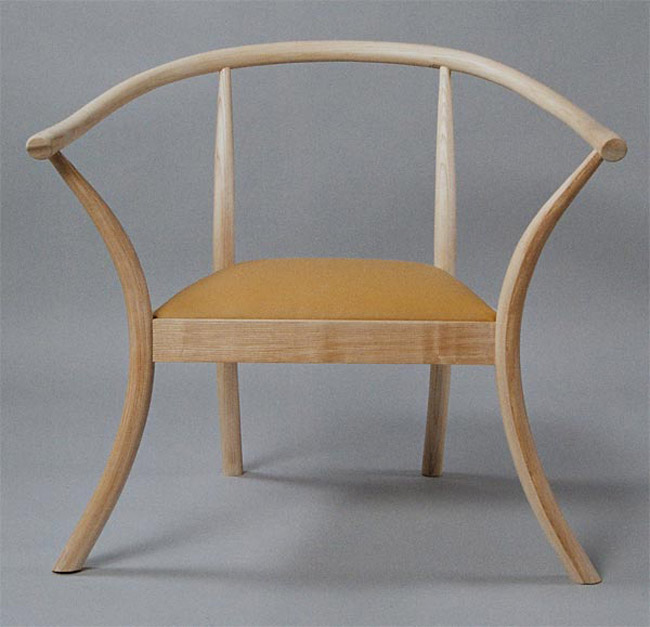
Below are a some examples where I think ash was a good choice for a particular project. In the first instance, a student piece, it was ideal for steam bending, and the overall pale look was sought. In the second, another student piece, it rather suited the Japanese inspired overall 'look' - the coarser textured ash added visual interest too. In the third, it came down to a customer request and a chance to highlight some olive figuring chanced upon whilst sourcing the wood, along with using sequential boards for some solid wood bookmatching on the drawer fronts. I recognise design preferences are individual, and designs I like may not suit all tastes, but here they are anyway, ha, ha! Slainte.