Home Articles Forums Gallery Marketplace Videos

WoodCentral Forums

Knowledge You Can Build On — Est. 1998

Find a woodworking club near you

Hand Plane Suggestions

Posts

Hand Plane Suggestions

#1

Alan Young

Hand Plane Suggestions

Alan Young

OK I've been here since 1998 or so. Posted many pics over the years and learned So Much ...here's the deal: my hand plane collection has never been too extensive and the kids are asking what I want for Christmas. I'm thinking of starting from the beginning-If you had to pick One Hand plane to *Start* your arsenal-what would you chose? Manufacturer/Size/Style- anything that causes you reach for that plane more often than the others- what would it be?

-Alan

P.S. also posting on Hand tool Side

Re: Hand Plane Suggestions

#2

Re: Hand Plane Suggestions

Tony - Memphis

Well, I am not a "heavy" user of planes, so... My favorite plane (and my first) is the Lie Nielsen 102 low angle block plane. Why? It is very versatile and easy to maintain and setup.

Tony

Re: Hand Plane Suggestions

#3

JL

Re: Hand Plane Suggestions

JL

I use a number of different hand planes.

My "go to" hand planes are:

The Veritas Standard block plane from Lee Valley

The Veritas #4 Smooth plane from Lee Valley

I choose Veritas and Lee Valley because they are of a good quality and don't cost quite as much as a Lie-Nielsen. The Lee Valley planes cost about 2/3 of what a Lie-Nielsen cost.

I like the #4 as it is a good, short plane that works for finish work as well as getting some wood off a board. You always need a good block plane for the close work.

YMMV.

If you go the Lee Valley route, it will cost about $225 or so for a #4.

Re: Hand Plane Suggestions

#4

Re: Hand Plane Suggestions

Bill Tindall, E.Tn.

When I need to hand plane something I subconsciously reach for a Bedrock #5 which would be similar to a LN #5. From what I gather many would have the #4 as their go to plane. I have a LN #4 sitting right beside the #5 and pass it by for the old #5. I cannot put in words why I prefer the #5 other than it just seems right for the planing tasks I do, which are mainly fitting parts for furniture. I rarely hand plane show surfaces.

The Cliftons are too heavy for my taste.

I used to think a heavy plane was desirable but I no longer do. I have a 5 1/2 LN that I almost never use.

The new LV planes appear to be an attractive option but I have never used one. I think they are worthy of consideration. But someone cheap (me for instance) should be looking on Ebay for a bedrock #5.

Re: Hand Plane Suggestions

#5

Re: Hand Plane Suggestions

William Duffield

I offered Alan some advise on this subject over on the Hand Tool Forum, but then I saw your comments here and so reconsidered from the point of view of which planes I pick up most often. Instead of a #4 or #4-1/2 for smoothing, or a block plane for knocking off corners and arises, I usually use a Stanley #3. Instead of a medium shoulder plane, I usually use either my L-N #73 large shoulder plane or my Veritas bull nose shoulder plane. Why? I don't know! The shoulder planes have wider blades than the VMSP. Evidently, my hands are larger than most people's, because I can comfortably use any of these one handed.

Re: Hand Plane Suggestions

#6

Re: Hand Plane Suggestions

roger lance

I'll make no suggestion on which plane to consider......anyone with your level of experience will know something about what they'd use in their work.....but I will recommend planes from Lee Valley based on price and quality.....can't go wrong with them or their tools.

Re: Hand Plane Suggestions

#7

Re: Hand Plane Suggestions

David Yoho

Alan, I'm also not much of a hand plane user but I do have a couple. I have a Record #4 and a Record low angle block. The one I've use most is the low angle block.

I also have a Veritas scraper plane. It's not really a plane but more a cabinet scraper in a plane body. Although I've used it a few times, I find myself reaching for and using my Stanley #80 cabinet scraper most.

Veritas does have a few specialty planes I've had my eye on but that's about it.

Re: Hand Plane Suggestions

#8

Interesting

Bill Tindall, E.Tn.

A good friend professional furniture maker also has a# 3 as his "go to" pane. He likes the fact that the short sole conforms better to plane less that perfectly flat surfaces.

Re: Hand Plane Suggestions

#9

Re: Hand Plane Suggestions

John in NM

For many of us who are "hybrid" tool users, a #5 or #5 1/4 are probably most useful. Either excels, with a good blade, at final stock dimensioning, whether its as a stand in jointer or breaking corners, etc. I'm as often using the #5 clamped upside down in my bench vise as holding it in my hand. It's also the one I use in my cobbled together shooting board. I had an old 5 1/4 that was the one I kept at work when I worked for a shop. The boss hated seeing hand tools around, thinking them slow. I found it very useful for evening up rails on tables and carcasses before putting on a top.

A smoother would be a second IMHO. I rarely smooth plane, though they do fit in my usual flattening/smoothing/sanding regimen.

Whichever way you go, try out one of Lee Valley's PM blades - well worth the price based on the one I've tried.

Re: Hand Plane Suggestions

#10

Interesting

Mark Mandell - Gone Round In New Jersey

I inherited an old Stanley No. 5. Cleaned it up a bit but still haven't gotten it to work.

Re: Hand Plane Suggestions

#11

Re: Hand Plane Suggestions

don stephan

For several years I had Stanley used planes that I cleaned up. But I was always working on the planes rather than with them. For a rush job needing a long plane I bought the Lie Nielsen #8 and it was a lifesaver. Expensive, but it's always worked without problem, and the weight helps it work better on board and veneer edges. I also have an LN 4 1/2 with all three frogs, an LN router plane, and an LN 62. But the plane I use most often is a LN low angle block plane. I never doubted that Veritas planes would work as well, I just like the more traditional look of the Lie Nielsens.

Re: Hand Plane Suggestions

#12

Re: Hand Plane Suggestions

AZ in Colorado Springs

I have a couple of wood river hand planes, nos 4 & 5. A couple of years ago a friend gave me an old Stanley no 4 and I love it. Pretty light weight, and the bottom is grooved. Just a good sharpening was required and it's very easy to use. I have a wood river block plane, and that also is very useful.

Re: Hand Plane Suggestions

#13

function begats form

Derek Cohen (in Perth, Australia)

OK I've been here since 1998 or so. Posted many pics over the years and learned So Much ...here's the deal: my hand plane collection has never been too extensive and the kids are asking what I want for Christmas. I'm thinking of starting from the beginning-If you had to pick One Hand plane to *Start* your arsenal-what would you chose? Manufacturer/Size/Style- anything that causes you reach for that plane more often than the others- what would it be

Hi Alan

Since you prepare your boards (getting them to size and flat) with machines, you are really looking at a couple of planes that will aid in tuning your work and/or finishing your work.

The type of tuning that planes do best is ...

1. chamfer edges (block plane)

2. square edges of boards and fine tune for length, such as drawer faces (shooting plane)

3. tweak the cheek of a tenon (I would not use a plane - I'd rather use a chisel or rasp. However, if I were using a plane, it would be a router plane)

4. chisel out hinge mortices (router plane)

5. smooth faces of boards (smoothing plane)

6. tune groove or dado width (side rabbet plane)

That should do for a start. I am ignoring dimensioning boards, such as with jack and jointer planes, since you use machines and just looking for a place to start.

Block Plane: my three of choice - LN #102, LN #60 1/2, Veritas DX60

Shooting plane: Veritas LA Jack. A wonderful BU plane that may be used for many tasks, such as a short jointer, but also as a plane on a shooting board. You will never look back.

router plane: Veritas Large Router Plane. Again, a very versatile plane, used for inlay, grooves, dados, mortice hinges, and tenon cheeks.

smoother: Veritas BU Smoother. There are many smoothers to choose from. However, I do not think that you are ready for the 911. Stick with the Golf. This is about easy-of-use and not about performance. The BUS performs as well as the best, and ideal for already-flat surfaces. The blade is the same as the Veritas LAJ, so can be swapped back-and-forth (BU planes use different bevel angles to create different cutting angles. Low angle for shooting and high angle for planing interlocked grain).

Side Rabbet Plane: LN #98/99

I'll post this on the Hand Tool side for comment.

Regards from Perth

Derek

Re: Hand Plane Suggestions

#14

Okay, I'll pile on....

Thomas Skaggs, Foothills of Mount Level

Brother, you know me. I'm not a tool collector nor "aficionado". So I cannot illuminate you on the fine points of hand planes. So what I can offer is just to tell you which planes I grab the most often. In order of frequency of use:

1. LN low angle block plane. It's just a doggone handy thing for shaving off wood in a wide variety of situations....makin' things fit.

2. Veritas low angle jack plane. I love it because it works so well on the figured woods I use. I find it to be very forgiving to use. I grab it more often than my smoothing planes.

3. Veritas shoulder planes (medium or large). I use them a lot for fixing rabbets, dadoes and other such cuts.

I guess I grab these planes the most because they are truly the most useful to me. Because I use machinery a lot, my use of planes is often about adjusting things. That said, I do use other hand tools a lot because they are more efficient than machines. For example, I love Japanese pull saws....so handy!

Anyway, you now have my 2 cents. Keep the change.

T.

Re: Hand Plane Suggestions

#15

Re: Hand Plane Suggestions

Jim Dillon

Alan, I'm a handtool klutz. Nonetheless, I have found my Veritas low angle block plane and medium shoulder plane to be very useful. I have two other planes (LN block and a Veritas something or other) but seldom use them. My preferences speak more to my inexperience with handtools than anything else. Jim

Re: Hand Plane Suggestions

#16

what about it doesn't work

Bill Tindall, E.Tn.

Once the blade is sharp I don't see how a plane can't work?

Re: Hand Plane Suggestions

#17

Re: Interesting

William Duffield

Interestingly, my favorite #3 is a postwar Stanley Bailey, even though I also have a three patent date #4C, a Bedrock #603 and a couple other assorted small smoothers. Other than an aftermarket blade, the Bailey worked perfectly off the shelf at an antique barn.

I almost never use my jack plane.

IMHO, those who recommend bevel up smoothers are in denial. :D

Re: Hand Plane Suggestions

#18

Alan Young

Re: Hand Plane Suggestions

Alan Young

Thanks for all the comments! I realize this sort of question is in many ways unanswerable beyond "It depends..." My own usage of hand planes involves an old wooden antique smoothing plane-@18 in length, a Record #5 jack plane , an old No 4 1/2 Stanley Plane and a small unnamed block plane I picked up at an Upper Peninsula Michigan Home center last summer. About a month ago in a klutsy move I knocked the no 4 1/2 on the floor and destroyed it.


Till that point my main usage was the Record and the Stanley-I had the Stanley set to remove a slightly thicker shaving than the Record- My use is usually planing furniture joints or glue-ups as necessary- overall I don't do a lot of major surface planing-truth be told I just as often reach for a chisel-1/4 1/2 or 3/4 and "drag" it across surfaces as a scraper-Unconventional usage I suppose but I can See the material being removed and have developed a good feel for the pressure and angle required for these situations. This technique works especially well in smoothing inlays-after they have set but need the glue and slightly elevated height of inlay material removed and flattened to be level with the background surface. After reading these comments and doing some extra other searches I am convinced I could become a "plane guy" if I dedicated my budget and would soon wonder how I ever got along without some of the styles and sizes I don't have.

Re: Hand Plane Suggestions

#19

I agree. Cap iron effect wins

Bill Tindall, E.Tn.

"IMHO, those who recommend bevel up smoothers are in denial"

Historically, when the cap iron effect was well known and employed bevel down planes with a cap iron (or the misnamed "chip breaker") were by far the configuration of choice. How many bevel up planes do you see from 1910, or any other old date? If they were better for working wood they would have been common.

For me the plane epiphany was discovery of the knowledge of the cap iron effect, only available with a bevel down plane. It enabled me to risk planing situations I previously avoided for fear of unanticipated tear-out. My use of a hand plane increased many fold.

Re: Hand Plane Suggestions

#20

Re: I agree. Cap iron effect wins

Derek Cohen (in Perth, Australia)

Historically, when the cap iron effect was well known and employed bevel down planes with a cap iron (or the misnamed "chip breaker") were by far the configuration of choice. How many bevel up planes do you see from 1910, or any other old date? If they were better for working wood they would have been common.

For me the plane epiphany was discovery of the knowledge of the cap iron effect, only available with a bevel down plane. It enabled me to risk planing situations I previously avoided for fear of unanticipated tear-out. My use of a hand plane increased many fold.

Bill, the reason BU planes were not in common use around 1910 was for two reasons: firstly, the grey iron was too fragile for this design. The low bed necessitated a thin sole. This was easily cracked. Recent times have seen the introduction of ductile iron, which led to the re-emergence of BU planes. Secondly, one needs to know something about bevel angles, since a higher bevel angle is needed than on a BD plane. I suspect that the early use of BU planes was for end grain only.

If recommending a smoother for a first time user, the BU plane is an excellent choice. The results can be superb, and easily achieved. I predominantly use BD planes these days, but they do require a steepish learning curve, and set up is not automatic, as it is with a BU plane. They both get you there.

Regards from Perth

Derek

Re: Hand Plane Suggestions

#21

Re: Interesting *LINK*

Derek Cohen (in Perth, Australia)

Interestingly, my favorite #3 is a postwar Stanley Bailey, even though I also have a three patent date #4C, a Bedrock #603 and a couple other assorted small smoothers. Other than an aftermarket blade, the Bailey worked perfectly off the shelf at an antique barn.

I almost never use my jack plane.

IMHO, those who recommend bevel up smoothers are in denial. :D

Hi William

My favourite size is also #3. I have a LN and an English Stanley (that was my FIL's). They are interesting also as a example of the re-emergence of the chipbreaker into tearout control.

Up to about 4 years ago, when we began discussing setting the chipbreaker, the planes I used focussed on high cutting angles to control tearout. As you know, the West Oz timbers I use are highly interlocked. BU planes and woodies with high angle beds were the designs I turned to.

In this time I had purchased a LN #3 with a 55 degree frog. It was not high enough to prevent tearout. 60- and above degrees was the minimum in my experience. So the LN #3 sat on a shelf. As did the Stanley #3, which had a common angle frog (45 degrees).

I began using the LN again when experimenting with the chipbreaker. After a while I decided that the high frog was more of a hinderance than a help, and ordered a 50 degree frog for the plane. Why 50 degrees and not 45 degrees? - well, I did not find much difference in practice, and I could still sit a #4 handle to the LN #3 (whose original handle was too small for my paw). It took a while for the message to sink in - partly because by then I was using the Stanley #3 with a chipbreaker very successfully - and eventually the LN #3 acquired a 45 degree frog. In practice it work no better than the UK-make Stanley (circa 1960, but with a Veritas PM-V11 blade and chipbreaker), but it is nice to hold. I like the extra mass in a small plane.

It's a damn pretty plane ...


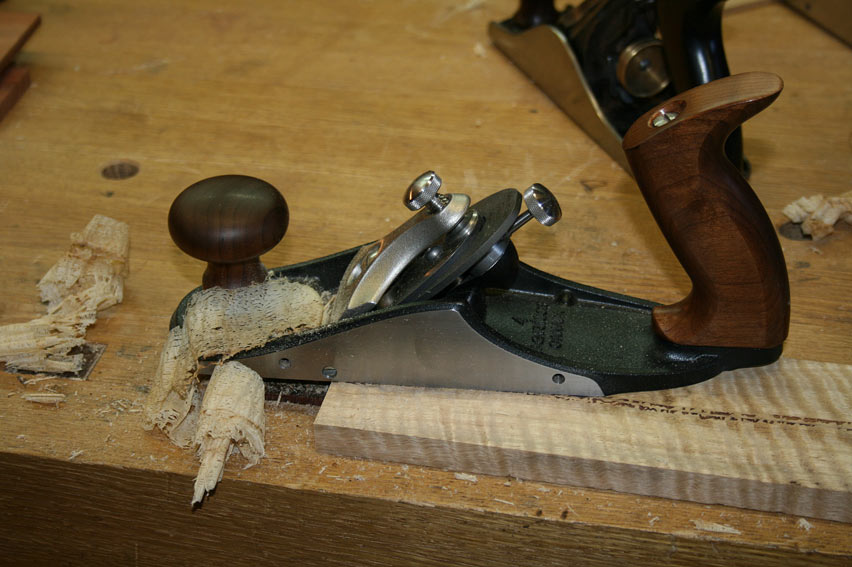
The other plane which I rave about takes all this one level higher. This is the Veritas Custom #4. If they had made a #3, I would have purchased that instead, but one is not out yet. I assume there will be one coming along. The Custom #4 is used with a 42 degree frog and the PM-V11 blade. This is such a sweet plane. With the chipbreaker, it fear no grain reversals.

Planing into the grain of some very interlocked Curly Marri ...

Now about that crack at BU planes :)

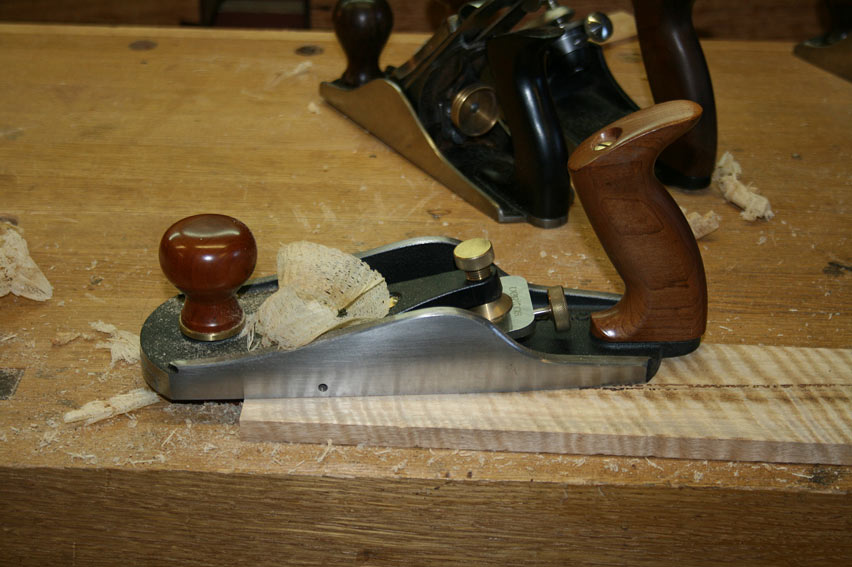
They are bloody good. Not ultimately as good as the double iron plane in the hands of someone who knows how to set a chipbreaker, but for someone who simply wants to extract superior performance, a plane such as the Veritas BU Smoother will do everything most users will aspire to. It takes someone a little more gung-ho to use a chipbreaker. The BUS is point-and-shoot.

My restyled (!) BUS planing the same board ...

For those here interested in understanding the ergonomics of hand planes, I have a link below to an article I wrote a while back. Long but lots of pictures.

Regards from Perth

Derek


The Veritas Custom Bench Planes

Re: Hand Plane Suggestions

#22

Wow! biggest chisel plane I ever saw


Re: Hand Plane Suggestions

#23

Re: Hand Plane Suggestions

William Duffield

Ironically, it's now worth more than it was before you dropped it. :D Check out the eBay prices for vintage Stanley plane parts, especially rosewood totes and knobs. Not only does it work for a chisel plane, but there are several other interesting tools you can make from it, including a stringing sizer, a tapered tenon cutter, and a diamond sharpening plate.

The high end plane manufacturers mentioned in this thread, including Lie-Nielsen, Veritas and Wood River (but NOT Clifton) now make their metal plane bodies from ductile iron, which is not brittle like traditional cast iron plane bodies, and won't break if you drop them on concrete.

Re: Hand Plane Suggestions

#24

Re: Interesting

William Duffield

They are bloody good.

Back in the good old days, when wood grew on trees, and Paul Bunyan harvested old growth, straight grain hardwood on centuries old trees from deep in the forests, and when furniture was brown, sharp was enough. If and when you can find wood like that, and you are adept at reading the grain, and your customer is not demanding crazy figure and exotic color combinations, a bevel up plane is really nice to have. I even have and use a few of them myself, including the obligatory assortment of block, shoulder and router planes, a L-N #164 (low angle smoother), and even a Stanley #62 (low angle jack) that is over a century old and has worked hard, but has none of the failures you describe elsewhere.

They do have a few small annoyances.

If you're not built like Paul Bunyan, you might get a little tired of pushing a blade with a 50° or 60° cutting angle. Yes, you can have multiple blades, but I'm not going to misplace my chip breaker, and I don't need to go look for a special screw driver to adjust it, and I don't need a special sharpening gizmo to set multiple bevel angles.

People discuss hardened tool steel blade wear bevels (and how to remove them by sharpening) commonly on all the hand tool forums, but no one brings up the wear bevel on the trailing edge of the cast iron mouth block that eventually spoils the tight mouth on all bevel up adjustable mouth planes. Maybe it's because they aren't designed to be sharpened away?

We're going to have to do some arm twisting of Rob and Vic, et.al. and see if we can convince them to start building #3 Custom bench planes, and make sure they have custom totes shaped for one handed use.
