Been a busy vacation week & weekend for me. I spent a good bit of time "in the shop" working on the LOML Jr's blanket chest that I started about a year ago. Figured out that I needed to remake several parts to make things go as they should. I'm hoping to have it close to done this week.
The guitar project is moving slowly. The guitar body has now been painted and clear coated. Now it's the waiting game for the finish to dry/cure some before I start putting it all together so I can finally play an instrument that I built.
Back at the "salt mine" today and I'm glad to report that nothing has changed and that things are just as busy as ever!!!
That's it for me, so what did YOU do this past weekend?
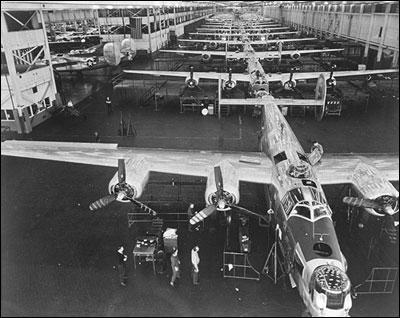
I live less than 4 miles away from the site of the historic Willow Run Bomber Plant. The factory built by Henry Ford produced the B24 Liberator Bomber during WWII
It was the embodiment of American ingenuity, perseverance and productivity. 1941 when Willow Run Airport was built by the Ford Motor Company to serve as an airfield for their B-24 Bomber Plant. This was the first aircraft manufacturing complex to use Ford’s automotive mass production technique, a leading technological innovation of the time. Ford Motor Company built 8,685 B-24 Liberators from 1942 until the end of World War II. At its peak, the Willow Run facility employed over 42,000 people and produced one B-24 every 59 minutes. When the war was over, the airport became the hub for passenger flights and air freight in the Detroit Metropolitan area
After the war the plant returned to automotive production. In 1953, after a fire on August 12 destroyed General Motors' Detroit Transmission factory in Livonia, Michigan, the Willow Run complex was first leased to GM, and eventually sold to it, with the salvaged Hydramatic transmission tooling and machinery relocated to Willow Run, and put back into production just nine weeks after the fire. Over the years, GM expanded the bomber plant by roughly half, into a nearly 5,000,000 square feet (460,000 m2) GM Powertrain factory and engineering center; a parcel of land to the south of Powertrain was set aside for assembly operations that began in 1959, including a Fisher Body plant that built bodies for the Chevrolet models assembled there, including the Corvair and Nova. In 1968, General Motors began reorganizing its body and assembly operations into the GM Assembly Division (GMAD). GMAD required 16 years to completely absorb Fisher Body's operations, and Fisher would manufacture bodies at Willow Run Assembly until the 1970s; vehicles would roll off the line there until 1992.
In addition to making automatic transmissions, Willow Run Transmission also produced the M16A1 rifle and the M39A1 20mm autocannon for the U.S. military during the Vietnam Wa. By the time General Motors entered bankruptcy in 2009, manufacturing and assembly operations at Willow Run had dwindled to almost nothing; the GM Powertrain plant closed in December 2010.
OK That is a "Brief" history of the Plant. The news from here this weekend centered around the Yankee Air Museum- On October 9, 2004, the Yankee Air Museum at Willow Run Airport suffered a terrible fire that destroyed the historic hangar housing the Museum and virtually all of the documents and artifacts.
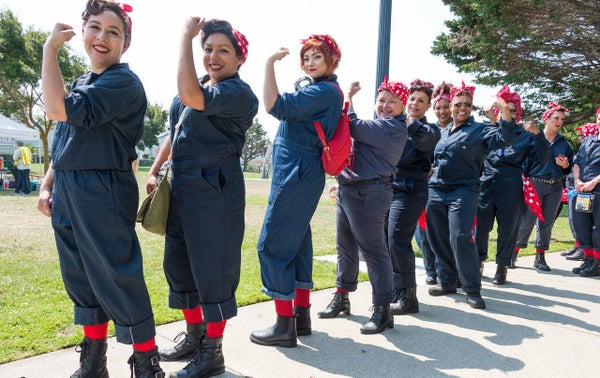
Over the last several years huge efforts have been made to rebuild a section of the Plant to re-house the remaining planes and artifacts that were not destroyed in the 2009 fire- This weekend as part of a fund raising venture-2,097 women and girls dressed as Rosie the Riveter, from 16 states, and Canada, including 44 “real Rosies” from the WWII era, came together yesterday at the WILLOW RUN BOMBER PLANT to set a NEW WORLD RECORD.
Some of the original Rosie's wait to enter the photo area.
And here is an interesting story of how the feedback loop went through a few rotations detroit, war, detroit, war, and so forth in the life of Robert Macnamara.
https://www.youtube.com/watch?v=poz_GgwabZU. The early part is relevant the rest is another subject.