Here's the tail end of a discussion of design that came from a recent discussion (see below):
I realize I am painting with a really big brush here, and design theory aside, but doesn't it come down to what looks right to you? I don't make a living doing this and I've never made anything complex and beautiful like a Philadelphia High Boy. When I make a table and get man glitter (saw dust) all over me, I don't care if the neighbor likes its look or not (I don't care for him anyway). In my simple ADD brain, it's a bit analogous to photography; you either have an eye for it or you don't. In that case (case being you don't have the eye), I suppose design, design theory, details, and all the nuances that come along with it are much more important.
Can beautiful furniture be designed and made in your head and built to the dimensions you see in your head (specific joinery details aside), or do you have to design it out using design rules and theory?
I would be interested if you moved this to 'Level 1' but I wouldn't have much if anything to contribute, please do though. I'm a woodworking hack.
Addressing your first quote first, we're all woodworking hacks by some definition, or nobody is. Now, getting back to a useful theory of design, you are spot on in asking about "what looks right to you?" For you, that is the precise thing you're trying to achieve -- not what looks right to somebody else or what some formula says you should create. Come up with you own ideas and execute them, then learn from them and move on to the next piece.
My only "Formal" design training has been from woodworking books. "Golden Rectangles and various series get mentioned as guides to designing.
I have yet to build anything that these guides/rules were of any practical value. My building is guided by form follows function. I have yet to have a need for a piece of furniture where a Golden Rectangle resulted in a practical size for a chest of drawers or a table, to take two examples.
The series I have been exposed to might lead to a trendy looking studio furniture chest of drawers but for any practical purpose the smaller drawer will become useless small or the largest drawer impractically large if the searies is used to size the assembly.
"Building what looks right" has some peril. If design has any similarity at all to other endeavors, food for example, mashed peas may be satisfying at first but as we learn more and are exposed to more, a more refined palette should develop.
I was so delighted just being able to build the first things I built their design was never given a thought (mashed peas). As I became more discriminating I more or less copied what "looked right" that others had built. Personally, I am largely stuck at this point.
My artist friend claims there is training that aids the design process. Yet when I seek her help on a particular issue she says "work on it till it looks right, You'll get it". The advise doesn't help much. She has taught me, however, that each design element should have a purpose (other than to show off) and that design elements from different design styles probably should not be mixed.
I know from turning that there are design principles that if one knows about will lead to more attractive form. The bun foot was turned by me, it didn't look right, I knew not why, I showed it to Alan Batty who took a smidgen off here and there, refined the cove and then it looked perfect. The main improvement was to match the curvature of the globe to the start of the cove above it, which leads to an asymmetrical cove. The lesson was that these kinds of transitions between coves and globes should flow smoothly, one to the other. Where as I thought symmetry was most important, I leaned it wasn't at all. There are probably others things that would be good to know, but where to learn them?
"Form follows function is a principle associated with modernist architecture and industrial design in the 20th century. The principle is that the shape of a building or object should be primarily based upon its intended function or purpose."
[Source: wikipedia.org]
I guess, without realizing it before, this is the approach I mostly take.
Using the Half Round table again as an example, the purpose of that table was to sit in a specific spot between two door openings. I then designed its shape to fit that purpose. Form followed function (or purpose) in that case. ?
That's interesting to me because I didn't even realize I had done that.
Like Bill, I mostly follow the "form follows function" formula when I design and build something. That may or may not produce a piece that's pleasant to look at. I've built some stuff that is awful to look at, even to my unsophisticated eye. I've also lucked into several pieces that are attractive; but it was pure luck.
I believe history shows us that there are basic design principles that apply to objects we humans find appealing. They probably all arise from nature at some level, the golden ratio and the chambered nautilus come to mind. Balance, composition, color, structure, all of those elements go into making an object appealing to our eye. Some people have a natural eye for it. I have a nice Nikon DSLR with many lenses, filters and related equipment. Over the years,however, I've been forced to admit that my wife takes much better photos than I do with her little Canon point-and-shoot camera. She has an eye for it; I don't.
While having a natural eye for design is wonderful, I believe it can be learned - or at least, some people can learn it. The principles have been distilled down over the years, put into text books and taught. They can be learned and applied, like the principles of cooking. For the most part, I think those that study design can produce work that is appealing on a number of levels because the principles are pretty universal. I also believe that some people are hopeless. There are people (I'm probably one of them) who can apply all the design theory the world has ever known and still come up with a pig.
The way I look at it, designed objects differ from purely artistic objects by virtue of their intended function. So, naturally, if you are building a piece for a specific space, it needs to fit into that space. But, the function of a table is to be a horizontal surface for some particular use or range of uses. That means that, in addition to its footprint (as in your example), it needs to have a considered height, size, weight-bearing capacity, and surface character; so all these considerations also affect your design decisions relating to the form of the piece.
But, in addition to form, there are a lot of other factors that enter into the design process, among them aesthetics, cost, materials, and available resources such as skills, tools, time, and other means to accomplish the task. The success of a design depends on how well you solve all these "problems' simultaneously. A lot of us don't give enough thought to some of these other factors.
Further, there are infinite levels of success you can achieve, from marginal to incredible, and there's almost never a single design that best solves the problem at hand. This opens up design to subjective interpretation, where you personally gravitate to a style that resonates with your own tastes, skills and proclivities.
Another construct that can be instructive is the notion of 'the customer.' In a sense, all art is design because there is an intended customer for the work. In the case of a pure art object, the customer might be a person or group of people or something more abstract such as an organizing principle or aesthetic, or it could be the artist himself. Objects designed with a functional intent, whether of wood or any combination of materials and componentry, all have customers, too. It might be a particular person, a jewelry box for your wife, for example. Or, it could be something like a table or chair or chest of drawers that is intended for use by you or your family and guests i your home. Or, it could be something for a actual paying customer. In that case, it is that customer's needs that are paramount, including how much they want to spend, what the specific function is, their tastes, and any other constraining factors such as the aesthetics of the place where this piece will live. (You would probably not, for example, build a sleek modern table to go in a room of 18th century furnishings, but, who knows?)
Often the customer is yourself, in which case, the sky's the limit. Spend as much time as you want, be profligate with materials to your heart's content, do it for the fun of it or for any reason that amuses or inspires you.
The upshot of this nosebleed is that design is not something to be feared. You can read all the design books you want to see what the authorities consider important. You can further educate yourself by visiting museums and galleries to see what others have done and to dissect and contemplate those pieces through the lens of your own tastes and preferences, on an emotional as well as analytical level. The more you see and read and experience, the better you will be able to make the litany of decisions that willl determine the next piece you make.
Great thread! I'm looking forward to learning a lot here!
I'll take a stab at the question of "Can you be taught good design?".
My first thought is that its probably not a coincidence that many of our best woodworkers pursued design before they became woodworkers. Sam Maloof had no formal training in woodworking, but he did study and work at industrial design before he started making furniture for his apartment. Michael Fortune studied design, but was lured to furniture making at the end of his studies. Tage Frid taught in the Rhode Island School of Design. Having said that, its equally clear that many great woodworkers are self taught in design.
I took a design class once. I thought there was a lot of bs and ego there, but that might just have been due to my thick skull. The part I got the most from was the part of each class where the professor showed dozens of slides of furniture in many different styles and the class discussed the questions of "What makes this piece work?" and "How could this piece be better?" No right and wrong answers, but often another student would point to a part of the piece that I knew I liked and help me understand why I liked it so much.
One technique that we used was rapid sketching. The idea was not to overthink something - start with a quick, rough sketch of, say a table leg, and make 20 or so variations. Then go back and pick one or two variations that interest you and develop them in the same manner.
A firm rule we had, that might not work for beginners, was to totally disregard joinery questions until you had settled on a rough design. Don't let the joinery drive the design. Though when you get down to details, you may need to make a few thoughtful changes to accommodate joinery and structural needs.
One other principle that I found useful was about working in a particular style, say Arts and Crafts or Rococo. The professor had two pieces of advice: don't think you have to use every single attribute of that style in a single piece of furniture and be very careful about mixing different styles. The idea being that if a style has thrived for a long period of time, something about that style works, so stick with it.
Sorry this is so long. Hope it was of interest to someone.
I bought a book called "500 Cabinets" thinking it would give me ideas. Wrong! With few exceptions the cabinets were art project with little to no practical purpose. The creators were making art with wood as a medium. The result was not a place to store your socks, even if the result was judged by the editor to be attractive to admire. It is well to distinguish these divergent objectives of woodworking.
Personally, I feel that the "builder in need" has limited sources for inspiration. Shaker and Arts and Crafts come to mine as sources for a place to store socks. Gallery shops are often not, nor much of the Period styles.
Your comment about your artist friend got me thinking. My daughter is an artist and teaches at the college level in DC. She basically teaches studio courses, painting drawing etc. Occasionally, she teaches "Design" as a component in her courses, but she readily admits that design, or at least academic design, is not her forte. I think she is a person who relies on her natural gift for design; she doesn't have to break a piece down into it's formal elements to manipulate it. I've never asked her to do it, but my guess is that she would have a difficult time explaining why something works or doesn't work in academic design terms, but she can fix it if it doesn't work. Maybe "have a difficult time" is overly harsh. Perhaps I should say that she just doesn't approach her work using those terms.
In any event, My guess is that your artist friend is the same sort of person. She instinctively feels what works and what doesn't, and she assumes you (and everybody else) can do the same - "Just work on it until you get it right. You'll know it when you do." Same with your turning buddy. They don't think of their work in academic design terms. Nevertheless, they have an eye for good design and can produce appealing work. The rest of us klutzes may stumble onto something that looks nice, but it's not intuitive for us.
I do believe, however, that familiarity with the academic principles can help some people. As I said below, I think prople trained in the academics of design can put the principles to work and their end product will come out looking nice. But I believe there has to be some natural ability in there somewhere for the pieces to come together. Some of us are hopeless and no amount of formal training is going to help.
I am gaining confidence that I can judge whether something looks good. However, if I am going to spend months building something I would like some assurance at the start that it will look good in the end.
Second problem, if you are stuck, as I was with the bun foot, knowing it doesn't look right is of no practical use without knowing how to fix it.
Which brings up the question........how does a woodworker learn design? Indeed, I suspect some elements of it can be taught. But where and by whom? We have classes to attend on how to cut dovetails but where to look for how to use them to make a place to store socks?
Comment: "don't think you have to use every single attribute of that style in a single piece of furniture and be very careful about mixing different styles" These were almost the exact words from my artist friend. Must be something to this principle. It was the guidance she advocated to strip the extraneous, show off and mis-matched elements from the desk that inspired me.
Question_ Where is furniture design taught? Is there any place accessible to the amateur?
Two things stand out for me in your reply, Jesse. One is the notion about studying design as a path to furnituremaking. You can add to your list Yeung Chan, who is among the most formidable craftsmen I've ever had the pleasure of knowing. Closer to home, have a look at some of Tommy Skaggs' furniture. As I recall, he had a graphics background, and he brings a lot of that sensibility to his pieces. He has also found a way to marry function beautifully with his radically different aesthetics, which sets his work apart from "art" pieces that could care less about function.
The other thing that jumped out at me was the notion of the quick sketch. All the designers I respect uncover their final designs through sketching and refining and playing with ideas. Rarely if ever do fully realized designs spring spontaneously onto a drawing board. You (speaking for myself) need this refining process to poke at your ideas and consider them in light of all the other concerns, including joinery and the construction process, that I mentioned in my earlier post. Learning to sketch in perspective is also an extremely valuable tool when presenting and developing ideas for a customer; most customers can't visualize what a two-dimensional plan or elevation drawing is telling them, but they instantly visualize a perspective sketch.
An extension of the sketching advice is a suggestion to make mockups, either full scale or some smaller scale. This gives you the ability to "walk around" the piece and view it from different elevations and viewpoints. Even if you don't have a command of notions such as form and visual weight and positive and negative space, you will often grok these concepts instinctively when viewing a mockup, whether or not you can articulate them in sophisticated design terminology, so you can make changes accordingly.
I bought a book called "500 Cabinets" thinking it would give me ideas. Wrong! With few exceptions the cabinets were art project with little to no practical purpose. The creators were making art with wood as a medium. The result was not a place to store your socks, even if the result was judged by the editor to be attractive to admire. It is well to distinguish these divergent objectives of woodworking.
I will agree that an idea book on cabinets should self-identify as either an art book or a guide to functional furniture.
Personally, I feel that the "builder in need" has limited sources for inspiration. Shaker and Arts and Crafts come to mine as sources for a place to store socks. Gallery shops are often not, nor much of the Period styles.
Here's where I respectfully disagree. Shaker and Arts & Crafts styles may come to your mind, but there are many, many other styles and forms of functional furniture out there, and it is possible to solve the design problem in an infinite number of ways, none of which need owe a thing to some established style. To be a successful design, it must solve the functional requirement for sure, but the rest of the design can reflect any other set of conditions or aesthetics that the designer and/or the customer impose on the problem. It all comes down to the customer.
I am gaining confidence that I can judge whether something looks good. However, if I am going to spend months building something I would like some assurance at the start that it will look good in the end.
If you really trust your judgment as you say, that should be assurance enough. If you need more assurance, you probably need to develop your sketching skills and make mockups, so you can really see what the piece will look like in the end.
Second problem, if you are stuck, as I was with the bun foot, knowing it doesn't look right is of no practical use without knowing how to fix it.
Practical use and value are not mutually exclusive. It is valuable to have a good eye that can discern when something doesn't look right. To turn this into a game plan for fixing it, you might want to look at some successful examples of the detail that doesn't seem right to you. It should be easy enough to see how they differ.
Which brings up the question........how does a woodworker learn design? Indeed, I suspect some elements of it can be taught. But where and by whom? We have classes to attend on how to cut dovetails but where to look for how to use them to make a place to store socks?
Design is a process that can be learned by trial and error, though none of us are designing in a vacuum. We all have tastes that we've developed in the course of our lives that form our basis for making aesthetic decisions. You like Shaker and A&C furniture. What is it about these styles that is appealing to you? Take those concepts and apply them to the next design problem.
As to where woodworkers can learn design, when I was the editor of American Woodworker magazine, we conducted a lot of reader and subscriber surveys to learn about our readers' demographics, training, abilities and tastes. One thing that jumped out at me was the fact that Shaker and Arts & Crafts styles were the top two historical styles that appealed to our readers. (And that Norm Abram was far and away the most influential woodworker in terms of recognizability and influence on woodworking methods.
My hunch about what makes those two styles most appealing is that they are the easiest to make, which jibes with your earlier statement about getting rid of extraneous ornament and complexity. After all, we're not building Faberge eggs, we're building sock drawers. Both these styles were designed to be the way they are. The Shakers consciously eschewed ornament and ostentation. Stickley wanted to design a furniture (and architectural style) that was simple enough for Everyman to make with limited tools and skills. Bob Lang can speak more eloquently to the Arts & Crafts motivations, which went back to Ruskin and Macintosh and the rebellion against the Industrial Revolution and particularly the gratuitously ornate Victorian junk of the late 1800s.
Another thing our surveys pointed out is that the vast majority of woodworkers say they get their woodworking information almost exclusively from books and particularly magazines. The trouble with magazines, as Toshio Odate once told me, is that they are like orphans, like a child without a parent, in the sense that there is no cultural continuity to their instruction. Over the course of a year, you might see six different articles on essentially the same topic, written from different perspectives. It is up to the reader to figure out which one rings true to them. This is starkly different from, say, the Japanese or Eastern European apprenticeship system (think Toshio Odate and Frank Klausz), where everything is self-contained, from the aesthetic to the tools to the methodology. Only one right way of doing things.
You can still get good practical design information from the likes of George Walker, who writes for Popular Woodworking. He uses classical design information to illustrate furniture-relevant concepts like form and line and proportion. In the end though, I like the approach of knowing what you like and figuring out how to pose a design problem and solve it yourself. The ultimate resource is inside yourself. IMHO
I agree with Ellis on every point, especially his conclusion that the answer is "within yourself." I don't think you're going to find a discipline that will pre flight your design and tell you if it will be successful before you spend several months building it. If there were such a discipline, it would remove the risk inherent in any creative endeavor and we would have far fewer starving artists. I do, however, believe that a familiarity with basic design principles gives one a general sense that something is good or not. Moreover, that familiarity will let you know when you're "breaking the rules, " which is not necessarily a bad thing. Remember when your English teacher used to tell you that it's OK to break the rules occasionally, but you needed to learn the rules first so you''ll know when you are breaking them? I think the same applies here.
Having said all of that, George Walker, whom Ellis mentioned, has a blog called "Design Matters" (link below). It's an interesting blog and I recommend it if you're not already familiar with it. Moreover, he is teaching workshops on furniture design this year, the dates and locations of which are in his blog. They might be helpful in your quest.
George Walker' blog "Design Matters" comes with a WARNING. I thought it might be instructive to reprint it here. I hope George doesn't mind.
Warning
Reading this blog and my column “Design Matters” may pose some health risks. Continued exposure to the content in this blog may result in serious side effects should you venture into a “Big Box” furniture store. Side effects may vary but may include: nausea, dizziness, diarrhea, and in severe cases convulsions. Even in cases of mild reactions it is known to cause embarrassing and uncontrolled verbal outbursts which may cause you to be escorted from the premises. Side effects are temporary and usually disappear shortly after leaving the store. Prolonged exposure to mass-produced ugly furniture may even result in death, though ongoing studies are still not conclusive.
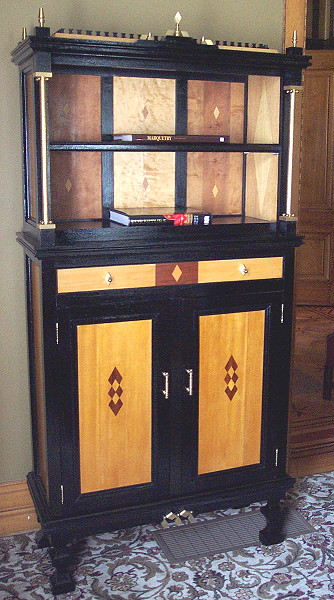
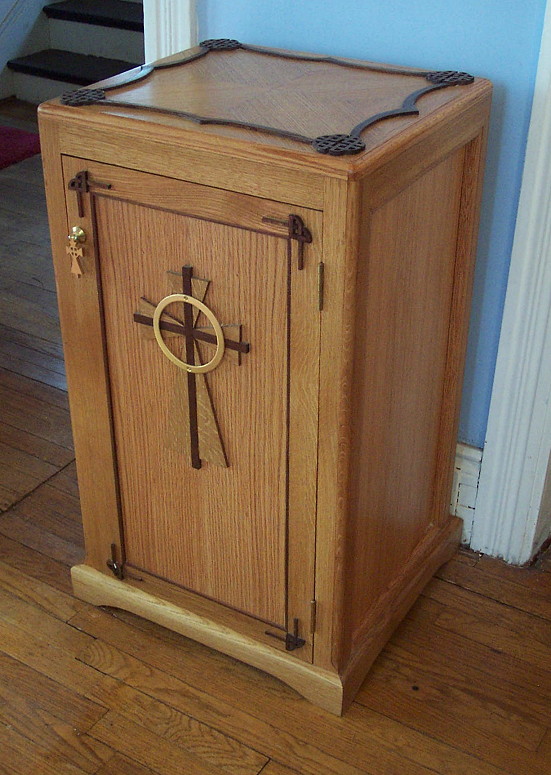
This is an Example of design Evolution. I built this piece for Me Myself and I-Lots a stuff going on here: Brass,veneer,inlay, Mansard Roof....I made it cause I wanted it. Interesting no one has commissioned a repeat
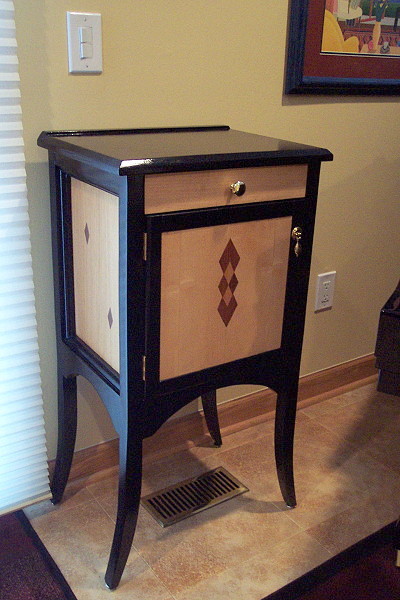
well not totally- a piano teacher friend liked a lot of the elements in the large bookcase but "needed" a small cabinet to hold sheet music-After a few drawings (which I did not take the time to find) we ended up with this:
The little diamonds on the side worked their way into the design when I knocked the whole cabinet over during construction and put a huge gouge in the side- The client was forgiving and went with my idea of a couple "free radical" diamonds which I inlaid in the places where it was dinged.
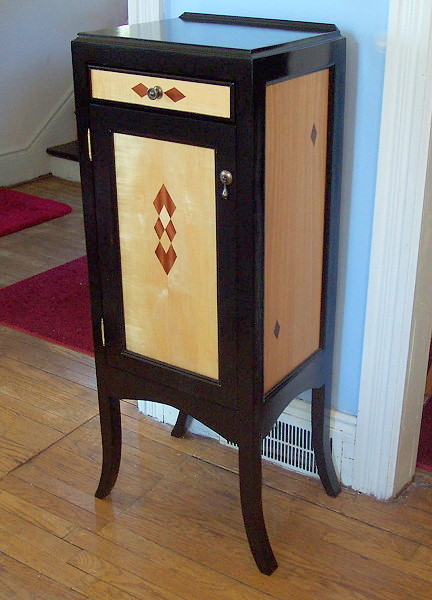
Another music teacher saw pics of this and wanted one too-only with more shelves-So we stretched it: The diamonds were now a "design feature" The top was changed to give a little more elegance to the piece
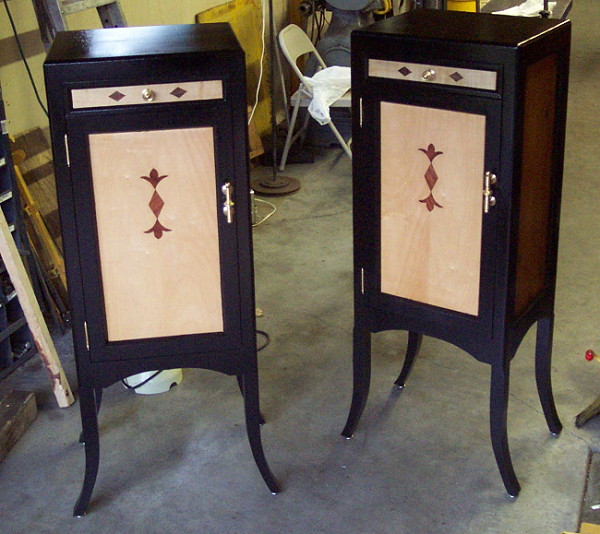
A buddy from college days has 4 musically inclined daughters-He started commissioning these as they approach graduation: A slight modification to the inlay design and I made the door handles- in retrospect the handles are pretty clunky and I don't think add much to the piece(s)
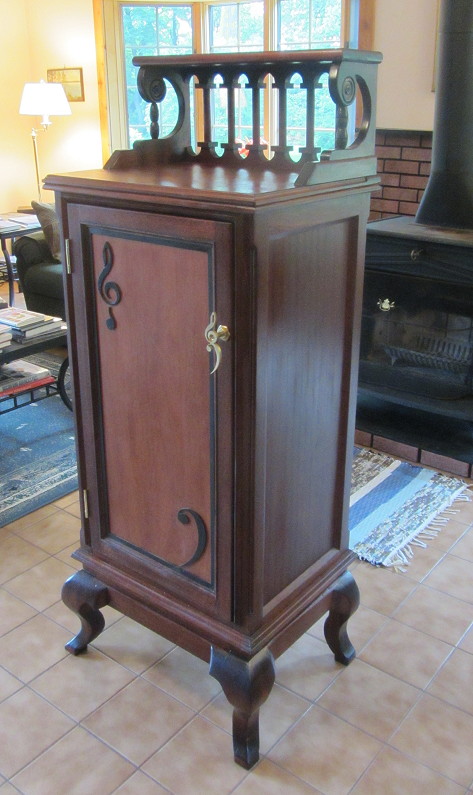
From there a friend wanted a cabinet with "Celtic features" to "Hold a telephone"-it was for her mom-still using a large land-line phone- This emerged from the music cabinet drawings
College buddy's no 3 daughter was next- He said make what ever you want just so it will hold sheet music- So with total artistic license- This is where I went: Including a new hand made brass door pull in the form of a G/F cleff
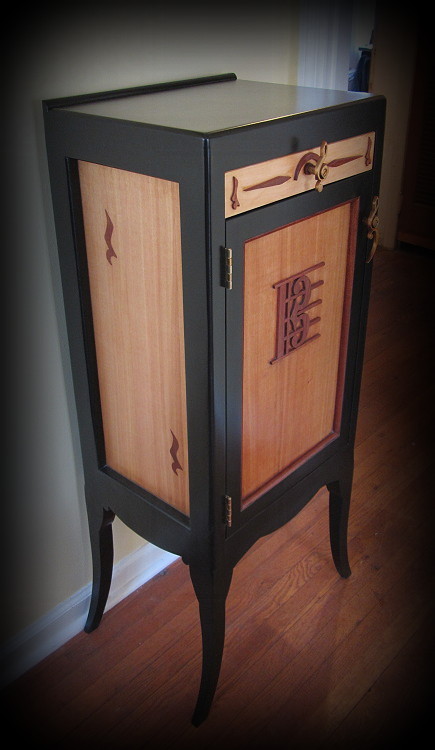
Then two more clients wanted sheet music cabinets-This one wanted a "C-Cleff" on the front- "quarter rest" inlays replaced the diamonds on the side and drawer front. The G/F cleff door pulls continued on:
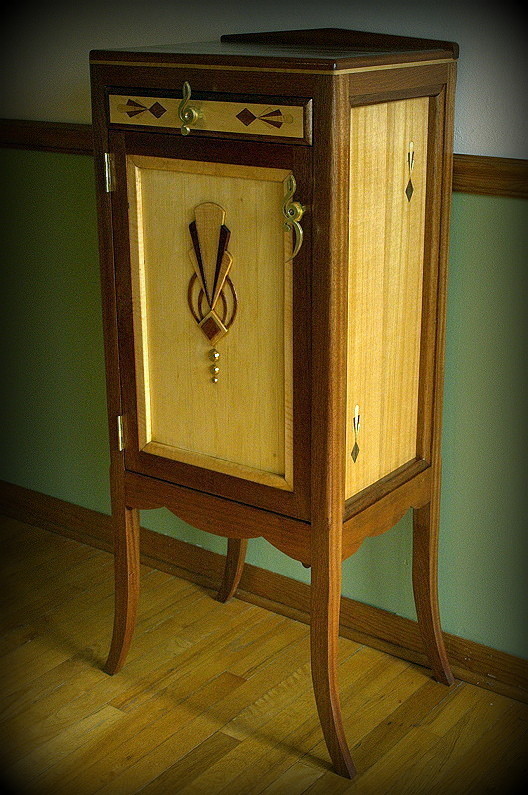
And this client had a guitar with inlaid Art Deco designs. I used those to influence the look of this one-keeping the Brass G/F Cleff door/drawer pulls
On these last two I added a scalloped apron and subtle tapering in the legs. This made the legs somewhat more delicate-
The point in these examples is to show how My original design was never fully reproduced-the reasons probably being the large bookcase has -I Think- nice proportions and pretty good execution-but overall too much going on for most spaces. Yet enough of it's "language" spoke to a client with specific logistical needs- Those needs were fairly consistent with several diverse clients-each getting a say in the look and feel of how the design would get recreated. My construction techniques and drawing templates are ready for the next iteration...
I've been a woodworker and artist all my life. I got my first handsaw when I was 5 years old, and I've attended art school, so I'll throw in my $.02.
There is a difference between talent and skill. Some people are born with a talent for design or throwing a football or writing code. But talent without skill never reaches it's full potential. Even if you weren't born with a talent, you can still develop skill. Design skill, like woodworking skill, comes from hours and hours of doing it.
A woodworker can develop design skill without even being in the shop or at the drawing board. Design is about learning how to look, and you can do that all day long. Next time you are stopped at a red light, look at the buildings around you, or the car beside you, or an unusual shaped tree. What do you like about it? What do you not like about it? How would you do it differently?
We can have emotional responses to design (I like it or I don't,) but without the intellectual skills to examine our emotions, it's hard to know what changes to make. There's where design education comes in. There isn't a plethora of furniture design programs in the land, but almost every college, even community colleges, have art department with classes in the fundamentals of design.
The basic elements of design - line, shape, space, texture, and color - are the same for a chair as they are for a sculpture, even though they have different functions. Learning about these elements and how they relate to each other and how to organize them is a life long journey. You learned from Alan Batty that symmetry and balance are not the same things. Don't let a single minded focus on furniture keep an art teacher from helping you from learn other very important things about design, which will make you a better furniture designer.
Finally, a soap box diatribe: Formulas and ratios are not design tools. They explain why some designs have wide appeal, not why everything should be designed to fit those parameters. A dining table designed with the Golden Mean ratio probably won't look good or serve very well as a dining table. A window shape that most people find appealing might might coincidentally fit the Golden Mean.
Unfortunately my art consultant lives 750 miles away and I only see her once a year for a "lesson". But these brief lessons confirm your point and they have been a great help in understanding what is right and not so right about furniture pictures I have shown her. Fortunately she admires/collects a particular style of Arts and Crafts furniture so we have some connection to wood and I have been able to help her in getting some things made.
Given my engineering mind I would likely have to choose carefully a design teacher. Given where I live I don't see much possibility for any formal training. I have thought about sketching, something I can't do without the aid of a drawing board and tee square. Serves me well for orthogonal furniture and not so well for a gracefully curved leg. There is some possibility of getting some sketching training locally.
Just a thought, is there a furniture maker near by whose work you admire? Maybe someone in Berea or Asheville. If so, why not approach him/her about some informal tutoring on design, e.g., I will bring sketches and you comment on them, maybe talk with me about your own design principles. Negotiate an hourly rate. Schedule at mutual convenience. Might get a taker or two and its low risk.
Asheville is near by and there are some excellent woodworkers gravitating there. Yet to see work I admire in Berea except for the chair person (not Boggs) but he is not an exceptional design person.
Design is one of those areas where it's a mix of art and science with a very fuzzy boundary between the two. The science part can be expressed in numbers and ratios, and there are a number of sources. Most sources (including my own) are more technical than "arty" because to get the artistic side of the skill, there really isn't any substitute for investing the time to develop a "good eye".
From what I've seen of your work here, here doing a good job of that. I encourage you to keep looking, questioning and discussing these things the way you do.
If you look at as many pieces of furniture as you can, the appealing parts will eventually rub off on you. You can speed that process up if you compare this to that and ask yourself "what works in piece A, compared to piece B, C, and D. Find some other people who like furniture and compare your impressions to theirs. You won't come up with any magic formulas, but you'll get to a point where you intuitively know what you're doing.
The other thing to do is to sketch, sketch and sketch some more. It doesn't matter if you aren't any good at it in the beginning. Your sketches only need to make sense to you. When I was in design school, they made us produce 10 thumbnail sketches of any idea before we could move on to develop a design. I hated this and thought it was stupid, but looking back it's the most valuable thing I learned. Start with your initial idea and get a small version of it on paper as quick as you can. Add as many alternatives as you can think of, including ones you know you won't like. "I can't draw" is not an acceptable excuse, the exercise will either prove your first idea worthy, or lead you to something better.
The tricky part of design is identifying what parts are art and what parts are science, and not applying a scientific solution to an artistic problem, or vice versa.