Home Articles Forums Gallery Marketplace Videos

WoodCentral Forums

Knowledge You Can Build On — Est. 1998

Urban Salvaged Hardwood Slabs, Milled In-House from Rare Trees. Shop Unique Walnut Stock.

Biscuit question

Posts

Biscuit question

#1

Biscuit question

james runchey

I haven't used biscuits as yet, but my son gave me his joiner, so I thought it a try on a project. I'm making some pull-out slides for our kitchen cabinets out of some half inch ash I have on hand. Will biscuits work in material that thin?

Re: Biscuit question

#2

JL

Re: Biscuit question

JL

I don't know if I would try it. Biscuits swell a bit when you hit them with glue.

Figure that you are going to have a bit less that 1/4" on each side (say 3/16"). I would worry about the biscuits swelling and showing up on the surface of the ash.

But if you want to try a test piece - go for it.

Re: Biscuit question

#3

for edge gluing?

Bill Tindall, E.Tn.

If so don't use them. They provide no benefit.

Re: Biscuit question

#4

Re: Biscuit question

Dick Coers

I've used thousands of biscuits since they came out. I've never seen the swelling problem that many mention. BUT, I never use a tight fitting biscuit. I dry fit them, and if I can't slide it in by hand, I tap them with a hammer to compress the fibers. I've always thought that if it was too tight, it would wipe off too much glue and make a dry joint. For thin stock, you may need to add a shim to your machine to center the slot. But as Bill said, you sure won't add any strength to the joint.

Re: Biscuit question

#5

Re: Biscuit question

mdclor

I have read that if you let the glue dry for a reasonable period, the wood will shrink back to its original thickness (1/2" in this case). You would be able to tell when it has done that by checking with calipers. Then sand and you should be okay and not end up with the depressions JL mentioned.

I have never done this, so, again, as JL mentioned, try it on some test stock. I have used biscuits on 1/2"plywood without problems and without waiting, but maybe I have been lucky. FWIW

Re: Biscuit question

#6

Re: Biscuit question

Tony - Memphis

I think the short answer to your question is yes. I have used them for 1/2" material before. Be careful of your alignment. I attach the jointer to a board and attach a spacer to raise the workpiece.

You weren't asking about biscuits in general... I have a DeWalt. I am not a big fan of biscuits though. They are more troubel thatn they are worth in most situations. However, there are times when they are great. The vertical alignment is not "perfect." So, don't count on them for that (IMHO). Also, watch your hands when using on narrow stock - they bite! As other said, mess aorund with it and get used to it and see if you like it or if you really think you need it for this project. If it is solid wood, I would skip the biscuits.

Tony

Re: Biscuit question

#7

Re: Biscuit question

Walt

I think this is where people get the depressions with biscuits. Cut the slots, put as much glue as will fit and clamp 'em up. The wood where the slots were cut swells due to the water based glue. Wait a couple hours - or over night, remove the clamps and sand. The wood over the biscuits still hasn't lost all the water from the glue so it's still a little swollen. I wouldn't be surprised if the wood around a biscuit slot would swell more than an edge joint because there's glue on either side of the biscuit. Sand everything smooth then the moist wood over the biscuit dries and shrinks and there's your depression. Having said that, biscuits were invented primarily for use in sheets goods according to what I've read. It sure seems like they'd strengthen butted joints in plywood, particle board, MDF and the like.

Re: Biscuit question

#8

Re: Biscuit question

Barry Irby

I agree with all of the above. I got my joiner years ago and used it like a mad man for a while until I realized they were not contributing much to the project. I very seldom use any now.

If I am making a large complicated glue up I sometimes put some in to help with alignment until I can get the clamps on. Most of the time I don't bother to glue the biscuits themselves. Then there is no concern about them swelling.

Re: Biscuit question

#9

Any Place

Mark Mandell - Gone Round In New Jersey

you can use a biscuit, you can use a spline which will be better, stronger, and won't swell(much).

Re: Biscuit question

#10

Question

Bill Tindall, E.Tn.

What are some applications where you find them useful?

Re: Biscuit question

#11

Re: Question

Barry Irby

I have used them in assembling cabinets made out of particle board and MDF. These were painted cabinets made without the benefit of a shop. Most cuts made with skilsaw and router in the field. Again, mostly for alignment. The biscuits minimized the number of air driven pins and nails.

I used them for attaching the face frames to cabinets. They make aligning the parts easy and fast. In some cases I used Kreg pocket screws and glue to permanently attach the faces. I don't like the appearance of the pockets, so I hide them if I can.

And I have used them as splines in miters like picture frames. They work well, seem to add strength, don't show and make assembly easier.

If I am assembling a table top by myself I might put one at each end and one near the middle. It seems to give me a little more confidence in getting the top together quickly. If my pieces lay up very nicely by themselves, I don't bother. I am nearly positive they add nothing to the strength of long grain edge to edge glue ups.

I like splines and or "feathers" in the corners of miter boxes.

One thing I like about them better than any screws, nails or any other metal fastener is if you forget where you put them, they don't ruin saw blades. Those Kreg screws will. DAMHIKT

Re: Biscuit question

#12

Re: Question

William Duffield

I've used them, along with drywall screws, for building kitchen cabinet carcasses in lumber core plywood. The only clamping needed with this technique is a clamp or two across a diagonal to make sure the box comes out square.

I've also used them for "frame and panel" with mitered corners and glued in veneered plywood panels. I've been pleasantly surprised how long these panels have held up without warping or gaps opening up in the miters.

There's nothing biscuits will do that a Festool Domino won't do quicker, more precisely and a lot stronger. I no longer own a biscuit joiner.

Re: Biscuit question

#13

Re: Any Place

Dick Coers

How is a spline stronger than a biscuit? How much stronger? I'll admit a floating tenon is stronger, but a spline?

Re: Biscuit question

#14

Lots a plywood case work

Dick Coers

I did a lot of plywood case work when I operated a custom woodworking business. Used for case joinery, and if a face frame was called for, attaching that to the plywood. We did several runs of short little shelving units for day cares. Prefinished them. I ran a strip of tape over the row of slots, then stained and clear coated. Pulled the tape, then glued up and clamped. As Barry mention, picture frame meters. I always appreciated the slight side shifting for alignment. Personally, I don't see any speed advantage to Dominoes.

Re: Biscuit question

#15

Splines

Mark Mandell - Gone Round In New Jersey

when properly used, place solid grain oriented across the glue joint making a very strong joint and increasing the glue surface. Biscuits are basically compressed flake-board that will fracture with longitudinal stress on the joint.

Splines don't swell and telegraph their presence into the upper and lower surfaces of the joined pieces as will biscuits (especially in sheet goods).

I use biscuits when joining stock that's at least 6/4 thick as they are a quick way to get good registration for the top surface

Re: Biscuit question

#16

Re: Question

don stephan

Installing a 3" wide rail between drawers in melamine cabinets. Haven't made any in decades, but biscuits worked extremely well for this as no glue would adhere to the melamine.

Re: Biscuit question

#17

Re: Splines

Dick Coers

The Lamello, Porter cable, and even Wolfcraft from Menards , that I have used, are compressed solid wood and the grain is oriented at a 45 degree angle to the joint. The Lamello ones I've always used are beech. What brand are you using? Lamello may still sell a fibre biscuit, but most are solid wood.

Re: Biscuit question

#18

Re: Question

AZ in Colorado Springs

I recently glued up a top for a French (Roubo) workbench (26" wide). I did not have parallel jaw clamps and the 7' long boards wanted to slide a bit. The biscuits kept the individual boards much more closely aligned. I have access to an 8" jointer and a 20" planer. I was able to do some surfacing of the sub-assemblies, but a little shift over 7' can mean wasting away a bunch of stock. And for the final glue up, where the assembly was too wide for the jointer, I wanted as little hand flattening as possible.

I've also used biscuits for simple shelving units, where the support pieces are inset from the ends. The biscuits are great for keeping things in alignment as the clamps are applied and tightened (wood glue is a great lubricant at first ... ), and it's really easy, using a biscuit joiner to get the same offset at each end, using the same setting of the fence. (I also use dowels for the alignment bit as clamps are applied, but the fence on the biscuit joiner is great for repeating the offset without a lot of measuring and marking.)

Re: Biscuit question

#20

So where did you get flake board biscuits?

Dick Coers

Porter Cable biscuits are made from compressed beech. If you look around the compression marks, you see the ray fleck of solid beech wood, and a definite grain direction that crosses the biscuit at approximately 45 degrees. The only way I have broken them is to bend them while holding the ends. A failure mode that can not be duplicated once placed in a slot.

Re: Biscuit question

#21

Re: Biscuit question

Sgian Dubh

"I've used thousands of biscuits since they came out. I've never seen the swelling problem that many mention." Dick, the swelling does occur, it's real, but there are techniques for preventing the swelling showing up in finished panel, particularly where the panel is a horizontal surface, such as a table or cabinet top. However, this is not a characteristic unique to biscuit joints used for alignment in edge joinery. A similar effect can be found in plain edge jointed panels, as well as in panels assembled with a spline, dowels, etc used as alignment aids.

Here are a couple of descriptions to mull over. Let's say a panel is assembled at 9 am using a water based adhesive: any of the methods just mentioned might have been used. Let's say, as a follow up, that said panel is removed from the clamps at about lunchtime the same day and prepped for polishing, and then polished. In other words, the whole job has taken less than about 12 hours from glue-up to polished: I've seen it done, so don't assume this is unheard of. The following visible results are likely.

1. Biscuits: a furrow along every glue line and elliptical depressions spanning across the glue line revealing the position of every biscuit.

2. Basic butted edge joint: a furrow visible along the glue line.

3. Spline reinforced joint. a wider furrow than 2 above along the length of the glue line.

4. Dowels: a furrow as all the above, but with additional cross grain dips indicating the position of the dowels.

Note: the likelihood of each of these possible end results varies from job to job, i.e., it's unpredictable.

Now, as to the cause of all these results? The only common factors are:

1. Water based glue, e.g., PVA, aliphatic resin, hide glue, urea formaldehyde, etc.

2. Haste. Too little time allowed between assembly and polishing.

The solution to eliminate all the faults described is simple, i.e., time. The water in the adhesive causes swelling of the wood locally where it was applied. Time will allow the added moisture to dissipate from the wood causing it to shrink again. After the wood has shrunk it can be worked, prepped and polished with little chance of the faults described showing up later.

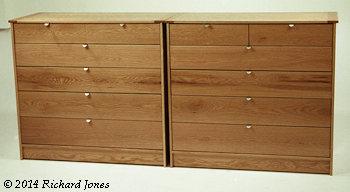
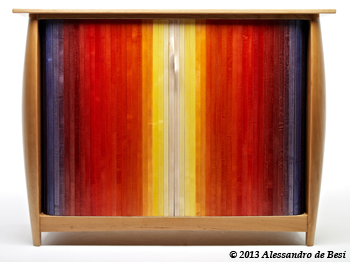
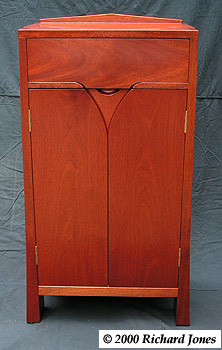
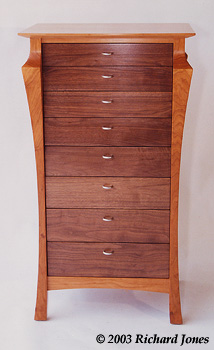
As to the strength of biscuit joints, they're pretty tough. I've used them fairly frequently for assembling some, or all horizontal panels to vertical sides in cabinets, as in the following examples, none of which have shown any sign of failure. I don't use biscuits very often in panel glue-ups, but that's simply because there's usually no need for them if the joint preparation is good in the first place. In fact, I find that biscuits, or any other "alignment" or "strength" aids used in this context help very little in making up for deficient edge preparation. In other words, if the edges aren't well aligned in the first place, they'll almost certainly fail, whatever method of assembly is used. Slainte.
Re: Biscuit question

#22

Re: Splines

William Duffield

Biscuits are designed to only swell enough to fit the thickness of the slot, creating a snug fit, but not pushing the stock apart. They are compressed to allow for easier assembly and to make it easier to get good overall glue coverage. The only swelling that happens to the stock is due to the moisture in the glue and is temporary. If you wait until the excess moisture has evaporated and the stock has returned to equilibrium size before doing any sanding, then you should't get any print through (biscuit shaped depressions in the surface).

Re: Biscuit question

#23

Re: Biscuit question

David Yoho

Will biscuits work in material that thin?

Sure they will but like others have said they won't add any strength to the edge joined work. I never get the problem associated with biscuits showing through the wood because I don't glue them. If and when I do use them it's most always for alignment. When applying glue to edge glue ups I do not put any in the slots or the biscuit. So they go in dry and haven't caused an issue like so many have reported.

Re: Biscuit question

#24

From Whence They Came

Mark Mandell - Gone Round In New Jersey

Got them when I bought the joiner. They can be peeled easily with a fingernail and the edges are quite porous like the edges of OSB.

Re: Biscuit question

#25

I don't disagree that it happens

Dick Coers

But just not for me. I understood the conditions, and compensated for it.