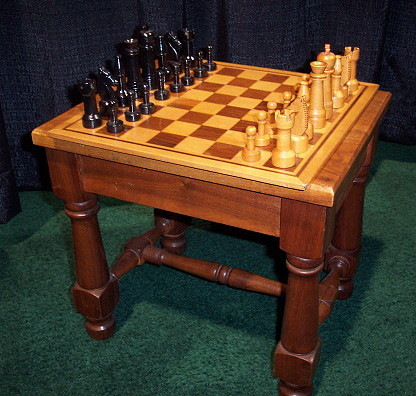
I am planning a Chess Ensemble- Pieces, Board and Table.The board squares will be made from Walnut and Maple and sized at least 1.75" Square-maybe 2". There will be mitered framing around the board.
I've made several boards in the past but all have been veneers over a substrate. I am considering solid wood board and am wondering how thin the squares need to be or what's the maximum thickness I can use before movement issues set in if the "solidwood" board is constrained by Mitered Framing.....
A chess board I made in college has 2"X2"X3/4" squares glued to a plywood substrate for the middle squares and 2"X2"X2" cubes around the perimeter. The squares are cross grain alternating direction for the walnut and ash squares. It's glued only.
There are hairline fissures that have developed at some joints over the past 40 years but you have to get really close to see them and the board is as solid as the day it was finished.
It has no frame so I can't say if the whole board tends to change size by the season.
Both the outer and inner mitered frames will be problematic as the miters will open and close with changes in the relative humidity.
If you plan to use solid wood squares, they too will be a problem. As they expand and contract, they will push the sides of the frame out of position. The field will also tend to open and close.
All in all, there is a reason that most chess board fields are made with veneers. If veneers are what you have used in the past I suggest you do the same again.
Many years ago I made two chess boards. I glued strips of maple and walnut together and the cross cut the stripes and flipped every other one And glued them back together. I a flash of brilliance (not) I resawed the strips of squares, making two chess board out of what would have been one. I laminated the now thinner pieces onto 1/2" birch plywood. The assembly was just over 3/4" so the pieces must have been about a 1/4. Both the maple and walnut were air dried and I thought at equilibrium. Probably used Elmer's glue. Within a day or two, the pieces shrank pulling the plywood into an arch or perhaps a trough. The outer edges were up about a half inch. If a Chess board is a battlefield, the kings had the high ground.
I also carved a chess set, but its not my long suit. The Knights looked more like German Shepards.
I was looking a chessboard made by my grandfather. He made this board in the 1960's (67-68?)
The wood is maple and walnut and is aprox 3/16 thick. Hard to see in the picture bu the squares are about a 1 1/4 square. The boarders are mitered and they have never split/come apart. I did take this to school for show and tell. The teacher placed the board on a radiator- When I went to get it at the end of the day the board had a major warp/twist to it. We left it alone and it flattened out perfectly but did develop a crack-down the center of the board. The miters/corners/edges have never come undone. So I have been trying to understand what if anything might be doable with solid material.
I made a chess board from solid wood using this plan from Rockler: http://www.rockler.com/classic-chessboard-plan. It uses dowels and spaces between the squares to solve the movement issue. Although it hasn't had 50 years to "cure", I think it has a very good chance of lasting that long without problems.
His board design has been imitated by a couple generations of woodworkers. In fact, Woodworker's Journal published an article detailing how to make it.
If you would prefer tight joints, I suggest resawing your own veneer to about 1/10" and laying it up on plywood, with a backing veneer on the underside. The mitered frame in your drawing appears to be wide enough to cause issues with seasonal movement. Your grandfather's board had much narrower miters, so the movement wasn't noticeable.
Alan, there was an article several years ago in Woodsmith, I believe, which uses the method of first glueing alternate dark and white strips of the width of the squares you want. The thickness as I remember was 5/8 inch. The width of the outside strips was about 3/8 wider than the center strips. Also the length of the strips was the width of eight squares plus 3/4 inch. As previously mentioned, the strips are crosscut, reverse every other one and re-glue the strips back together. The excess width and length are used to make a tongue all around the board which goes into a slot cut in the framing pieces. The tongue is free to move in the slot, and about a 1/16 reveal is allowed all around the board. The board can be held in place with a spot of glue or a small dowel. I have made several boards this way, and never had a problem with expansion or separation. Woods used were walnut and maple. I did a fast look for the magazine article, but couldn't find it at first look. I know I have it because I lent it to a buddy not long ago. If you're interested, I probably can find it and run you a copy.
the good Colonel when we need him?! He made a chess set for each of his many offspring and would surely have a good answer for you. I'll bet if you Check, a search will find many of the pics he posted of those sets. Perhaps one will help answer your questions, Mate.
Krenov's dowel assembly ingeniously deals with the problem of wood movement, but the problem of sawing all those dowels to length and drilling all those holes without chipout and the even more annoying problem of dealing with inconsistent diameter and shape of dowel stock would make me very reluctant to try it. However, there is a recent technological solution to those problems. The 4 mm. Festool Dominos solve all the problems with dowels. A different jig for holding the small pieces would need to be devised, but the new Bessey and Kreg self-adjusting toggle clamps and the Woodworker's Journal plans make that issue close to trivial.
The Domino advantages include:
- No chip-out when drilling the mortises;
- No dust collection issues. (You don't need an air gun in one hand to keep the drilling jig clear and working accurately);
- the precise size and length of pre-manufactured Festool tenons makes assembly easy and accurate;
- no glue needed for assembly;
- tenons are inexpensive. ~$5 for the 112 tenons required for the internal joinery of an 8x8 board. Ref. Festool item 495661.
A solution was alluded to, a link provided to a magazine I don't have, Mr Duffield provided an alternative, but I didn't understand the overall strategy. I am missing how one makes a chess board with dowels, or dominoes .
The problem with reporting what works is that what the board has endured is often lacking in the report. For years I have kept a very wide piece of various woods and followed their width seasonally. They don't vary as much as +/- 1/32". But then my shop doesn't vary more than +/- 15% RH, more common +/- 10% RH.
I have taken to moving chest of drawers to the garage for a couple of weeks before delivery. It is not uncommon to have to adjust a drawer after exposure to high humidity. They might fall apart in AZ; I don't have a way of testing. Ditto chess boards.
What you missed in Ellis's post is that the link provides the whole article on-line, so you don't have to have a copy of the magazine.
The Krenov "solution" is to allow each block of the chessboard to float individually and move with the seasons by drilling a hole for a dowel (Krenov loved dowel construction) centered in each of the four edges of each block. Each block is then connected to each adjacent block, longitudinally and latitudinally, with a dowel Thus, you can arrange all your blocks for figure, and not worry about cross-grain or end-grain gluing problems. Dominoes do the same thing, with the minor process improvements I've noted. Again, it's not a compelling reason for spending the money to buy a Domino machine, but the advantages can add up, if you use your imagination (and maybe a spreadsheet). If you are only planning to build one or two chessboards, then a couple sheets of veneer, an X-acto knife, straight edge, some MDF for substrate and cauls, and some concrete blocks may be a better choice.
a solution that the Woodsmith mag suggested years ago was to space each tile by the thickness of a piece of paper. It's barely enough to be noticeable but yet provides enough space so that the effect of wood movement is negated. I made a chessboard for my son 5-6 years ago using this method, and there have been no probelms at all even though he lives in ND where the humidity swings are pretty substantial.
I copied Krenov's chess table about 10 years ago. His construction methods are described and illustrated in "The Impractical Cabinetmaker". Assembly was easy and the top has been stable.