Home Articles Forums Gallery Marketplace Videos

WoodCentral Forums

Knowledge You Can Build On — Est. 1998

100+ Wood Species + Full-Shop Services: Lumber, Veneer, Tools & CNC. Everything in One Place.

Router table fence question

Posts

Router table fence question

#1

Router table fence question

Bill Houghton, Sebastopol, CA

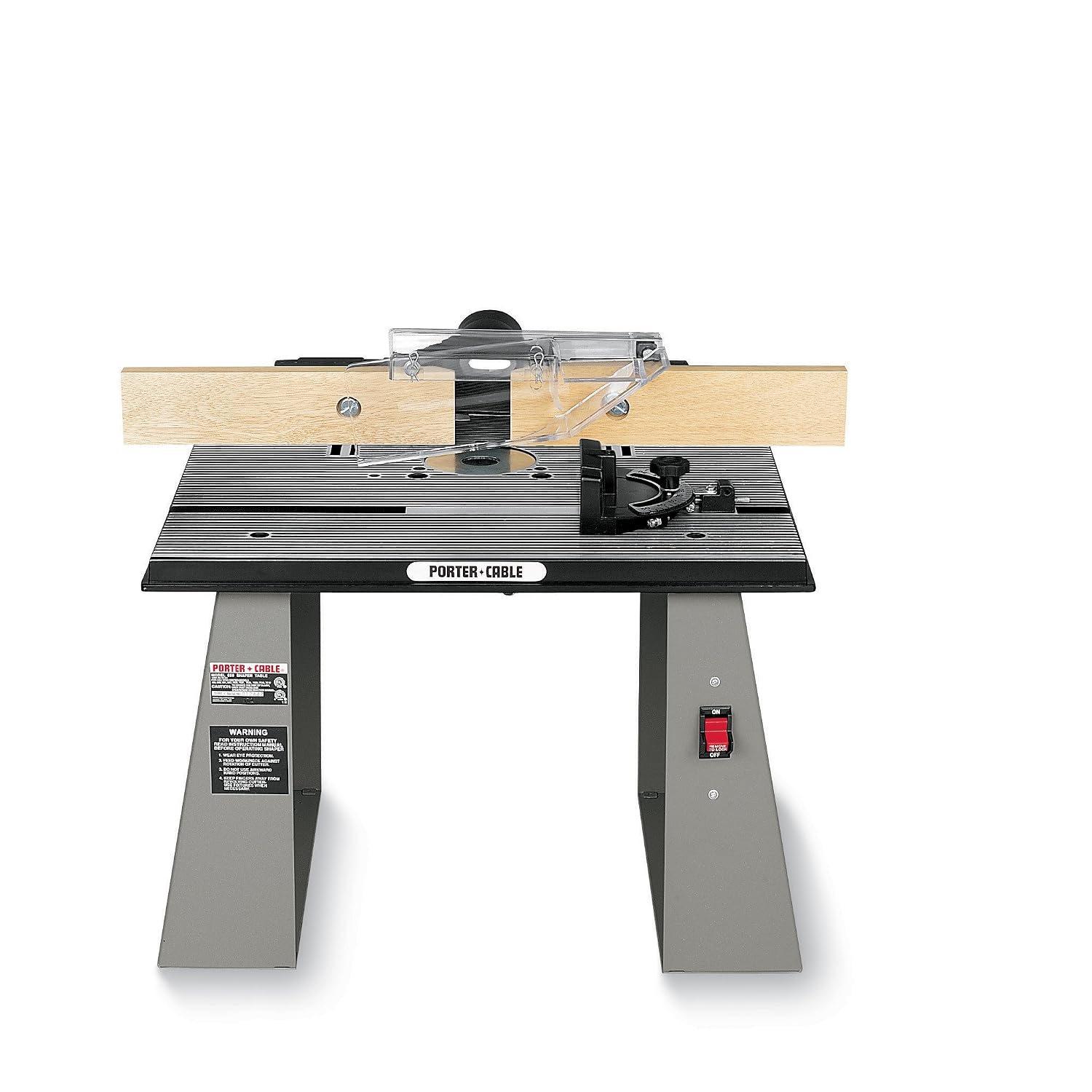
I'm building a new fence for my router table, an older Porter-Cable 698 (image below, for those not familiar with it). The fence hold-down holes are only 5" apart, and, a cutout for the bits the size of the opening in the tabletop plus 3/4" baltic birch ply on each side for the dust collection box adds up to 4-5/8". This doesn't leave much room for the hold-down bolts, if I bring the fence to the back of the opening in the table.

As I think about it, though, is there any reason to bring the fence further back than the centerline of the opening in the table? The P-C table has a miter slot, so, if I cut tenons or similar joints on the table, I don't necessarily need the fence. If I build it so the fence stops just behind the centerline, I'll have plenty of clearance, I think.

Help, please; I'm running into the problem of different parts of the fence running into each other.


img

Re: Router table fence question

#2

Re: Router table fence question

Bruce, a MN Galoot

I just finished making a rudimentary router table for a friend. He wondered why I hadn't centered the router on the table, so I had to explain why he wouldn't ever find himself routing anything in the middle of a wide piece of wood on that table anyway, so he wouldn't need or want it to be centered.

That's a long-winded intro to answering your first question, that I hardly ever find myself routing anything into wood where I am cutting more than 2-3" from the edge. So, maybe move the fence a bit past the centerline, but not much more, especially if you have a slot for a miter.

Bill, does your table have an overhang? I hold the fence to the table with C-clamps on either end. I read one review of the 698 table wherein the reviewer really hated the hold-down screws anyway. Take them off and use clamps. You'll gain a bit of room.

Re: Router table fence question

#3

JL

Re: Router table fence question

JL

Is there any reason to bring it back further than the center line?

IMO, yes. Pattern and other bearing bits. As an example, I use pattern bits for trimming to patterns. I use other bearing bits to get edge profiles. Rather than approaching the router bit "straight on", I have it an a bit of an angle to the fence. This way the chips are "captured" by the edge of the work piece and the fence. The chips can then get sucked up by the vacuum hose that I have mounted in the fence.

I also have a number of small parts jigs that I use once in a great while. These sort of approach the bit from at or near the back.

Flutes and similar decorative features. These are often in the middle of a piece.

Dadoes.

Re: Router table fence question

#4

Re: Router table fence question

roger lance

Bill....why not use 1/2" bb or even 3/8" bb to box in the dust collection box??....gain some room....I believe this is 1/2" on my dust collection box....


Re: Router table fence question

#5

Re: Router table fence question

Dave Paine

Bill, seeing this gave me flash backs to when my wife gave me a Delta Router/Shaper as a gift. Similar sized table, two part fence. I eventually gave it away, since I got frustrated in the "nudge and budge" fence adjustment, especially if I needed to re-create an operation.

I now use an Incra fence. The few times I have needed to move the fence beyond the centreline of the bit, is if I have a bit which does not have a bearing, such as a two bit set to create tongue on one piece and groove on the other. This set makes a cut on the entire face.

I sometimes have to move the fence all the way back and feed the piece from left to right so that the face being cut is close to me. I have to arrange a temporary cover for the bit when doing this.

I have likely done the same technique when needing to use a long bit to "joint" an edge. I have a jointer, but sometimes prefer the control/adjustments the Incra fence provides.

Re: Router table fence question

#6

Re: Router table fence question

Jason Waters

I would comsider using something other than 3/4 to save space. How about 1/4 aluminum or even 1/4 hardboard, or as mentioned, 3/8 or even 1/2 ply would be better.

Sometimes as woodworkers we forget about "metal"....I know I do, then I say, a small piece of metal would help me a lot. 1/4 aluminum can be drilled and tapped for machine screws which can help too save not needing nuts, etc to get in the way.

As for going over the centerline, you mean to the back? Not to the front, right?

Re: Router table fence question

#7

Re: Router table fence question

del schisler

go to this site it is all about router's and tables and more info just regester . I been a member for yrs. Most tables don't have to have all the stuff i have table and can do anything with all the T track's ect. check out the router work shop router table and fench's ect. they had a pbs program for yrs call router work shop the two fellow's Bob and Rick has been in router yrs and yrs . the link

http://www.routerforums.com/

Re: Router table fence question

#8

Re: Router table fence question

Jason Waters

I remember that show! I thought there were some good tips I got from it. I had forgotten about it.

Re: Router table fence question

#9

Yes, to the back

Bill Houghton, Sebastopol, CA

And, lo and behold, this month's issue of Foine Woodworking has an article with some illustrations that seem to argue for a fence that will set back behind the centerline of the bit.

Still working on it. My previous fence clamped down to T-track bolted to the side of the table (the table itself, which is webbed underneath with little side overhang, would be difficult for plain old clamps). I made the mistake of cutting the baltic birch I had in stock a little short to re-use those T-tracks, before I realized the spacing problem with the factory holes. I'm currently weighing the use of some Azek 3/4" trim I happen to have left from a previous remodel. This is cellular PVC, so I can probably tap it for machine screws AND use PVC glue to fasten parts together.

We're getting intermittent rain this week*, and my shoplet's too small to do any serious cutting of large stock indoors, so the project may wait until next week. Not a problem, as I've got plenty of other things to fill my time. Plenty.

*NOT complaining; we've only just crept up to 2/3 of typical rainfall, from the 1/2 we had for much of the winter. The more rain, the better.

Re: Router table fence question

#10

Re: Yes, to the back

Jason Waters

Don't forget to allow the fence to also come forward of the bit too. So you can take those multiple passes when using large bits like raised panel bits. I know some routers can handle it, and mine can, but I find I get better results with a double pass.

Re: Router table fence question

#11

My Homemade fence on Homemade table

George, Oxford, NC

I made my fence to pivot at one end. I put a dowel on the underside at one end and put it in a hole drilled in the table. I can pivot the fence as far as I want front and back. I use a clamp to hold the other end. You don't need to be square to the front unless you use the miter slot which I don't. I use a push block that rides against the fence. The only measurement that matters is from the center of the bit to the fence which, with a pivoting fence can be as big as your table will allow. The extra block showing in front of the fence is to go between the two sliding fence faces to create a zero-clearance insert for special bits.


img

Re: Router table fence question

#12

Pic 2

George, Oxford, NC

Backside of fence


img

Re: Router table fence question

#13

Re: Router table fence question

Charlie Lenz

I don't know if I'm understanding this right, but can't you just remove the fence if you need more room to cut tenons ? If you need some kind of a fence to use as a stop, why not just replace the fence with a with a 1" x 2" laying flat, or 1 1/2" x 1 1/2" angle iron and bolted it down in the fence mounting holes in the table ? Would that not work ? Or am I not understanding your situation ?