Home Articles Forums Gallery Marketplace Videos

WoodCentral Forums

Knowledge You Can Build On — Est. 1998

Identify and use hundreds of woods

You don't need a huge motor on a bandsaw?

Posts

You don't need a huge motor on a bandsaw?

#1

You don't need a huge motor on a bandsaw?

wilbur

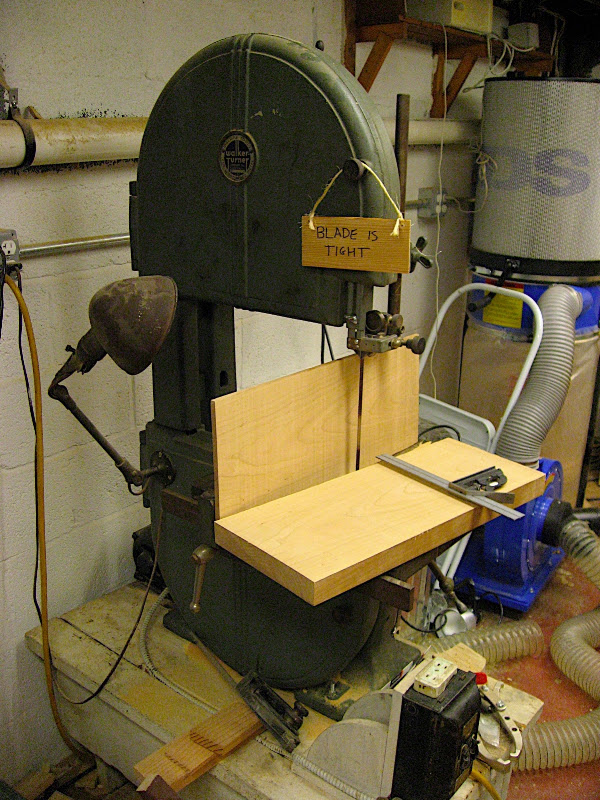
Tonight I resawed a piece of 8/4 cherry that was just under 9" wide, using a blade that was probably less than optimal: a 1/2" x 6 tpi hook blade. I probably should have used a 3 tpi blade.

Anyway, it went just fine using my 1940's era Walker-Turner 16" bandsaw. The reason I'm posting about this is that my bandsaw still has the original 1/2 HP motor on it. If you read anything about bandsaws today, it seems that serious 14" Delta or Delta clone-style bandsaws have a 3/4 HP motor at the bargain end of the range, and quickly move to a 1 HP motor, and can be gotten with 1-1/2 HP motors. Move up to a 17" bandsaw and you're taking about 2 HP minimum.

I looked at some old machinery catalogs from that era, and it seems that most bandsaws in in the 14-16" size came with a 1/2 HP motor max. I'm sure that they had to resaw boards back in the day as well. So if 1/2 HP was good enough for resawing back then, why was there a motor HP escalation over the years?

Oh, and here's proof that I did it. There's a 12" combination square on the board for scale.

Re: You don't need a huge motor on a bandsaw?

#2

Re: You don't need a huge motor on a bandsaw?

R Payne

I like the sign. :)

ron

Re: You don't need a huge motor on a bandsaw?

#3

Kneale Brownson

Says something about the quality of today's motors

Kneale Brownson

Re: You don't need a huge motor on a bandsaw?

#4

Re: You don't need a huge motor on a bandsaw?

Bill Houghton, Sebastopol, CA

There seems to be a general consensus among the gatherers of old machinery that the old repulsion-induction motors are more efficient than newer motors.

On the other hand, someone who bought one of those from me recently was told by two people with the engineering/manufacturing background to know that building a 1/2 HP repulsion-induction motor to the standards of the 50s would cost $900-1400 today.

Nice driveby gloat, by the way; one of those saws can wander into my shop anytime it feels like it, even with a wimpy little 1/2 hp motor :)

And I agree - the sign's a good idea.

Re: You don't need a huge motor on a bandsaw?

#5

An different experience

Bill Tindall

I have a 3/4 HP modern motor on a 14" Powermatic and I can stall it with a 3 tpi tooth blade resawing ( a 3 tpi blade takes bigger bites). On the other hand I have a 1954 Delta 18" with a "vintage" 1 HP motor and it handles a 3/4" 3 tpi blade just fine. An undisclosed factor is what the blade speed is in these experiments. Obviously the power(I am not sure if this is the correct metric) delivered to the teeth can be changed by changing pulley ratios with the trade-off being blade speed.

Re: You don't need a huge motor on a bandsaw?

#6

Re: You don't need a huge motor on a bandsaw?

wilbur

Thanks! You would not believe the number of wordings I went through before I came up with that. I started off with "Tighten/Loosen" but then I realized that I would forget whether the blade was tight or needed to be tightened.

Finally I went with the "So simple even a moron would understand this sign" school of writing. ;)

By the way, the other side says, "BLADE IS LOOSE".

Re: You don't need a huge motor on a bandsaw?

#7

Re: An different experience

wilbur

Hi Bill,

For what it's worth, The calculated SPFM of my bandsaw blade with the pulleys that I have is about 3,600 SFPM. I don't have a way of measuring that directly.

One of the things I needed to do with the bandsaw when I first got it and was getting it back into working condition was replace the sheaves, and I took that opportunity to increase the blade speed from what it was.

Just to clarify, are you saying that you can get away with a lower HP motor if you choose your pulley ratio to increase the blade speed?

Re: You don't need a huge motor on a bandsaw?

#8

Maybe horses were stronger back then

Charles Yawn

>;)

Re: You don't need a huge motor on a bandsaw?

#9

Re: You don't need a huge motor on a bandsaw?

del schisler

on my 14 delta with riser block I use a 1 hp 3450 rpm motor With a 1" Browning double belt pully on motor And a 6" double belt on the saw Those are iron pully's Very good I have never stalled it I use it for resawing Using a 3/4 3tpi Works for me But the old motor's are better Been around them back in the 40's

Re: You don't need a huge motor on a bandsaw?

#10

Opposite...

John in NM

You should be able to get away with a lower HP motor if you arrange the pulleys to slow down the final speed, sacrificing speed to gain torque.

Your old motor is part of the equation, my unisaw is similar - runs a 1 HP 1950's motor at 1750 rpm and doesn't stall. With the lower speed, there are some operations like plunge cuts that I won't try with it, seems to want to kick more. But anything that keeps me away from somewhat risky stuff like that is probably good on the whole :D

Re: You don't need a huge motor on a bandsaw?

#11

Re: You don't need a huge motor on a bandsaw?

Keith Newton----Little Rock, Arkansas

Wilbur, Do you earn your living using that saw? I earn my living out in my shop, and I changed my motor from 5 hp to 7.5 hp. It would rip that 9" at the speed yours cuts 3/4". Time is money. I like my power.

Re: You don't need a huge motor on a bandsaw?

#12

Ellis Walentine

I used to have that same saw...

Ellis Walentine

...until the fire, that is; although I had the enclosed base on mine. Great bandsaw! I was doing some pretty serious bandsawing in those days and I found that the original motor just couldn't cut the resawing jobs I was forcing on it. I replaced it with a 1 1/2 hp Baldor and the results were remarkable.

On a related subject, my first Unisaw was an old late 40s model with the 1 1/2-hp repulsion induction motor, and it couldn't cut anything over about 2" thick. I sold the saw and got a new (1978) Rockwell Unisaw with a 3-hp motor. I could still bog it down in 3" mahogany if I pushed hard enough, but I never had to worry about a stall.

Can you tell I'm an advocate for larger motors? It's not that you absolutely can't get by with an old underpowered one, but I don't think you should have to sacrifice blade speed for power.

Ellis

Re: You don't need a huge motor on a bandsaw?

#13

Re: You don't need a huge motor on a bandsaw?

Bill White

HP rating is a joke. I have a Ridgid vac that is showing a 6 1/2 HP rating. WHAT????? I've never been able to run a 6.5HP motor on a 120v line before.

I think that the ratings are no-load rates just before the motor explodes and kills everyone within 1 sq. mile.

Bill

Re: You don't need a huge motor on a bandsaw?

#14

Re: You don't need a huge motor on a bandsaw?

Richard

You say you cut a piece. What if you needed to cut 50 pieces or many pieces several times a week? You may appreciate more power then. More hp means faster cutting. So I'd say t just depends on what a guy is doing. I have always been advocate of more power is better. The only thing that really matters is if your happy then that all that counts.

I have that same band saw. When I got it someone had already change the motor from the original. When that motor gave up I put a 3hp 3phase in it.


Re: You don't need a huge motor on a bandsaw?

#15

Re: You don't need a huge motor on a bandsaw?

wilbur

Granted, I'm a hobbyist, and I'm not doing this to make money. Just so I can get my brain around what is done in a production environment, how long would it take to resaw a 2 foot long 9" wide cherry board with your more powerful motors?

I certainly understand the advantages of having a bigger motor, and granted, I'm not in production mode. But this still doesn't explain why if you look at catalogs from the 1940's, this particular bandsaw and bandsaws of similar sizes were really only sold with a 1/2 HP motor back in the day. They certainly had motors with more HP back then, so it's not like a 1-1/2 HP motor hadn't been invented yet.

From the 1940 Walker-Turner catalog listing for the woodworking model of this bandsaw they say "12 inch capacity between upper guides and tables afford unusual capacity", so clearly this saw was meant to handle resawing a 9" board. The motor that they list on that page is a 1/2 HP 1740 RPM motor.

Re: You don't need a huge motor on a bandsaw?

#16

Ellis Walentine

Whatever works for you

Ellis Walentine

Wilbur, from the picture, I can't really see the motor you're using, but if it is the repulsion-induction variety, which seems likely, I think I've heard that that style has a bit more output horsepower than the newer style motors. (I'm way outta school here, so I'll defer to someone who knows more about motors to set the record straight.) Motors were a lot heavier in those days relative to their horsepower. We had a 2-HP motor on our 36" bandsaw that must've weighed 250 lbs. It was about 2' in diameter and 2 1/2' long.

In any case, you say you're getting by fine with the original 1/2 HP 1725rpm motor, so de facto you don't need a bigger motor. I too, was able to resaw moderate timbers with the original motor on my Walker-Turner (I think it was a 3/4 HP, 1725 rpm, but I made this switch over 25 years ago, so don't hold me to it), but I wasn't satisfied with the slow feed rates compared to other large bandsaws I had used. Plus, the saw bogged down when roughing big, uneven turning blanks, and it bogged even more when I used wider blades and higher tensions. So, when the original motor died, I didn't think twice about upping the horsepower. To me, the difference was profound and worth every penny.

Whatever works for you.

Ellis

Re: You don't need a huge motor on a bandsaw?

#17

Re: Whatever works for you

Derek Cohen (in Perth, Australia)

Hi Wilbur

How hard are the woods you work with?

My first bandsaw was a 14" Rigid with a 3/4 hp motor. I could just about resaw a 4" thick board of Tasmanian Oak (similar to White Oak). After a couple of years I tired of the stalling and that trying to resaw anything harder than this was painfully slow (with a 3 tpi 1/2" blade). So finally I changed to motor to 1 1/2 hp. What a difference! Now I was resawing 10-11" thicknesses on a riser.

This bandsaw still suffered from limitations in build quality (guides, etc), and these filtered down to the quality of the finished product. About 2 years ago I bit the bullet and bought a Hammer 4400. This is 17 1/2" and 4 hp. The resemblance of the Rigid to the Hammer is purely coincidental.

Regards from Perth

Derek

Re: You don't need a huge motor on a bandsaw?

#18

Re: Whatever works for you

wilbur

Hi Ellis,

So on a bigger bandsaw with a more powerful motor, how long would it take you to resaw a 9" wide cherry board?

Re: You don't need a huge motor on a bandsaw?

#19

Re: Whatever works for you

wilbur

Hi Derek,

Up to this point the hardest woods that I have made my bandsaw deal with is white oak and hard maple. I'm primarily using North American hardwoods.

Re: You don't need a huge motor on a bandsaw?

#20

Ellis Walentine

Depends on how long it is

Ellis Walentine

The answer, of course, is "faster than I could with a 1/2-hp motor." I wouldn't recommend having resaw races, though.

Ellis

Re: You don't need a huge motor on a bandsaw?

#21

24" long board, then?

wilbur

Sorry to keep harping on this, but I am trying to get some quantitative idea of the speed difference, and yes, I know that this isn't a race.

Re: You don't need a huge motor on a bandsaw?

#22

another critical factor here that is rate limiting

Bill Tindall

As I recall in your first post you are using a 6 tpi blade. It won't matter what motor you put on the machine, you are going to have to use a slow feed rate to keep from clogging up the tiny teeth. I am not at all surprised that a small motor will drive these tiny teeth. If the gullets are clogged they mostly aren't cutting. In a 9" piece you have 54 teeth in the material, twice the maximum recommended and three times optimum. So the relevant question becomes- when sawing a 9" piece with something close to the optimum number of tpi what HP is needed to drive the blade. If someone was production sawing lumber this wide they would be using a 1 1/2 tpi blade and it will take a substantial motor to drive it.

Re: You don't need a huge motor on a bandsaw?

#23

Ellis Walentine

Apples and oranges

Ellis Walentine

As Bill mentioned, tooth configuration (and sharpness, I would add) are key factors. I do routine ripping and resawing with a Timberwolf 1/2" x 3tpi blade. My bigger bandsaw (20") has a 1" x 2-3tpi (variable pitch, carbide tipped) blade on it. For a controlled experiment, we should be using fresh, identical blades, otherwise we won't be able to draw any valid conclusions from this test. So, if you'd like to proceed, we should both call Suffolk Machinery and order new blades for our saws. I suggest 1/2" x 3tpi (hook). I'll resaw the same piece of wood on my 16" Walker-Turner (I got another one, a wood/metal model with a variable speed gearbox ;) and my 20" Steel City saw and record the average time required to resaw a 9" x 24" piece of wood. (If I can't find a piece of cherry, maybe we can settle on some other species.) You do the same with your W-T and your 1/2-HP motor and we can compare notes.

What we won't be able to compare, though, is feed pressure, unless we figure out how to put a scale of some sort between our pushing hand and the work. Unless we control that variable, too, we still won't be able to draw accurate conclusions. For the purposes of the test, we could stipulate that the feed pressure should be the maximum amount that feels right and doesn't bog down the saw.

I'm game if you are.

Ellis

Re: You don't need a huge motor on a bandsaw?

#24

I sort of have that saw too...

John in NM

But without the gearbox (I'm jealous! :D)....

I got it in trade for an old Gerstner box I'd rebuilt, but couldn't get it into my shop without tearing it apart. It's now kind of on long term loan to a guy in Tucson, I doubt I'll ever get it back. We put on a fixed speed gearbox for cutting steel, its a heck of a nice saw.

I'd say your feed pressure will be self limiting in the experiment, given two new, sharp, and identical blades. That's what you're really testing, how hard you can push through without bogging down the saw and without getting a wandering kerf. It sounds like a neat experiment to me.

Re: You don't need a huge motor on a bandsaw?

#25

One of the Magazines....

Barry Irby

FWW? did a comparison of blades a few years ago. IIRC they set up a sled with some drawer runners as a carriage for the piece of wood and then a weight hanging from a pulley to apply a uniform force. It would make it interesting to see what happens with such a rig and different motors.

I wanted one to turn my saw into a mini saw mill.