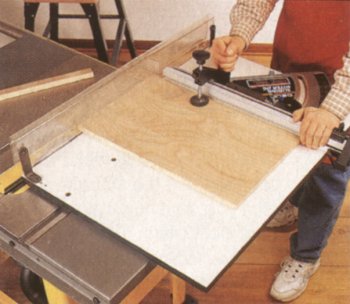
It's about 16" x 10" and is made from 3 boards of about 4" wide. I planed and jointed the pieces before the glue-up. I started to trim the piece down to the size I need and found that the piece isn't square. I checked my table saw blade against my sliding miter jig and my fence, they're both square.
This sounds weird, but two of the angles seem square when I use my angle iron on them, but the other two aren't. I'm off by about 1/8" when I check the "off" angles on to the end about 12" away (that edge will be one of the 10" sides).
How do i get it square? I've tried putting the square edge against my sliding jig, and my fence, and shave a little off. That's helped from where I started, but now i'm down to not much left to shave.
>Indeed this is a frustrating problem that used to crop up from time to time.
step 1 be sure square is in fact square. Repost if you don't know how to check a square.
As I understand your question sometimes the saw cuts square and sometimes it does not. This problem can result from slop in miter gauge slot or the piece slipping against the miter gauge as you saw it. These problems are a thing of the past after I finally!!(as in 30 years late) made a saw sled. I am assuming the long sides are parallel, for nonparallel sides will result in the same problem. Check to be sure.
Step 2. With a marking knife, or pocket knife, mark the finished size of the lid using your square that you are sure is square.
Step3 Nibble away at the excess with saw, hand plane, or jointer (I have used them all with success) until its perfect. If you don't know how to remove a tapered portion with a jointer see my article on how to make tapers. The same technique can be used to remove them.
If you find the saw consistently does not cut square then reset miter gauge based on what the saw is cutting, not some other factor.
>Have you checked to see if the two long sides are parallel?
When you use the miter guage (slider) on the table saw are you holding the piece tightly aganst the slider? It's posible for it to slide as the cut is made and create angles on the ends.
>step 1 be sure square is in fact square. Repost if you don't know how to check a square.
Um, no, I don't know how to check if the square is indeed square.
>As I understand your question sometimes the saw cuts square and sometimes it does not. This problem can result from slop in miter gauge slot or the piece slipping against the miter gauge as you saw it. These problems are a thing of the past after I finally!!(as in 30 years late) made a saw sled. I am assuming the long sides are parallel, for nonparallel sides will result in the same problem. Check to be sure.
Could be, sometimes I cut nice and square pieces. I'm using a Delta Sliding Miter Sled which has a lock down for the piece. See pic.
>Step 2. With a marking knife, or pocket knife, mark the finished size of the lid using your square that you are sure is square.
I'll do this after making sure the square is square.
>Step3 Nibble away at the excess with saw, hand plane, or jointer (I have used them all with success) until its perfect. If you don't know how to remove a tapered portion with a jointer see my article on how to make tapers. The same technique can be used to remove them.
This is what I was doing, but when I got one of my dimensions down to what I wanted and still had a problem I decided to stop and ask for help.
If you find the saw consistently does not cut square then reset miter gauge based on what the saw is cutting, not some other factor.
Barry Irby
>Have you checked to see if the two long sides are parallel?
I have now, and yes they are. Out of curiosity, what would it have meant if they were not parallel?
>When you use the miter guage (slider) on the table saw are you holding the piece tightly aganst the slider? It's posible for it to slide as the cut is made and create angles on the ends.
I'm trying to, it has a lock on it, which I screw down after I hold the piece against my slider. I'm using a Delta 36-205 http://www.thewoodshop.20m.com/graphics/delta_36205.jpg
My piece is currenlty these dimensions:
Short Side (measured on each end of the long side)
10 13/16" and 10 13/16"
Long Side (measured on each end of the short side)
>You asked "I have now, and yes they are. Out of curiosity, what would it have meant if they were not parallel?"
Lets say you number the sides 1,2,3,4 with 2 & 4 being the long sides. If the two long sides are not parallel and you cut end 1 with 2 against the slider, the rotate the pieces 180 degrees and cut end 3 with 4 against the slider, if the slider is cutting square, you will have two square corners (between 1 & 2 and 3 & 4) but the other two corners will not be square. Draw it out in an exaggerated scale and you will see.
This assumes you are keeping the face side up. If you don't and you cut both times having side 2 against the fence, then the two corners connected to side 2 will be square. (If the slider is cutting square.
>1. you will need a board about as wide as your square is long. It must have parallel sides obtained by ripping it or buying it that way to begin with.
2. Place square on one edge of board and with something sharp ( a pencil line is too fat) scribe a line across the board (perpendicular to the sides). Place the square on the opposite edge of the board and scribe a line close to the first. Optimistically......if the lines are parallel the square is square. Pessimistically, if the lines are not parallel the amount they are off is twice the amount your square is out of square.
Surely someone has posted these directions in the Articles.
>I am not fond of a sled that rides in only one miter slot. If there is play in slot force it to one side every time and align things to accommodate this position. Then make a new sled that rides in both miter slots.
>As other posts have said, I'd regard the sliding sled as the culprit. Check it out by trying to cut the largest square or rectangle your saw and fence will allow.
This won't waste any significant amount of material as you'll be doing is a small trim of each edge.
If that piece turns out square ( and your square is square) your saw setup is good and the fault lies in the sliding sled.
>The traditional way to check a square is to use the blade to verify that one edge of a board is straight. Scribe a line across the board and then flip the square and draw a second line as close to the first as possible. By fliping the square I mean that you will scribe agaist the blade each time but the other end will face left for one line and right for the other.
The adgantage of this method is that the error will be doubled. If your square is out by .010" it will be difficult to tell by looking at a pair of parralel lines. but with this method a .010" error will show up as .020" which is something a good eye will be able to pick up.
>I have never been successful attempting to nible away it an out of square cut by attempting shaving the piece against the saw blade. Any cut less than the thickness of the saw blade tends to deflect the blade slightly throwing accuracy off. Take a cut that is at a minimum the thickness of the saw blade plus a smidgen.