WoodCentral Forums

Est. 1998 — 27 years of woodworking knowledge

Where Hardwood Comes from 6, log carriage

Posts

Where Hardwood Comes from 6, log carriage

Edited #1

Where Hardwood Comes from 6, log carriage

Bill Tindal, E.TN

>Part 6 the skid way and log carriage

I'm headed to Mt. Rogers in VA this morning to hike in what I hope are blooming Rhododendron. What may be the most interesting part of this series I will post Sunday PM. Then I will describe the main saw and the strategy for converting logs to lumber and why you hardwood supplier doesn't have 8" boards.

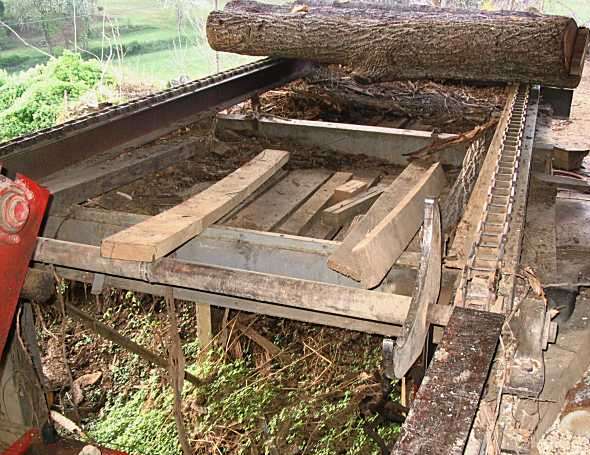
The next picture was taken at a different small mill. The lighting in this mill is better for showing the log carriage. This mill does not debark logs, which is very uncommon, but the skid way and log carriage are typical, though the carriage is less automated than typical (it is a small mill). Logs are carried to and dumped onto the live skid way in front of the main saw call ed the �head saw� I suppose because it is at the head of the process. This picture shows some walnut logs on the skid way chains. The crescent shaped pieces of metal in the foreground hoist the log onto the saw carriage with a hydraulic cylinder.

In the old days the skid way was just a slopped ramp. The sawyer and a helper rolled the logs up the skid way and onto the saw carriage with cant hooks. It took great strength to roll large logs. One day while I was at a mill someone bet the sawyer that he could not pick up a hickory railroad tie he had just sawed. The sawyer hoisted it to his shoulder with ease and then danced a jig for good measure.

img

Re: Where Hardwood Comes from 6, log carriage

Edited #2

continued, the log carriage

Bill Tindal, E.TN

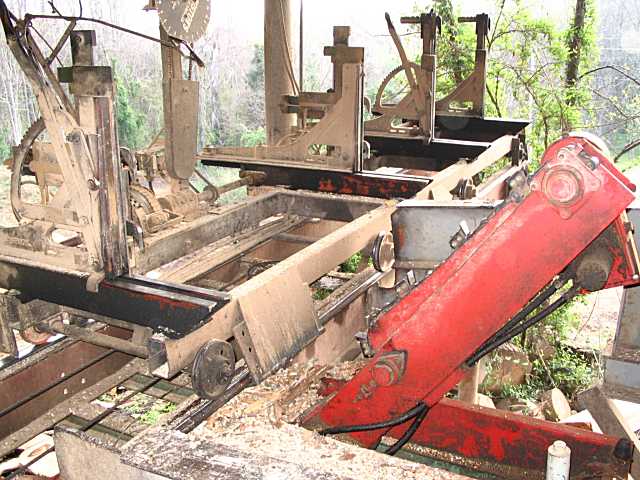
>Log carriage This picture shows the log carriage. The carriage is the heart of the mill and it performs several functions. It holds the log securely during sawing. It travels on a track to move the log across the saw and it advances the log toward the saw in increments determined by the sawyer to produce boards of specified thickness. The log lays on the horizontal metal piece just above the carriage wheel. It is supported in back by the vertical �head blocks� and held on the carriage by the �dogs�, the downward pointy things on each head block. One can sometimes see �dog dents� in the edges of hardwood lumber. They will be serious dents about 1� wide in the edge of a board. The log is positioned relative to the saw by moving the head blocks forward or back. To saw the log the carriage is pulled across the saw with a cable, which can be seen under the carriage. The large dial at the top of the picture tells the sawyer how thick the board will be.

The big orange thing is one variety of log turner. It has some teeth and it rotates these teeth on a chain. A hydraulic cylinder pushes the device forward to the log on the carriage. The teeth engage the log and rotate it. Hardwood logs are typically sawed to yield the most high grade lumber. To do this the log is frequently turned to find the clearest log face to remove a board from.

It takes a great deal of skill to set up the carriage. If it is not aligned perfect the mill will cut boards that are not uniform thickness. If the lumber is not uniform it will be down-graded by the lumber inspector.


img

Re: Where Hardwood Comes from 6, log carriage

#3

admin

This series is available here

👍 This page answered my questions

Your vote helps other woodworkers quickly find the answers and techniques that actually work in the shop.