WoodCentral Forums

Est. 1998 — 27 years of woodworking knowledge

Shop Flooring 'Live' Load

Posts

Shop Flooring 'Live' Load

#1

Shop Flooring 'Live' Load

Robert Hutchins

>Knowing that we've discussed this before, I still can't recall what the recommended live load a home shop floor should be framed for (assuming pier and beam or second story). A friend asked me if he should beef up the floor framing for a 16x20 shop he plans to build. It will have a table saw (contractor type), jointer, bandsaw, workbench, dp, etc. in it (nothing super heavy) with benches and counterspace around the perimeter per usual.

I googled for SYP spans and got lots of tables and different live load values for different types of areas (bedrooms, corridors, etc.). I thought that 30 to 40 lbs/sqft would be about right but don't want to have him blame me if its underbuilt. He's in a rural area and won't be affected by municipal codes; however, he doesn't want to skimp either.

Anyone - engineers, builders or anyone else - care to wade in on this?

What would you do?

Re: Shop Flooring 'Live' Load

#2

Well, since you ask "what would you do?"

John in New Mexico

>Add up the weights, or estimations of them, for all the machines and benches, etc, and divide by the square footage. Also understand that the tables are often a bare minimum and will feel bouncy and kinda flimsy, especially under a load. Maybe less important in a shop than a house, but I'd use L/480 or L/600 as deflection minimums. Also figure deflections for the sheathing material under point loads spanning between joists (like a jointer on a mobile base), and increase the sheathing thickness as needed.

John

Re: Shop Flooring 'Live' Load

#3

Nothing specific

Mark Goodall - ATL - tooljunkie

>I can't offer anything specific, by the rule of thumb I always follow in just about everything is: "one size higher".

When I build my shed, for instance, it called for 4x4 skids and 2x6 floor joists and 1/2" plywood. I instead used 4x6 skids and 2x8 floor joists and 3/4" plywood.

I'm glad I did, as I put alot more in that shed, including engines, motorcycles, and much more weight than I ever anticipated.... it's probably strong enough to park a car inside.

I figure the cost difference is usually between 20%-30% more to go one size higher, which is cheap compared to the time involved.

I figure there are enough builders out here who skimp and use one size lower than they should to save a few bucks. I'm just trying to balance out the world.

Happy Woodworking!

Re: Shop Flooring 'Live' Load

#4

Ellis Walentine

Ask him what he wants

Ellis Walentine

>Floor framing tables generally reflect the minimum section modulus for a particular species that will allow no more than 1/360 deflection across the span of the joists under a particular combination of live and dead loads. A shop almost certainly will have a dead load that exceeds that of a normal living room or bedroom, so this would suggest increasing the section modulus of your joists (e.g., using 2x12s instead of 2x10s). The live load isn't the issue.

Another thing to consider is the flooring itself. Consider that point loads such as wheels on a mobile machine base may run to hundreds of pounds. A single layer of T&G plywood subflooring will be squashy under loads like this, so you might want to double up on the thickness of the flooring.

Regardless of the size and spacing of the joists you use, nailing solid blocking between them will increase the overall stiffness of the floor significantly. Also, if your friend will have a wood lathe or other machine that is prone to unbalanced loads and vibration, I'd suggest installing heavy posts and beams directly under that section of the floor.

Ellis Walentine, Host

Re: Shop Flooring 'Live' Load

#5

Re: Shop Flooring 'Live' Load

Barry Irby

>I aggree with everything so far. Another thing you might want to consider is introducing another beam under the system. Cutting the span in half has the effect of quadrupling the strength of the joists.

Moving the joists closer together has the same effect on the floor sheeting.

So you might look at what would be required for joists now with them on 16" centers and use that size with them on 12" centers and with a beam under them at mid span.

Also, Gluing the sheeting to the joists adds significant strength.

Re: Shop Flooring 'Live' Load

#6

Re: Shop Flooring 'Live' Load

Tom Scott (Midlothian, TX)

>Robert,

For reference, residential floors are supposed to be designed for a minimum live load of 40 psf. Machinery would more realistically be categorized as a dead load, but you're not going to find published load tables with that much dead load. Personally, if I were designing a structured floor for my shop it would not be for less than 100 psf live load. I would also use a minimum 2 layers of 3/4" plywood for the flooring and try to limit the deflections. All of this probably pushes you to using I joists, which is good.

Tom

Re: Shop Flooring 'Live' Load

#7

Re: Shop Flooring 'Live' Load

john b SW Chicago burbs

>My shop,20x30', the longest span between beams is 13'6". The joists are doubled 2x10" on 16" centers with one row of wood cross braces covered with one layer of 3/4" t&g plywood. It was my intention to put down another layer of plywood, never did get that round tuit, floor seems very solid with no bounce. john b.

Re: Shop Flooring 'Live' Load

#8

Re: Well, since you ask "what would you do?"

Charles Self

>Add to your figures loads for things like lumber, either stacked to use or for drying.

Best bet: figure for a particular load, then go at least one size up on the floor joists--or reduce the distance between joists from 24" to 16" or to 12".

I can tell you from experience that it is both easier and cheaper to shore it up now than it is to shore it up later.

Re: Shop Flooring 'Live' Load

#9

Re: Shop Flooring 'Live' Load

Al Killian

>I would go to your local lumber supleir and give them the size you want to make it and tell them the estimated weight of the tools and stuff. Tell will be able to give you a detailed list of materails needed to make it soild. A shop layout would alsao help them with this.

Re: Shop Flooring 'Live' Load

#10

Re: Shop Flooring 'Live' Load

Glenn Madsen near San Francisco

>Well, that's the problem, from my perspective. When you build a shop, it's going to be there for a very long time. Tools move. They come and go. Woodworkers change their interests, sell their houses, leave this phase of life, new folks move in.

The current layout and design of the shop is a temporary decision, and will change. Don't let the floor design limit too much what you can do with it. Overbuild it strongly.

(This all spoken by a California, who designs shop floors by digging the the forms a bit deeper, and pouring more concrete, for what it's worth.)

Re: Shop Flooring 'Live' Load

#11

You got it...

John in New Mexico

>Anything that is movable is always "live load", whereas the weight of the structure itself (and flooring) is the dead load.

Re: Shop Flooring 'Live' Load

#12

Re: You got it...

Barry Irby

>Dead load includes the Weight of the structure and the weight of "fixed" equipment. This is form the International Residential Code or IRC. Live loads are the short term ones.

Wood is an amazing material and is affected differently by different types and durations of loads. Dead loads are the worst because they last the longest. You can increase the loading by 15% for short term loading such as wind loads. Interestingly, you can double it for Impact loads. In other works for loads like those delivered by a sledge hammer or a pile driver, wood will accept twice the load it will for a dead or long term load. I believe I recall that dead loads are any load that lasts over 60 days. Much of my shop equipment sits in one place or nearly so for longer than that. Other than expense, you can�t tell if you over build. You will know if you under build.

Re: Shop Flooring 'Live' Load

#13

How About This Plan

Robert Hutchins

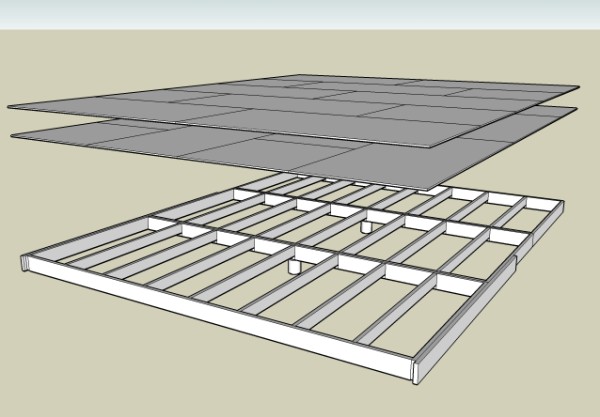
>It's 2x6 joists on 24" centers with 2x8 headers and bands and 2 ply of 5/8" sheathing and piers in the center of the load as shown with perimeter piers (not shown). Billy plans to use 8' 2x6's and use the cutoff's to block the spans which are 76" (6'4"). The headers are 2x8x16 that will rest on the center piers spanning eight feet. Overall dimensions 16x20, which he said fits his pistol just fine.

Obviously, 2x8 joists could be used as well and either size joist could be on 16" centers. His question was really about whether saving money, I think.

What do you think?


img

Re: Shop Flooring 'Live' Load

#14

Re: How About This Plan

Glenn Madsen near San Francisco

>I'm not an engineer, nor do I play one on TV, but that doesn't seem NEAR strong enough for the stuff in my shop.

(pouring more concrete...)

Re: Shop Flooring 'Live' Load

#15

Re: How About This Plan

Keith Newton

>Robert, I would frame that with 2 X 10 across the 16' @ 16" OC, way with a line of bridging across the middle, and forget about the post. What you save in not having to buy and fool with the post will pay for the extra lumber cost, if there is any. Assuming that there are bearing walls under those sides.

Re: Shop Flooring 'Live' Load

#16

Re: Shop Flooring 'Live' Load

Larry Clinton At Frankfort (Central)., Indiana

>Bob, I just looked up the prices for dimensional lumber online at Lowes.

The cost difference between installing 2 x 6 on 24" centers and 2x10's on 16 is less than $110. Considering the problems he could face with a "spongy" floor, and the total shop cost, I certainly would not cut corners on the floor. I would probably spend $150 or so extra and put at a minimum 2X10's on 16 with a center beam on piers. I would then cross brace them in at least on place. When I built my shop a couple years ago, I put 2X6 walls on 16 with a couple 2X8 studs at each corner, figured the total cost for the extra sturdy walls was around $200 ~ $300 over conventional 2X4's on 24. I have a cement floor - but I poured it with High strength concrete and about 7 ~ 8" thick. With all the extras I put into my shop I probably spent a couple thousand - but I don't have to do anything over and I have a very low energy bill for heat and air. Maybe your friend is trying to cut costs, if so I would put a single layer of floor down on a good sub-structure. If he finds that too spongy, It is an easy fix to add a second layer of flooring. It would not be easy (or cheap) to brace up an inadequate sub-structure.

Re: Shop Flooring 'Live' Load

#17

Re: Shop Flooring 'Live' Load

melvin marquess

>i'am in the process of adding a 24 x 24 addition to my shop. my existing shop has a suspended slab. new section is designed with 3 24'x 12" LVL's for beams 6' o.c. with block piers, cut them to length, set them in place and you're done. joists are 2 x 12 x 14 16" o.c. doubled 3/4" t&g plywood. it should support pretty much anything i put in there. where my straight line rip saw will set the joists will be doubled. it weighs about 2300 lbs, molder is 900 lbs, planer about 800 lbs and the cabinet saw is about 400 or so. add 2 or 3 thousand b.f. of material at a time and there is alot of weight to consider. so at any given time there will about 5 or 6 ton sitting on my shop floor. plus all the other stuff so it's prob closer to 8 ton.

👍 This page answered my questions

Your vote helps other woodworkers quickly find the answers and techniques that actually work in the shop.