WoodCentral Forums

Est. 1998 — 27 years of woodworking knowledge

Clamping tapered boxes

Posts

Clamping tapered boxes

#1

Clamping tapered boxes

Stan Armstrong

>Lots of people on the web will tell us how to calculate compound angles for tapered boxes, but how do we clamp and glue them. The only solution I can find is to use 5-minute epoxy to attach angled gluing blocks. Then you have to knock off the blocks and resurface the box. There�s got to be a better way. What method do you use for gluing and clamping them? I am interested in shallower boxes because I am constructing the bottoms to dust collection boxes for a router table and a contractor�s saw.

I have spent some hours trying to answer this question, both searching the popular woodworking forums and using Google.

Any help you can offer will be appreciated, including promising web links.

Re: Clamping tapered boxes

#2

Bart Goldberg

Re: Clamping tapered boxes

Bart Goldberg

>I use a wide roll of painters blue tape to assemble my boxes while letting the glue set. This kind of tape removes easily without leaving any marks that would require resurfacing. If needed, you can always use a stronger type of tape over the painters tape if needed. I then add splines to reinforce the joints.

While painters tape may not be optimal for achieving the clamping force needed for joinery that uses yellow glue, you can always switch to epoxy, which has no such clamping pressure requirements.

Hope this helps.

Bart

Re: Clamping tapered boxes

#3

For dust collection? Whats wrong with screws?

John in New Mexico

>I must be missing something here.

Several methods work well, most notably clear packing tape, though it works best on smooth surfaces. I've also got some of those Ulmia spring clamps which work really well, though it needs to be close to square (probably couldn't do much past 20 degrees from 90 either way, but I've never tried). Most sure method, especially for shallow boxes also takes the longest. Make a jig with large blocks screwed down at each corner about 1/2" to 1" outside the finished box's outline. Then use paired wedges to clamp the box sides against the blocks. The taller the box is, the stouter the jig needs to be to keep from bending.

John

Re: Clamping tapered boxes

#4

Re: Clamping tapered boxes

Barry Irby

>There are a bunch of ways to do this. You have figured out about the glued on blocks. You could use double stick tape to adhere the blocks and then peal them off. (Some double stick tape can be very strong. Clamp the blocks to your pieces and give the tape a few minutes to get a "bite". You may be surprised.)

You can make or buy spring clamps that are sharp on the ends and they bite into the wood and apply force. Often used on picture frames.

Kreg makes a "right angle" clamp. One end fits in one of the holes you drill with the Kreg jig. Maybe you could adapt this. In fact, the Kreg or pocket screws might be just what you need.

You could put a band clamp around the large perimeter of your hopper and then put a weight on the smaller part to apply pressure.

Since you are making shop fixtures I assume you are not as concerned with the finish as if you were making a jewelry box. (?)

You could cut notches in the work pieces that do not penetrate the inner surface and use the notches to give the clamps a bite.

And you can buy the hoppers from Woodcraft or the TS. I'm sure others sell them too. I bought one and did not use it. As I recall it was about$15. OTOH, I personally would rather make one even if it cost twice as much, did not work as well, and took longer than driving tot he stoore to get one. I suspect their others here that are reluctant to admit it, but they made theirs too.

Re: Clamping tapered boxes

#5

Re: Clamping tapered boxes

Ed Mulligan, Cape Cod

>For shallow tapers such as sailboat masts etc band clamps or 'spanish windlass' or surgical tubing or inner tube strips or some tapes work well. I surmise your job has a rather steep taper and any of the above methods, with possible exception of the tape, would slide off the work. The glued on blocks work best for your situation IME.

If you can accept the holes, tape it up and shoot some brads to secure the joints.

Ed

Re: Clamping tapered boxes

#6

Re: Clamping tapered boxes

Ernie Miller

>When making jewlery boxes for toys for tots I use large rubber bands. for more pressure add more bands. it depends on the taper how well it will work. Painters tape will hold the parts together untill the bands are in place.

Re: Clamping tapered boxes

#7

Re: Stretchy pallet cling wrap *LINK*

Grant Smith(remove 1 for email)

>I make small boxes often. When it is time to clamp up a mitered box, I first reach for my Frame Clamp, made by hirsch. I have since bookmarked a link to how to make one myself, however (see below). This clamp could be easily modified to work with any shape box... just change the angles of the clamp blocks.

But I also make flag cases (three sides and a right triangle), five and six sided boxes, etc. Here's how you clamp up any shallow box with mitered corners:

Say you are making a shadow box that is 2" deep and ten inches on a side. It could be any number of facets..the process is the same:

-cut your pieces as accurately as you can...ask at WC if you need help making them accurate. Very lightly sand the outside corners of each mitered piece so it won't cut the tape (see below)

-Lay the pieces out end to end and inside up on a flat surface.

-Clamp a straightedge to your bench at least as long as the total lengths of all of the parts

-Lay a piece of clear packing tape longer than your facets by at least 4" or so (or better yet, strapping tape) sticky side up parallel to the straightedge. You may need to hold the ends down by taping them or have an assistant hold it down and taut

-Now, beginning an inch or so from one end of the tape, place your mitered sections end to end tightly against one another on top of the tape and against the straightedge.

-When all of the pieces are in place and pressed to the tape well, apply your glue to the miters and install the box bottom or any captive parts

-starting at one end, roll the box up and use the tail of the tape to secure the last joint. Lay the box bottom on the bench and hold it with one hand while you further smooth the tape and make minor adjustments. If all looks well, move on to the cling wrap clamping below.

Cling wrap clamping:

Depending on the size of your clamping needs, you can use the cling wrap in 2, 4, 6 or wider widths. It is the wrap used at homecenters for binding pallets and bundles of long objects together for customers and overhead storage. Great stuff... stretchy, strong, and stickyness free. They sell it at homecenters, too for about $5 per roll for a handled spool.

Once you have your project glued up with the packing tape trick above, get out the cling wrap and pretend you are a spider. On a four or six sided box, I begin wrapping the wrap around the outside of the box in ever tighter passes. I'd wrap it maybe ten times around and call it good. If you doubt how much force this applies, then just wrap some around your hand in the same way, and you'll become a believer. The packing tape provides alignment, your accurate miters provide the tight joints, and the stretchy wrap provides the clamping force.

I get my stretchy wrap free most times. Whenever I'm at Menards loading up something that requires wrapping, I make sure to mention to the clerk that I SURE COULD USE SOME OF THAT STUFF AT HOME!. Often, they toss it in my truck and say TAKE IT!. It aint stealing if they give it to you.

Also see this link at Fine Woodworking for more clamping tips:

http://www.taunton.com/finewoodworking/pdf/FWW141-044.pdf

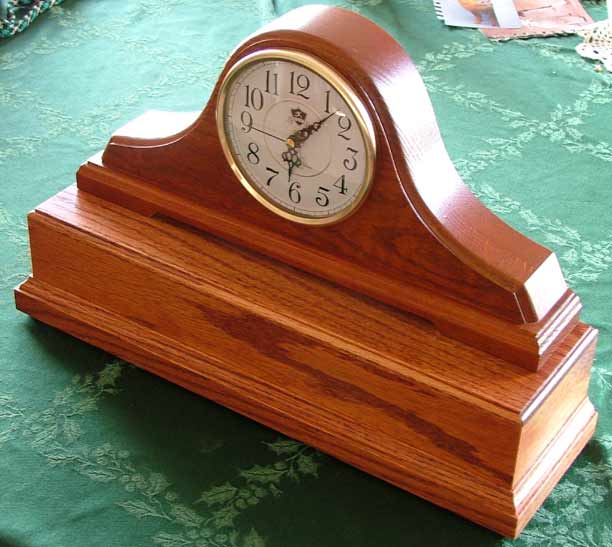
The pet urn (bottom part) I built for a friend pictured below was clamped using the packing tape/stretchy wrap trick.

Regards,

Grant in Iowa

img

frame clamp

👍 This page answered my questions

Your vote helps other woodworkers quickly find the answers and techniques that actually work in the shop.