Re: Unicorning other steel
Derek Cohen (in Perth, Australia)
Bill, I have added a unicorn profile to a variety of chisel steels: O1 and A2 (of course), but also PM-V11, M4 and 3V. The harder, more abrasion-resistant steels simply need a little different technique - more or less pressure, more or less speed, and a more or less abrasive compound.
In other words, the technique, per se, is not different, just that the set ups we use are different, and each one requires a slight variation. Bear with me as I describe my progression to date. This may help another starting out.
I've been using a half-speed grinder all the way through (when I set up the original stitched wheel, it was in a variable speed lathe but at 1425 rpm, the same as a half-speed grinder). The original wheel was a 6" and soaked in green compound, and it cut quite aggressively. Adding a unicorn profile to chisels was still okay, which goes to show how forgiving the method is with chisels.
I started a new system using a new 8" half-speed grinder (I had already planned to get another grinder before David came up with this Unicorn nonsense, one to shape curved blades and lathe chisels). There was a new 3/4" wide stitched denim wheel, initially, and then I added a 2" wide version with eyes on plane blades.
The 2" wide wheel was a mistake. Not only are the denim wheels much harder than the less-stitched cotton wheels, but the 2" wheel was difficult to use as it did not remain flat. The 3/4" wide wheels are the way to go.
Over the past couple of weekend I have been busy with painting doors and restoring the brass hardware. The latter has involved buffing away lacquer and polishing the brass (before re-lacquering and re-installing). I learned something from this buffing: the white compound is far more aggressive than the green compound. One might think that it would be preferable to use a more gentle buffing action, but the hard denim wheels then needed more pressure, and this (I think) created a variable surface on plane blades. I was struggling to unicorn BD plane blades.
All the buffing of brass destroyed the 2" wheel, and I used this as an excuse to get two more wheels, a hard felt wheel and a soft cotton wheel. And a bar of white compound.
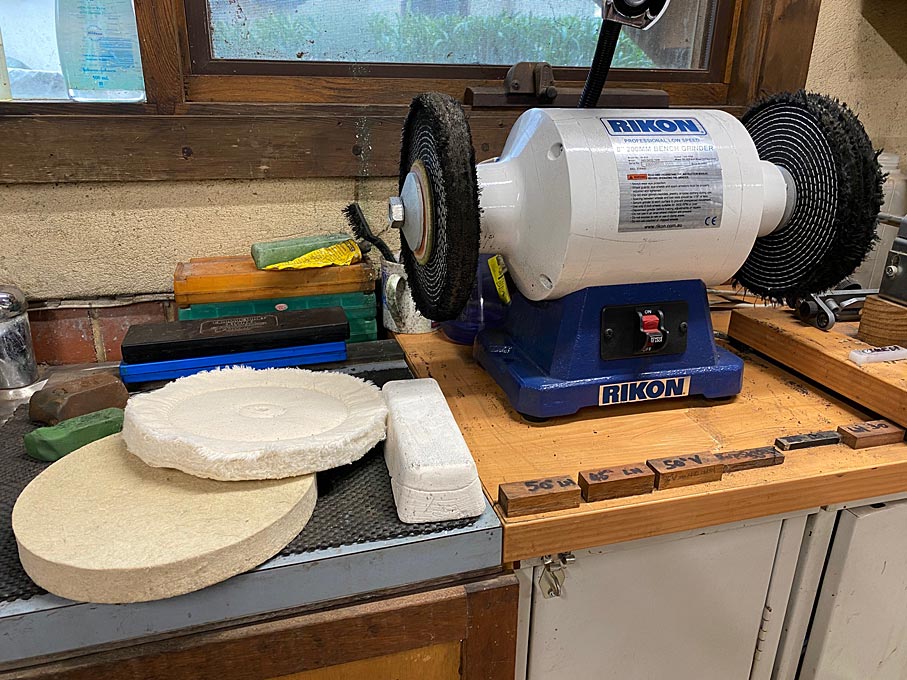
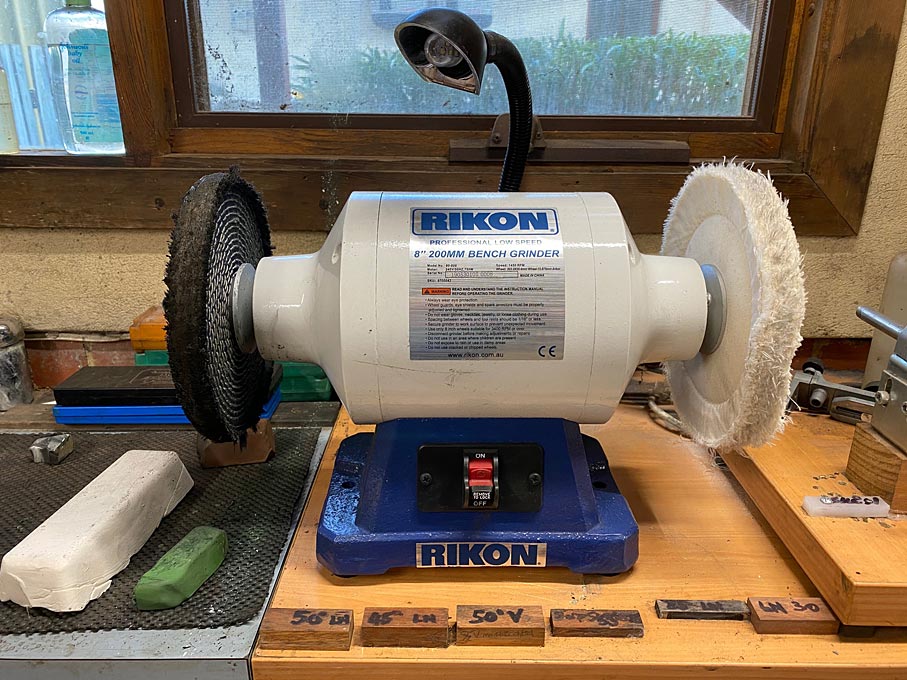
The hard felt was just too aggressive for my liking, and it was the final wake-up I needed to recognise that gentler is better. So now I have the softer cotton wheel on the other side. This is used with the white compound only ...
I spent a little time working on the technique for BD plane blades. The plane is a Bedrock #604, and the blade is a custom M4. The wood is Hard Maple ...
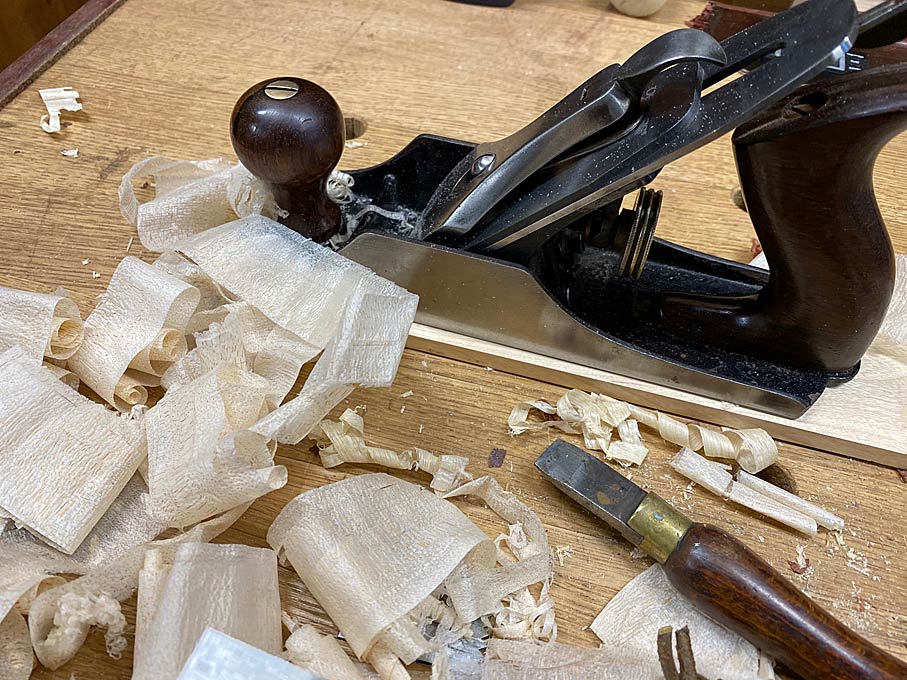
The blade has its existing 30 degree hollow grind. This was freehanded on a fine diamond stone (600 grit) to raise a wire, then smoothed a smidgeon on a worn extra fine diamond stone (possibly around 2000 grit. Then over to the wheel ...
I use the bottom of the wheel as it is easier to track the angle of buffing. I start with the primary bevel parallel to the circumference of the wheel. Then gently drop the end of the blade by about 10 degrees and lift the bevel into the wheel. This process lasts about 5 seconds. There is a very fine wire, which is removed on a hardwood-green compound strop.
The result was consistent full-width shavings with the existing very fine camber. I would call this a success.
Hard Maple is easy to do this ... 

Regards from Perth
Derek