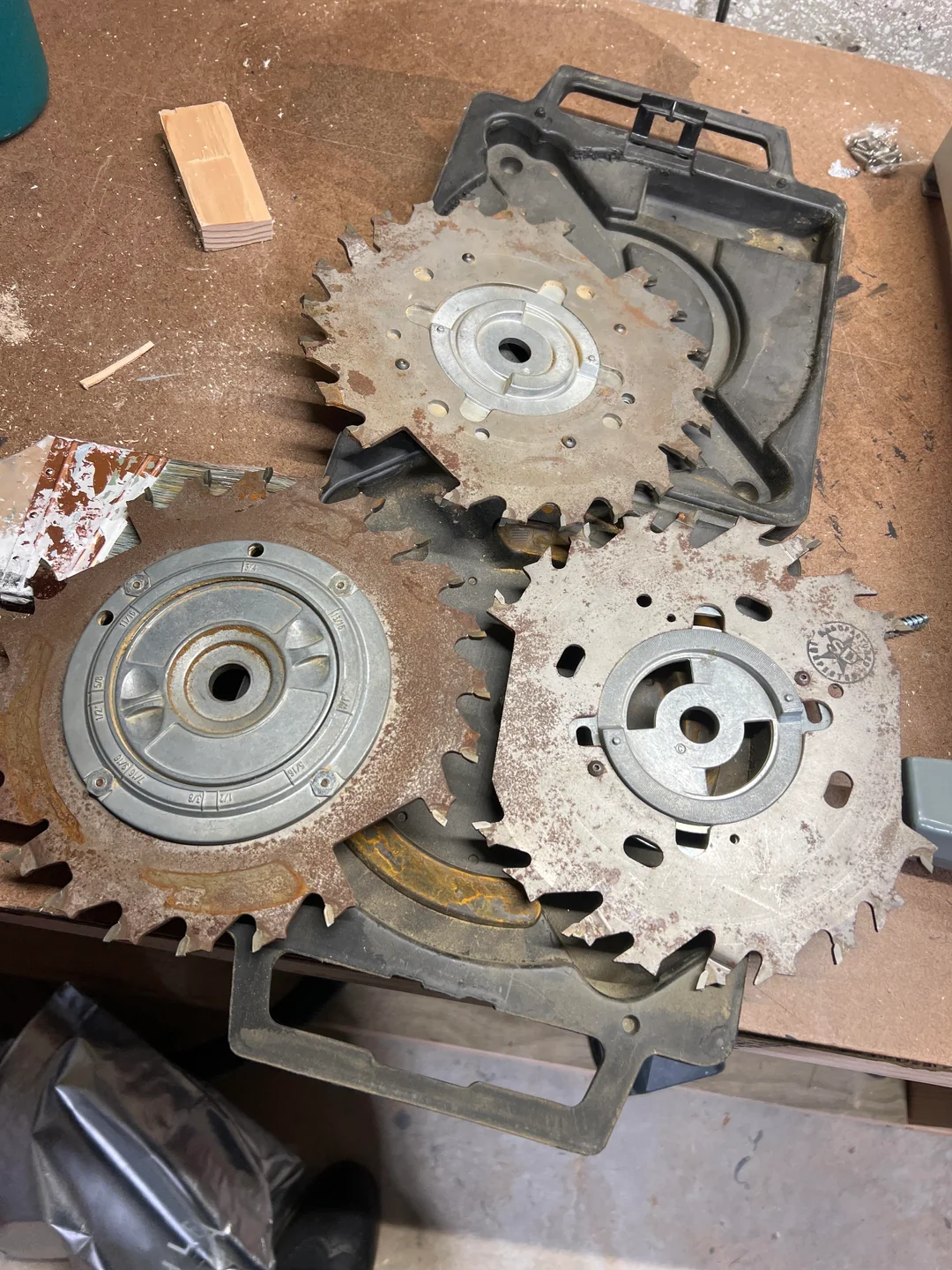
For many woodworkers who grew up with contractor saws in the 1960s through the 1990s, the wobble dado was a familiar accessory. It was inexpensive, simple to set up, and widely sold in hardware stores. Thousands of cabinets, shelves, and shop projects were built using them.
But as woodworking tools, safety standards, and expectations have improved, the wobble dado has become a relic—rarely recommended and almost never sold by professional suppliers today. While some old-timers remember them fondly, most modern woodworkers steer clear for very good reasons.
This article explains why wobble dados are considered unsafe, why they were popular anyway, and what today’s woodworker should use instead.
What Exactly Is a Wobble Dado?
A wobble dado is a single sawblade mounted on an off-center cam. Instead of spinning true, the blade oscillates in a shallow arc, sweeping left and right as it spins. By adjusting the cam angle, you can widen or narrow the cut.
This produces the correct width of a dado, but not a flat bottom. Instead, the cut is concave and scalloped, getting deeper at the edges and shallower in the center.
It’s quick and clever—but also fundamentally unstable.
Why Wobble Dados Are Considered Unsafe Today
Modern safety concerns come from three real-world mechanical problems:
- balance,
- arbor stress, and
- cutting behavior.
None of these show up with a good stacked dado set.
1. They Introduce Imbalance at High Speed
Table saws rely on a perfectly balanced blade. When the blade spins true, the cutting forces are radial—straight outward—and the saw runs smoothly.
A wobble dado forces the blade to:
- oscillate at 3,000–4,000 RPM
- change direction twice per revolution
- push sideways against the arbor bearings
As width increases, so does the amplitude of the wobble. The result is vibration you feel in the table and fence.
Vibration is not just annoying—it increases the risk of:
- kickback, because the wood encounters uneven lateral forces
- grabbing, as the blade “lunges” at the edges of the oscillation
- user error, because the saw no longer feels stable under the cut
Balance is safety, and wobble dados aren’t balanced.
2. They Apply Side-Loading to the Arbor
Table saw arbors are designed for one thing: a blade whose rim travels in a perfect circle.
With a wobble dado, every rotation puts lateral stress on the threads, bearings, and washers. Over time this can:
- loosen the arbor nut
- wear the bearings
- cause the blade to deflect mid-cut
Cheap wobble dados amplify this problem because they’re often stamped from thin, less rigid steel.
3. They Produce Unpredictable Cutting Forces
Because a wobble dado’s tooth path is constantly changing:
- the blade alternately cuts aggressively and weakly
- chips are ejected unevenly
- the cut “chatters” when the arc transitions
This increases the odds of:
- burning
- binding
- a sudden surge or stall
- kickback on wide dados or hardwood
On a saw without a riving knife (common when wobble dados were popular), the risk climbs dramatically.
Modern safety culture expects predictable tool behavior, and wobble dados simply don’t provide it.
If They’re Unsafe, Why Did Anyone Use Them?
Understanding their popularity helps explain why older woodworkers still defend them. For decades, wobble dados were:
1. Cheap and Readily Available
A stacked dado set could be expensive, often mail-order only.
A wobble dado hung on the wall at any hardware store.
For hobbyists on a budget, it was the obvious choice.
2. Quick to Adjust
Wider or narrower dado?
Turn a dial, and it’s done.
No shims, no chippers, no fuss.
This “fast setup” was the wobble dado’s greatest attraction.
3. Good Enough for Rough Carpentry
If you’re building:
- basement shelves
- kids’ toy boxes
- utility cabinets
- shop fixtures
…the scalloped bottom didn’t matter. A screw or glue joint still held fine.
Many woodworkers weren’t chasing furniture-level precision.
4. Used on Saws With Low Expectations
Older table saws lacked:
- riving knives
- blade brakes
- sturdier modern arbors
- machined table surfaces
- smooth, accurate fences
A tool that vibrated wasn’t exactly out of the ordinary.
Today, on a premium cabinet saw, the same vibration feels unacceptable.
Why Modern Woodworkers Choose Safer Alternatives
Today, we aim for predictable, smooth, accurate cuts—and we have better tools for the job.
Stacked Dado Sets (Most Common)
A stacked dado uses:
- two outer blades
- chippers
- shims for fine adjustment
Everything spins balanced, just like a regular blade.
Advantages:
- safer and smoother
- flat-bottomed cuts
- consistent width
- works well in hardwoods
- predictable feed pressure
- compatible with modern riving knives (when removed, depending on saw)
This is the gold standard for table saw dados.
Router with a Straight Bit (Safest for Beginners)
A router—especially in a table—makes:
- extremely clean dados
- perfectly flat bottoms
- adjustable width using shims, fences, or undersized bits
- no side load on the motor
- no kickback from spinning teeth in a large circular sweep
Routers excel at plywood dados because you can dial in the exact thickness.
Hybrid Techniques
Many furniture builders now combine methods:
- two router passes for clean shoulders
- one shallow dado pass on the table saw for depth and speed
- router plane for final flattening
This yields crisp, accurate joinery with minimal danger.
Where Does That Leave the Wobble Dado Today?
For most woodworkers, it’s a tool best left in the past—interesting from a historical standpoint but poorly suited to modern expectations of safety and accuracy.
A wobble dado:
- vibrates
- stresses the saw
- produces low-quality cuts
- increases kickback risk
- invites user error
- is outclassed by stacked dados and routers in every measurable way
If you inherit one or find one at a garage sale, treat it as a curiosity, not a go-to accessory.
Conclusion
Wobble dados weren’t inherently reckless—millions of safe cuts were made with them—but they belonged to an era when table saws were rougher, expectations were lower, and alternatives were limited.
Today, with affordable stacked dado sets, high-quality routers, and a stronger focus on kickback prevention, the wobble dado has largely outlived its usefulness.
Modern woodworking rewards precision and control, and wobble dados offer neither. They’re fascinating from a historical perspective but not a tool worth using in a contemporary shop.


With a router in a table and with a fence, there are some very nasty things that can happen, particularly when tuning a hole for width. It is basically a shaper which is a tool notorious for returning body parts to sender. I like having both hands on a router, at least that way, unless I absently rest the tool at arms length (pause for effect), they are relatively safe.
Wobble dado blades I won’t defend, but they seem to be the victim of a poor name. They don’t actually wobble, Each tooth has a different path, but they aren’t doing anything irregular or unplanned. If they develop a bad vibration that could be a balance thing as with a wheel on a car. I haven’t experienced that, though I never used mine much. Largely because dado joinery does not appeal to me.
For less than the cost of most dodo sets today, you can get a biscuit joiner, and it makes invisible joints of enormous strength, if one know how to use them. These days plywood is often some wacky half metric measure where chasing it won’t add much to your day, when you could fire in some biscuits with complete accuracy and a fraction of the dust. biscuits work well in both ply and solid wood. I can’t imagine doing a lot of dados in solid wood.
My dad and I used a wobble blade on his Craftsman Radial Arm Saw for years almost every day and never experienced ANY of the issues listed here. No vibration at all. As a matter of fact I was impressed by how smooth it ran and the finish of the cut. The stack blade dado doesn’t even come close to the fish in the cut of the wobble dado.