The graph illustrates one of the most consequential economic changes in the United States over the past half-century: the growing disconnect between what the economy produces and what workers receive for their labor.
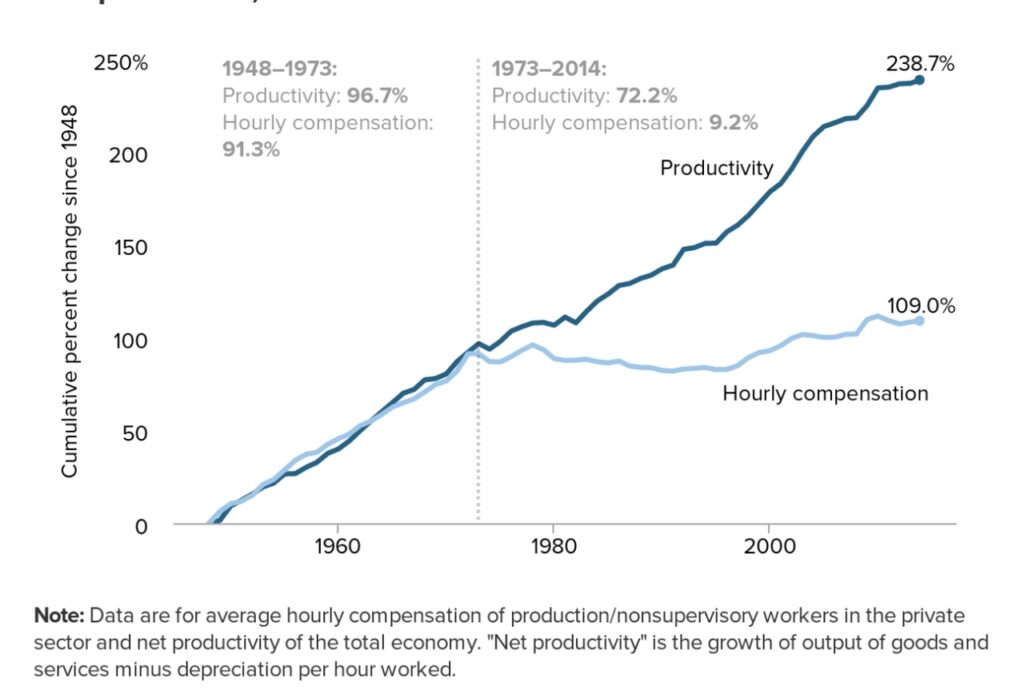
From 1948 to 1973, productivity and hourly compensation rose at roughly the same rate. Workers became more productive, and their compensation increased substantially alongside that productivity.
After 1973, the relationship changed. Productivity continued climbing, but compensation for production and nonsupervisory workers largely stagnated for decades before rising again. By the graph’s endpoint, productivity had increased by 238.7% since 1948, while hourly compensation had increased by 109%.
That divergence helps explain why many Americans feel that economic growth has not translated into a comparable improvement in their standard of living.
However, the graph needs one important qualification: it compares net economy-wide productivity with compensation for a particular group of workers. It is not a complete accounting of every worker’s pay, benefits, or household income. The precise size of the gap depends on the measures used, including inflation adjustments and whether compensation includes benefits.
1. What caused the divergence?
There was no single cause. Several structural changes reinforced one another, particularly after the early 1970s.
1. Technology increased productivity without guaranteeing higher wages
Computers, automation, advanced machinery, and improved management allowed businesses to produce more with fewer labor hours. But the economic value of those gains did not automatically flow to the employees whose work helped generate them. The distribution depended on bargaining power, competition, ownership, and public policy.
2. Globalization and offshoring weakened some workers’ bargaining power
International trade brought consumers lower-cost goods and created new markets, but moving production to lower-wage countries also put pressure on many American manufacturing workers. The credible threat of relocating production could restrain wages, even for workers whose productivity was increasing.
3. Unions weakened and bargaining power shifted toward employers
Collective bargaining historically helped workers negotiate wages, benefits, and a share of productivity gains. Declining union membership, changes in labor law and enforcement, and the growth of employment arrangements with less worker leverage reduced that counterweight in many industries.
4. Corporate priorities and income distribution changed
In many firms, greater emphasis on shareholder returns, executive compensation, cost reduction, and financial performance coincided with weaker wage growth. Profits and returns to capital could rise without a proportionate increase in ordinary workers’ compensation.
5. Essential costs rose, making income gains feel smaller
Housing in high-demand areas, health care, child care, education, and other necessities have become serious affordability problems for many households. Even when nominal wages increase, rising costs can erode purchasing power. Housing shortages and market concentration in some sectors can compound the problem.
A further factor is that productivity and pay are measured differently in many versions of this graph. Economy-wide productivity includes output generated by capital, technology, and workers in highly productive industries, while the compensation series covers a narrower group. Inflation measures and the distinction between wages and total compensation also affect the apparent gap. These measurement issues explain part of the divergence, but not all of it.
2. What changed around 1973?
The year 1973 is an important dividing point, but it was not the date of one specific policy decision that caused the entire problem.
Several changes converged:
- The postwar economic order came under pressure. The oil shocks of 1973 and 1979, rising inflation, and slower productivity growth disrupted the economic conditions that had supported the earlier period of broadly shared prosperity.
- Economic policy increasingly prioritized controlling inflation. High interest rates and policies designed to restrain demand helped bring inflation down, but recessions and persistent labor-market weakness also reduced workers’ bargaining power.
- The balance between labor and capital shifted. Changes in labor law, union strength, taxation, trade policy, and corporate regulation affected how productivity gains were distributed.
- The economy became more unequal. A growing share of income went to high earners and owners of capital, while compensation for many ordinary workers grew more slowly.
The U.S. Bureau of Labor Statistics identifies both declining labor’s share of income and differences between the inflation measures used for output and consumer compensation as important parts of the gap. Economic research also points to globalization, automation, and employer market power. The relative importance of these factors remains debated.
The central point is that productivity growth does not determine how income is distributed. Economic institutions and public policy influence who receives the benefits.
3. How can we rectify the problem?
The goal should not be to stop productivity growth. It should be to ensure that productivity growth translates into higher real wages, affordable necessities, and broadly shared prosperity.
Here are the policies I would prioritize.
1. Reconnect compensation to productivity
Establish a stronger expectation that sustained productivity gains should translate into higher real compensation. This could involve collective bargaining, sectoral wage agreements where appropriate, profit-sharing arrangements, and stronger enforcement against wage theft and illegal retaliation.
Employers should retain a return on investment, but employees should not be systematically excluded from the gains their work helps produce.
Why it matters: Workers with greater bargaining power have a better chance of capturing a share of economic growth.
2. Strengthen competition and limit economic rent-seeking
Enforce antitrust laws, scrutinize mergers that reduce competition, address anticompetitive conduct, and remove unnecessary barriers to entry for small businesses.
In concentrated labor markets, employers may have enough power to hold down wages even when they are profitable. In concentrated product markets, businesses may be able to charge prices substantially above competitive levels.
Why it matters: Competitive markets can put pressure on firms to pass efficiency gains to consumers and compete for workers.
3. Modernize the minimum wage and the tax system
Increase the federal minimum wage gradually, with appropriate regional and small-business considerations, and index it to inflation or a suitable wage measure. Make the earned income tax credit more effective for low-paid workers.
Tax policy should also examine the treatment of capital gains, inherited wealth, and very high incomes, while preserving incentives for productive investment.
Why it matters: A stronger wage floor and well-designed tax credits can improve incomes at the bottom without requiring every employer to negotiate individually with every worker.
4. Reduce the cost of essential goods and services
Reform restrictive zoning and permitting to allow more housing where people need it. Increase competition and price transparency in health care. Expand access to affordable child care and pursue policies that reduce unnecessary education costs.
Why it matters: A wage increase has limited value if rent, medical bills, and other essential expenses absorb the entire gain. Increasing the supply of scarce goods can improve living standards without adding the same inflationary pressure that broad demand subsidies might create.
5. Invest in domestic productive capacity
Encourage investment in advanced manufacturing, infrastructure, energy, research, and worker training. Where strategically justified, strengthen domestic supply chains without resorting to indiscriminate tariffs that raise costs for American consumers and businesses.
Support small and midsize businesses in adopting technologies that increase output and improve workers’ skills.
Why it matters: A sustainable rise in real wages requires both a fairer distribution of income and an economy capable of producing more valuable goods and services.
6. Make the gains from automation and AI more widely shared
As AI and automation increase output per worker, encourage employee ownership, profit-sharing, training, and transitions to better jobs. Consider how tax and benefit systems should adapt if a growing share of national income comes from capital rather than labor.
Why it matters: The next productivity boom could widen the gap further—or raise living standards substantially. The outcome depends on who owns the productive assets, how labor markets function, and how the gains are distributed.
These proposals are not all equally easy to implement, and some involve real trade-offs. The underlying research supports examining labor bargaining power, competition, taxation, and productivity investment together rather than assuming any single reform will close the gap.
4. What about today’s economic problems?
The productivity-pay gap is not the sole explanation for inflation, housing costs, national debt, or economic insecurity. Each has its own causes. But the gap contributes to an important structural problem: the economy can grow without many households experiencing a comparable improvement in their financial circumstances.
A current illustration is the decline in labor’s share of national income. Reuters reported in August 2026 that the U.S. labor share of nominal GDP fell to 52.9% in the second quarter, the lowest level in the historical series it cited, as output grew faster than labor compensation. That measure is not identical to the graph’s compensation series, but it illustrates the continuing concern.
Here is how a productivity-focused reform agenda would address several major problems:
| Economic problem | A productive response |
|---|---|
| Inflation | Expand supply, remove bottlenecks, and improve competition rather than relying exclusively on suppressing demand. |
| Housing affordability | Allow more housing construction and improve infrastructure in high-demand areas. |
| Weak wage growth | Strengthen bargaining power, competition for workers, and access to productivity-enhancing skills. |
| Income inequality | Broaden access to capital ownership, improve wage growth, and reform taxes and transfers. |
| National debt | Pursue sustainable revenue, cost-effective public spending, and stronger long-run economic growth. |
| AI-related job disruption | Support retraining, worker mobility, profit-sharing, and broader participation in the returns to automation. |
One important caution: raising wages through better productivity, stronger bargaining, and competition is different from simply injecting more money into the economy. If demand rises faster than the economy’s ability to supply goods and services, inflation can erase some of the gains. Policy needs to improve both purchasing power and productive capacity.
5. The most important structural reform
If I had to identify one overarching objective, it would be this:
Restore the link between economic growth and the economic well-being of ordinary working people.
That does not mean guaranteeing every worker the same income or forcing wages to rise independently of economic conditions. It means creating an economy in which productivity improvements generate broadly distributed gains rather than disproportionately increasing returns to a relatively small group of owners and highly compensated individuals.
The practical test should be whether productivity growth leads over time to:
- Higher inflation-adjusted median compensation.
- A lower burden from housing, health care, and other necessities.
- More opportunities for workers to accumulate savings and own productive assets.
- Sustainable business investment and employment.
- Broadly shared improvements in living standards.
These measures are more informative about economic well-being than GDP growth or stock-market performance alone.
Conclusion
The divergence shown in the graph was not an inevitable consequence of technological progress. Technology made the economy capable of producing far more per hour of work. Changes in markets, institutions, and policy helped determine how much of that additional output reached workers.
Rectifying the problem requires more than raising wages by decree or redistributing income after the fact. It requires a combination of stronger worker bargaining power, competitive markets, affordable necessities, productive investment, and policies that distribute the returns from technological progress more broadly.
The objective is not to make the economy produce less or to punish successful businesses. It is to make economic growth work better for the people who sustain it.


