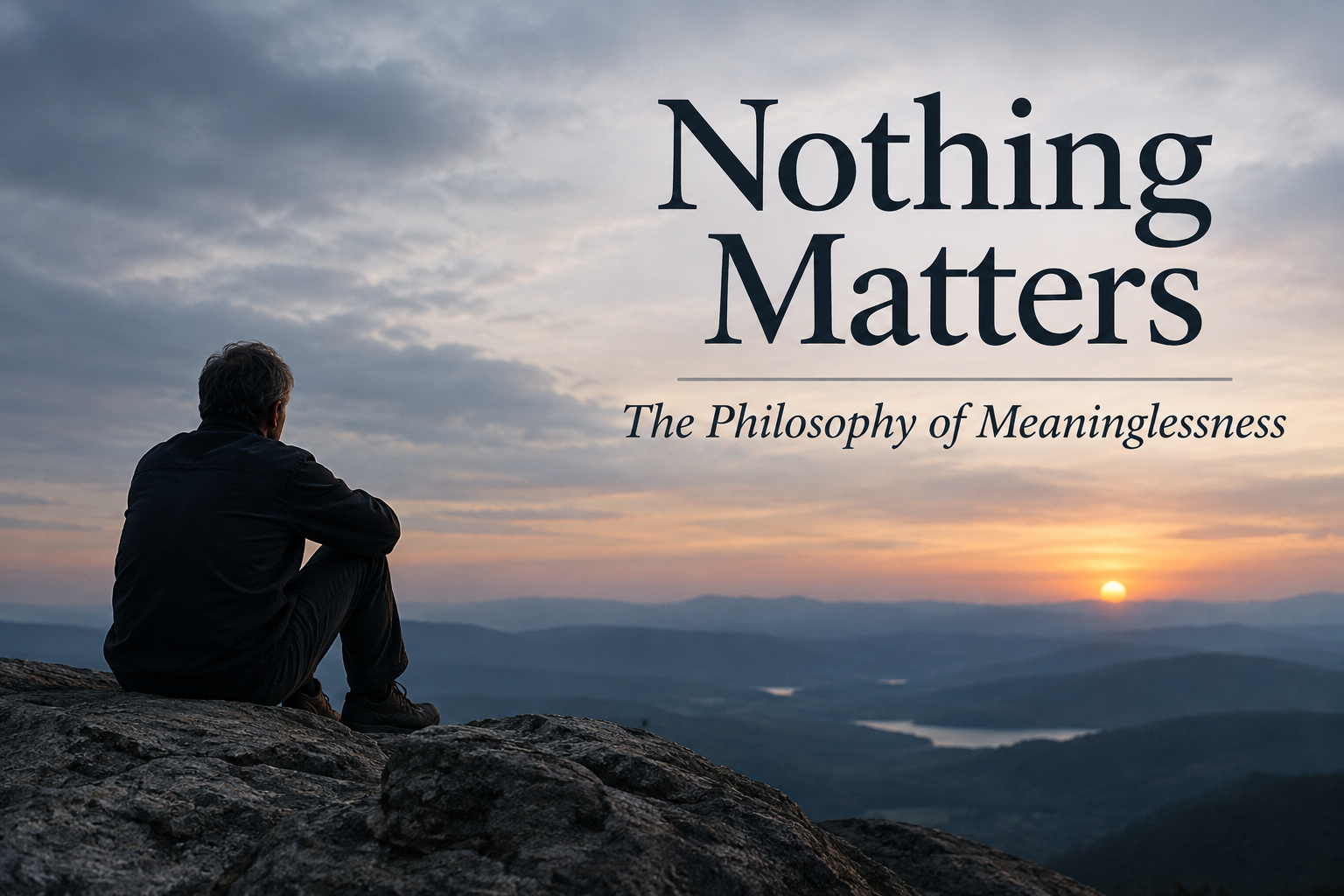
The Philosophy of Meaninglessness
Contents
- Defining Nihilism
- The Death of God
- Condemned to Be Free
- Imagining Sisyphus Happy
- Optimistic Nihilism
- The Nihilist Generation
Introduction
Say it out loud
Nothing matters. Said alone in an empty room, the sentence can sound like a verdict. Said to a friend over coffee, it sounds like a joke. Said at three in the morning, it can sound like a trapdoor.
This book takes the sentence seriously, which is different from agreeing with it. For a century and a half, philosophers have asked what follows if the universe holds no built-in purpose: no author, no plot, no scoreboard. Some concluded that we should despair. Some concluded that we should rebuild. A few concluded, to the annoyance of nearly everyone, that the situation is rather funny and quite freeing.
The chapters follow that argument in order. We begin by defining nihilism and separating its two very different temperaments. We then go to Friedrich Nietzsche, who diagnosed the collapse of Europe’s old certainties and insisted we must get through it. Next come the two great twentieth-century replies: the existentialism of Jean-Paul Sartre, which says we must build our own purpose, and the absurdism of Albert Camus, which says we should stop expecting the universe to answer and live well anyway. We close with optimistic nihilism, a modern attitude that borrows from all of them, and with a look at why this old philosophy suddenly feels so current.
A word on method. I describe each thinker as faithfully as I can, then say where the position runs into trouble. Nothing here asks you to adopt a conclusion. The aim is to give you a map of the territory, so that when the thought arrives at three in the morning, you know where you are standing.
Chapter 1
Defining Nihilism
The word comes from the Latin nihil, nothing. It is older than Nietzsche. German philosophers were using it by the end of the eighteenth century as an accusation against ideas that seemed to dissolve everything solid, and Ivan Turgenev’s 1862 novel Fathers and Sons gave it a face in Bazarov, a young man who accepts no principle on authority alone. By the time Nietzsche took the word up in the 1880s, it already meant something between a charge and a mood.
Philosophers now sort nihilism into several kinds. Existential nihilism holds that life has no inherent purpose. Moral nihilism holds that nothing is objectively right or wrong. Epistemological nihilism doubts that knowledge is possible. Political nihilism rejects all existing institutions. This book is mostly about the first kind, together with the moral shadow it casts.
Two ways of answering an empty sky
Nietzsche’s most useful contribution is less the claim that our values lack a foundation than a distinction between what people do next. He separated passive nihilism from active nihilism.
Passive nihilism is resignation. The passive nihilist reasons that because nothing is ultimately worth doing, nothing deserves much effort. It shows up as numbness, withdrawal, cynicism, a shrug that hardens into a worldview. Nietzsche tied it to exhaustion: a weakened will and a longing for rest. He saw it in Schopenhauer’s pessimism, which treats existence as suffering to be endured and, if possible, quieted. He also saw a quieter version in the comfortable person who stops asking anything of life except ease.
Active nihilism treats the collapse as work to be done. If inherited values have lost their authority, then pretending otherwise is dishonest. The active nihilist questions customs, exposes the hollow ones, and refuses to prop up beliefs merely because they are familiar. Nietzsche read this as a sign of strength: a mind with enough force to live without the old certainties. But he also saw it as a transitional stage. Demolition clears ground; it does not build. An active nihilist who never reaches the building stage has become a more energetic version of the passive one.
| Passive nihilism | Active nihilism | |
|---|---|---|
| Response | Resignation: nothing matters, so why try | Demolition: what no longer holds should be taken apart |
| Mood | Fatigue, numbness, cynicism | Defiance, restlessness, appetite |
| Relation to old values | Lets them rot, or clings to them out of habit | Tests them and discards what fails |
| Risk | Stagnation | Destruction with nothing to follow it |
| Next step | None; this is a resting place | Creating new, life-affirming values |
The premise is the same. The lives that follow from it are opposite.
That is why the distinction matters. The belief that nothing is inherently meaningful does not, by itself, decide whether a life is bleak or vivid. The response decides that. Every philosophy in the rest of this book accepts something close to the nihilist premise. They differ almost entirely on what to do after accepting it.
A test you can use
After you have taken a belief apart, what do you do with the space it leaves? Passive nihilism leaves it empty. Active nihilism clears it so that something can be put there.
Chapter 2
The Death of God
In 1882, in The Gay Science, Nietzsche published a short parable that became the most quoted sentence in modern philosophy. A madman lights a lantern in the morning, runs into a marketplace, and cries that he is looking for God. The crowd, mostly unbelievers, laughs at him. He stares them down and tells them what he has come to say: God is dead, and we have killed him.
It is easy to read this as a boast. It is nothing of the kind. The madman is horrified. He asks how we could wipe away the horizon, what we were doing when we unchained the earth from its sun, and whether we are not falling endlessly in every direction. The crowd falls silent. Then he says that he has come too early, that the deed is still on its way to them and has not yet reached their ears.
A diagnosis, not a celebration
Nietzsche was not announcing a victory for atheism. He was describing a cultural fact. Europe’s moral and intellectual life had for centuries rested on the Christian story: a created world, a divine order, a purpose built into suffering, a final accounting. Science, historical criticism, and the slow habit of asking for evidence had worn away belief in that story. Yet the values built on top of it, such as compassion, equality, truthfulness and the sanctity of the individual, were still being treated as though they stood on their own. Nietzsche’s worry was that they did not. Pull out the foundation, and the building will not fall at once, but it will fall.
Dostoevsky had drawn the same worry in fiction a few years earlier, in Ivan Karamazov’s fear that without God everything is permitted. Nietzsche pressed further. He predicted that the consequences, which he named nihilism, would dominate the next two centuries, and that most people would not notice until they were already living inside them.
The last man
In Thus Spoke Zarathustra, Nietzsche sketched the figure he feared most: the last man. The last man has solved the problem of meaning by lowering his ambitions until nothing is risked. He wants comfort, safety, a little pleasure by day and a little by night. He blinks, and he calls this happiness. This is passive nihilism at civilizational scale: not a dramatic collapse, but a contented fading.
Against this, Nietzsche set a program of overcoming. He called for a revaluation of all values, the active work of asking which of our values enhance life and which merely hold it back. He offered the idea of amor fati, the love of one’s fate, which means affirming one’s life, flaws and losses included. And he offered the thought experiment of eternal recurrence: imagine you must live this exact life again, endlessly. Could you say yes? A person who could has made peace with existence without needing a cosmic guarantee.
The old foundation is gone. Nietzsche’s answer was to learn to build on air.
What it means now
It would be a mistake to treat Nietzsche’s “God” as only a theological term. It stands for any grand story that once ranked everything and told us where we belonged: the destiny of a nation, the inevitability of progress, the dignity of a career, the promise that effort is always repaid. When such a story loses credibility, the symptoms Nietzsche described appear: drift, irony, and the sense that nothing underneath the surface is holding. That is where we will find ourselves again in Chapter 6.
It is also worth being honest about the limits of his answer. Nietzsche’s ideal figure, the creator of new values, can sound like a solitary hero, and he is vague about how such values could be shared or justified to anyone else. Later thinkers took up exactly that problem.
Chapter 3
Condemned to Be Free
If Nietzsche diagnosed the problem, the existentialists tried to live in it. The line that defines their approach comes from Jean-Paul Sartre’s 1945 lecture, later published as Existentialism Is a Humanism: existence precedes essence.
Existence before essence
Sartre’s example is a paper knife. Someone designed it, with a purpose and a use in mind, before it was ever made. Its essence, what it is for, came first, and the physical object followed. For most of history, people assumed humans worked the same way: a creator had a design in mind, and our nature was fixed before we arrived.
Sartre argued that if there is no creator, the order reverses. A human being first exists, turns up in the world, and only afterward defines what she is by what she does. There is no blueprint to consult. You are not a nature waiting to be fulfilled. You are a project, and the project is yours.
The weight of freedom
This is the source of Sartre’s startling phrase: we are condemned to be free. Condemned, because we never chose to be free and cannot stop. Even refusing to choose is a choice, and it too has consequences for which we answer. Sartre described three feelings that come with this: anguish, the dizziness of knowing that your choices define you; abandonment, the recognition that nothing external will do the deciding for you; and despair, the acceptance that you act without a guarantee of success.
He added a demanding twist. When you choose, he said, you choose not only for yourself but implicitly for everyone, because you are asserting what a human being ought to be. Freedom, on this account, is not license. It is responsibility without an exit.
Bad faith
The existentialist’s name for evasion is bad faith. In Being and Nothingness, Sartre describes a café waiter whose every movement is a little too precise, a little too eager, as though he were playing the role of “waiter” instead of simply being a person who waits tables. The waiter hides inside the role to avoid the open question of who he is. Others hide in “human nature,” in “the way things are done,” in “I had no choice.” Bad faith is the lie that we are things with fixed essences rather than free beings.
Simone de Beauvoir sharpened the point in The Ethics of Ambiguity. Freedom, she argued, is not fully real if it is enjoyed alone. A person committed to her own freedom is committed to the freedom of others, since her own is bound up with theirs.
Meaning is not found. It is made, one choice at a time, and you are answerable for the result.
Where it strains
Critics have raised two objections that deserve a fair hearing. First, radical freedom seems to understate how much of a life is shaped by things nobody chose: poverty, health, family, the century you were born into. Sartre came to accept this and spent his later career trying to reconcile freedom with material conditions, partly through Marxism. Second, the claim that we must create meaning can feel like a new burden instead of a relief. If there is no external standard, what makes one chosen purpose better than another? The existentialist replies that it is on us to hold a purpose honestly and with open eyes, but not everyone finds that answer satisfying.
That dissatisfaction is where Albert Camus begins.
Chapter 4
Imagining Sisyphus Happy
Albert Camus is usually grouped with the existentialists, and he spent much of his career refusing the label. His 1942 essay The Myth of Sisyphus starts from a different place. The existentialists ask how we should create meaning. Camus asks whether we are right to expect it at all.
The absurd
For Camus, the absurd is not a feature of the world and not a feature of us. It is the collision between them. Human beings have an unquenchable appetite for order, purpose and explanation. The universe offers none of these in return; it is silent, not hostile. The absurd lives in the gap between the demand and the silence.
Camus opens the essay by asking whether, given this, life is worth living at all. He treats the question as the first one philosophy must answer, and he treats it with great seriousness. His answer, as we shall see, is yes.
He considers three possible responses to the gap. The first is to give up on life. The second he calls philosophical suicide: leaping into faith, or into a grand system, that promises the missing meaning, which he sees in thinkers such as Kierkegaard and Jaspers. The leap closes the gap by pretending it was never there. Camus rejects both. The third response is to hold the contradiction open and live inside it with open eyes. He calls this revolt.
The myth
Camus finds his image in Greek myth. Sisyphus, as punishment, is made to roll a boulder up a hill. Each time it nears the top, it rolls back down, and he must begin again, forever. It is the perfect portrait of futile labor.
Camus places his attention on the moment after the boulder rolls down, when Sisyphus walks back to the bottom. He is conscious, he knows his situation entirely, and nothing about it will change. That is the tragic moment. And that is the moment, Camus says, when Sisyphus is greater than his fate. A man who sees clearly, and refuses both hope and despair, cannot be crushed by what he understands. The struggle toward the heights is enough to fill a human heart.
One must imagine Sisyphus happy.Albert Camus, The Myth of Sisyphus
Revolt, freedom, passion
Camus draws three consequences. Revolt is the refusal to look away from the absurd or to resolve it falsely. Freedom follows, because if no grand purpose is waiting, we are released from living in service of one. Passion is the decision to experience as much and as intensely as we can, valuing the quantity and quality of lived moments rather than outcomes.
Two replies compared
| Sartre (existentialism) | Camus (absurdism) | |
|---|---|---|
| Starting point | Existence precedes essence | The human need for meaning meets a silent universe |
| Central task | Create purpose through chosen action | Live without appeal, keeping the tension open |
| Meaning | Made by the individual | Not to be found, and not required in order to live well |
| Key figure | The free, responsible chooser | Sisyphus, conscious and unbeaten |
| Temptation to avoid | Bad faith | The leap, whether into faith or into a system |
The two men were friends until 1952, when a disagreement over Camus’s book The Rebel and the politics of the Cold War ended the friendship in a public quarrel. Their philosophies reflect the same distance. Sartre wants purpose to be built; Camus doubts that the hunger for it can ever be fully fed, and says we should live well despite that.
A third voice
In 1971, the philosopher Thomas Nagel published a short essay, “The Absurd,” that offers a quieter diagnosis. Absurdity, he argued, comes from carrying two perspectives at once: we take our lives seriously from the inside, and we can always step back and see that everything we take seriously is arbitrary from the outside. Nagel thought defiance, Camus’s preferred posture, was too dramatic. He recommended irony: acknowledge the mismatch, and carry on with a smile.
Chapter 5
Optimistic Nihilism
Put Nietzsche, Sartre and Camus in a room and they will agree on a surprising amount. There is no cosmic purpose handed to us. This is an occasion for a task, not for collapse. And the task is to live fully, honestly and without hiding. In recent years, a loose attitude has gathered these threads under the name optimistic nihilism, especially online, where it has traveled through essays, videos and conversation more than through academic journals. It is less a school than a stance.
The argument in three steps
- Nothing matters, cosmically. The universe is about 13.8 billion years old and unimaginably large. Our planet is a small and young part of it, our species a recent arrival, and a single human life a flicker. No outside observer is keeping score.
- So nothing is required of you. If no external authority ranks the possible lives, then none of them is mandatory. The standards that weigh on you, such as the correct career, the right milestones, the expected achievements, have no cosmic enforcement behind them.
- So mattering is local, and it is yours. Your friend’s laughter, the taste of food, the satisfaction of finishing something hard, the face of someone you love: these matter to you, and being small on a cosmic scale does not cancel them. They never needed cosmic approval to be real.
The optimism lies in the third step. If life has no assigned meaning, then it also has no assigned failure. You cannot fall short of a purpose that was never set. What looked like a void becomes something closer to an open field.
What it is not
The stance is easy to caricature, so it helps to say what it excludes. It is not hedonism, since pleasure-chasing as a program tends to wear out the capacity for pleasure. It is not passive nihilism with a smile painted on, because the point is engagement, not withdrawal. It is not a license for cruelty. The claim that nothing matters cosmically does not imply that nothing matters to the people you affect, and their experiences are as real as yours. And it is not denial, a way to avoid sadness; grief and loss remain what they are.
Cosmic insignificance and personal significance are different measurements. One does not cancel the other.
The honest objections
Critics make two points worth taking seriously. The first is that optimistic nihilism looks too convenient: a philosophy that reaches a comforting conclusion from a bleak premise should make us suspicious. The second is a question of logic. If nothing matters, why should joy be better than misery? The usual reply is that joy does not need cosmic authorization to be preferable. We find some experiences worth having, and that preference is a plain fact about what it is like to be us. A reasoner who demands an external justification for it is asking for something that no value, even in a meaningful universe, could supply.
A third worry is practical rather than philosophical. A mood is easier to adopt in a good week than in a bad one. Treat this stance as a practice, not a one-time conclusion; it takes repetition, especially when circumstances are hard.
Practices that fit the idea
- Name which expectations you are carrying, and ask whose they are. Keep the ones you endorse. Put down the ones you only inherited.
- Choose small, concrete engagements over large abstract ones: a craft, a garden, a regular dinner, a person you check on.
- Let curiosity do some of the work that purpose usually does. A question worth asking can hold attention without being a mission.
- Use humor on the absurdity of your own seriousness, without aiming it at other people’s pain.
Chapter 6
The Nihilist Generation
Nihilism once belonged to novels and seminar rooms. Now it is a feature of ordinary talk. Jokes about nothing mattering fill social feeds, “doomer” is a self-description, and many people under forty speak about the future with an irony their grandparents would have found strange. The argument of this chapter is that this mood is not simply a fashion or a character flaw. It is a response to the real collapse of structures that used to supply meaning, and the way it is handled will matter a great deal.
The script that stopped working
In 1931, the historian James Truslow Adams gave the phrase “the American Dream” its modern form in The Epic of America, describing a country where life could be better and fuller for everyone according to ability and effort. Through much of the twentieth century, a version of that promise was a workable script: finish school, find steady work, buy a home, raise a family, retire with security. The script told you what a good life was, what it cost, and what you would get.
For many younger adults, the script no longer pays out as advertised. Housing, tuition and healthcare have grown costlier than wages for years. Careers are more precarious and less likely to last a lifetime with one employer. Surveys over several decades have recorded falling confidence in institutions, from government to the press to organized religion, and a growing share of Americans describe themselves as having no religious affiliation. Add the background hum of climate anxiety and an endless feed of crises, and the sense that the old story has lost its authority is not hard to explain.
Nietzsche’s description fits closely. The structures were never cosmic truths. They were stories that organized meaning, and when the evidence against them piles up, they stop working.
Waking up, or going numb
Here the distinction from Chapter 1 does its work. The collapse of inherited structures can produce either of two reactions.
Passive is the numbness: scrolling past the news, treating all commitments as suckers’ bets, using irony as armor. It is understandable, and it has real costs, including loneliness and a ready audience for anyone selling a simple enemy or a simple cure. A population that believes in nothing is not hard to steer.
Active is the awakening. It starts by seeing clearly that the promised path was never guaranteed, and it asks what to build in its place. Those who take this route are not rejecting meaning. They are rejecting borrowed meaning, and looking for the kind that holds up when examined.
The void is a place to pass through. The danger comes from living in it.
Toward authenticity
The word the existentialists used for the way out is authenticity: living by values you have examined and chosen, instead of ones you absorbed. At the personal level that means asking what you would want if no one were watching and no one were keeping score. At the social level, it often means building smaller, sturdier structures than the grand ones that failed: a neighborhood, a workplace that treats people decently, a craft community, a congregation or a club that actually meets, mutual aid, local politics. These forms are modest. They are also the places where meaning has always been made in practice, long before anyone wrote a philosophy of it.
On this reading, the nihilist generation is less a lost generation than an early one: the first to see plainly that the inherited script has run out, and therefore the first obliged to write something of its own.
A counterpoint
“Nihilist generation” is a convenient label, and generation-sized claims are always generalizations. Many young people draw real meaning from faith, family, and community, and the mood described here is not equally shared. It is also fair to ask whether previous generations had firmer certainties or only different ones. Treat the argument above as a reading of a trend, not a measurement of every person.
Conclusion
Nothing matters, and that is where it starts
We began with a sentence that can feel like a verdict. By now it should look more like a premise. Nietzsche showed that the premise, once accepted, leaves a choice between slumping into passivity and doing the harder work of building. Sartre said that the work is yours alone, and that freedom is a weight you cannot put down. Camus said that the silence of the universe is not an insult, and that a life lived in full awareness of it can be a happy one. Optimistic nihilism takes the best of each and offers an everyday version: if nothing is required of you, you are free to care about what you actually care about.
None of this removes the hard parts of being alive. Grief is still grief. Injustice is still worth opposing, and not because the cosmos demands it, but because people are harmed by it and that matters to them, and to you. The point of the philosophy is not to make life lighter by pretending nothing is at stake. It is to remove the false weight, the borrowed expectations and imaginary scorekeepers, so that you can pick up the real things.
If you take one idea away, take this: the absence of a universal meaning does not leave you with nothing. It leaves you with this: this day, these people, this work, this strange and brief chance to pay attention. That is a great deal to have.
A note for readers
Books about meaninglessness can land differently depending on where you are standing. If the ideas here feel less like philosophy and more like a description of how your own days feel, or if you are struggling, please consider talking with someone you trust or a mental health professional. Philosophy can be a companion, but it is not a substitute for support.
Further reading
Where to go next
- Friedrich Nietzsche, The Gay Science (1882), especially section 125, the parable of the madman.
- Friedrich Nietzsche, Thus Spoke Zarathustra (1883–85), for the last man and eternal recurrence.
- Jean-Paul Sartre, Existentialism Is a Humanism (1946), a short and readable entry point.
- Jean-Paul Sartre, Being and Nothingness (1943), for bad faith and the full argument.
- Simone de Beauvoir, The Ethics of Ambiguity (1947).
- Albert Camus, The Myth of Sisyphus (1942), and the novel The Stranger (1942) for the absurd in narrative form.
- Thomas Nagel, “The Absurd,” The Journal of Philosophy (1971).
- Fyodor Dostoevsky, The Brothers Karamazov (1880), and Ivan Turgenev, Fathers and Sons (1862), for nihilism in fiction.
- Viktor Frankl, Man’s Search for Meaning (1946), for a different answer to the same question.
Nothing Matters · The Philosophy of Meaninglessness


