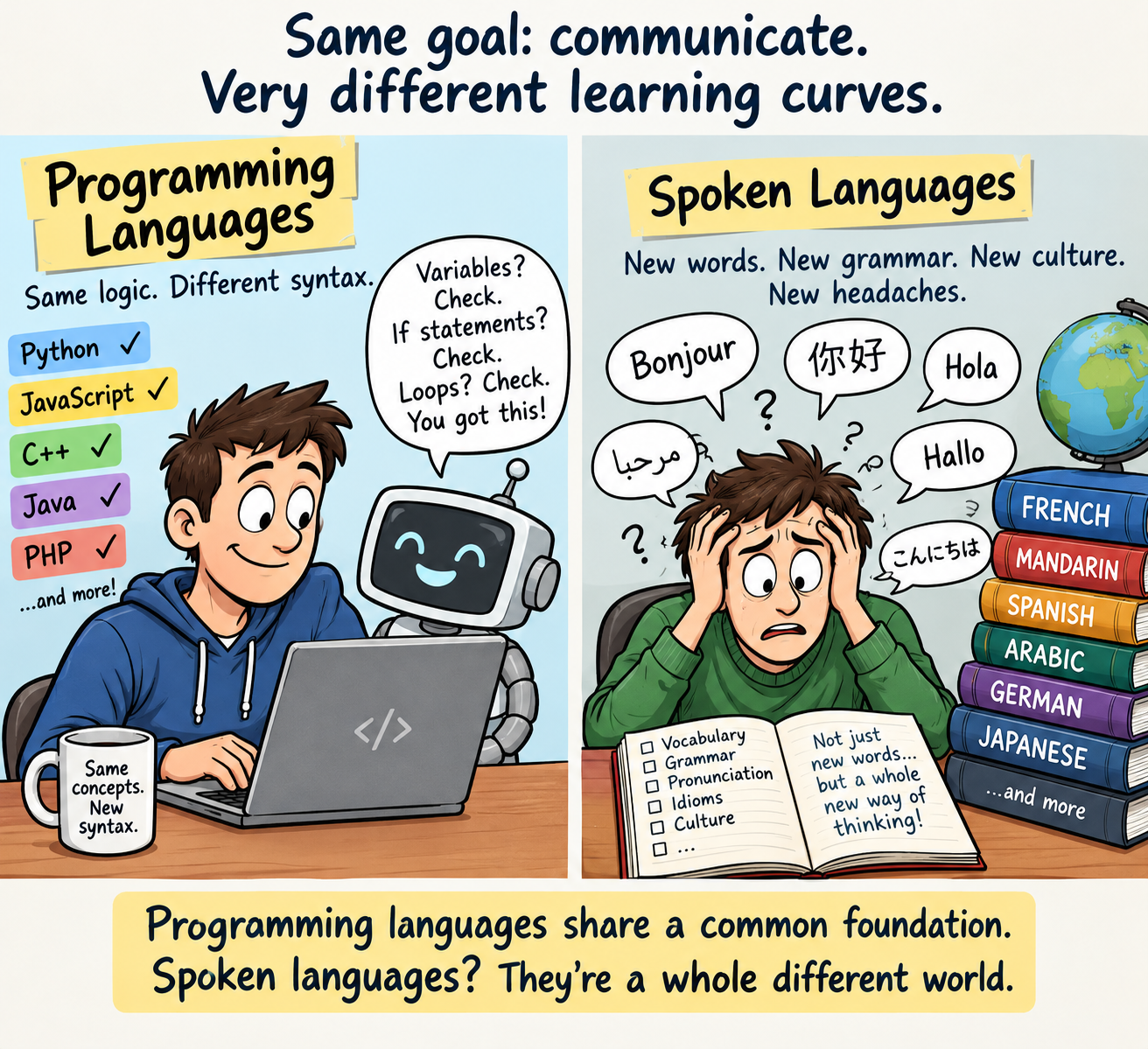
Programming languages are generally easier to learn than spoken languages because they share a much more consistent underlying structure. Once you understand the basic concepts—variables, data types, conditional statements, loops, functions, and data structures—you already have a foundation that applies to many other programming languages. The syntax may change, but the fundamental logic remains largely the same. Learning a new programming language often amounts to learning a different way of expressing concepts you already understand.
Spoken languages are considerably more complex in this respect. Each has its own vocabulary, grammar, idioms, pronunciation, cultural context, and often a different way of structuring thoughts. Knowing English, for example, provides relatively little direct help in learning Mandarin or Arabic. Even languages that share common roots can differ significantly in grammar, usage, and pronunciation.
Programming languages, by contrast, are deliberately designed to be precise and unambiguous. They operate within defined rules, and a computer will generally tell you when your syntax is incorrect. Natural languages evolved over thousands of years through cultural interaction, and they are full of exceptions, irregularities, implied meanings, and expressions that make sense only through context.
The key difference is that programming languages share a common conceptual foundation, while spoken languages require us to learn not only new rules but often entirely new ways of expressing meaning. Once you have learned to program, picking up another programming language is usually much easier than starting from scratch. Learning another spoken language rarely offers the same degree of transfer.


