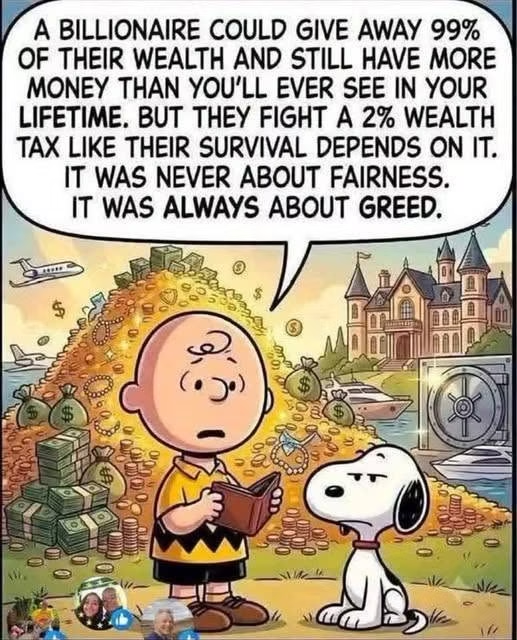
The weakness in this meme is that it takes a complicated question about wealth, fairness, and economic responsibility and reduces it to a simple moral judgment: billionaires have more than they need, therefore resisting a wealth tax is evidence of greed.
That is emotionally effective, but it skips several important questions. How was the wealth acquired? What obligations does ownership create? What does society already collect in taxes? And what policies actually help people improve their circumstances?
I think the most productive way to examine this is to separate the meme’s moral argument from its economic assumptions.
1. Wealth is not necessarily evidence of wrongdoing
The meme invites us to look at a billionaire’s fortune and compare it with the financial struggles of an ordinary person. The contrast is striking, but the contrast itself tells us very little about how either person arrived at their circumstances.
Wealth can result from many things:
- Creating a business that produces goods or services people willingly buy.
- Developing an invention, technology, or process that increases productivity.
- Investing capital and accepting the risk of losing it.
- Inheriting assets accumulated by previous generations.
- Benefiting from political favoritism, monopolistic practices, fraud, or other advantages that undermine fair competition.
These are not morally or economically equivalent situations.
A person who builds a successful business by creating something valuable has a different claim to the resulting wealth than someone who accumulates it through corruption or the suppression of competition. Inherited wealth raises still other questions about opportunity, family responsibility, and the transmission of advantages across generations.
The meme treats all these cases as though they were interchangeable. They aren’t.
Having more than someone else does not establish that you obtained it dishonestly, just as having less does not establish that you were cheated. Neither conclusion can be drawn from the difference in wealth alone.
At the same time, the opposite is also true: the fact that wealth was legally acquired does not automatically establish that every advantage contributing to it was fair. We need to examine the circumstances rather than infer virtue or guilt from someone’s bank balance.
2. A wealth tax is not the same thing as taxing income
The meme’s claim that a billionaire could give away 99% of their wealth and still have more money than most people will ever see is mathematically plausible for some billionaires. But it doesn’t establish what tax policy should be.
Consider what a billionaire’s wealth actually consists of. It may include shares in a publicly traded company, ownership of a private business, real estate, and other investments. A net worth of $10 billion does not necessarily mean $10 billion sitting in a bank account. Much of it may be tied up in assets whose value fluctuates.
A 2% annual tax on $10 billion in net wealth would initially amount to $200 million a year, assuming the entire amount is taxable. That is not a tax on $200 million of newly earned income; it is a tax on the value of existing assets.
This distinction matters because:
- Income taxes generally apply to income received, subject to the applicable rules.
- Capital gains taxes generally apply when taxable gains are realized, with important exceptions and special rules.
- Wealth taxes apply to the value of covered assets, potentially whether or not those assets generate income that year.
A business might be extremely valuable while producing relatively little current cash for its owner. A wealth tax could require that owner to sell assets, borrow money, or find cash elsewhere to pay the bill. Depending on the design of the tax, that could affect investment decisions and business ownership.
These are legitimate policy concerns, not proof that the person opposing the tax is greedy.
The other side of the argument deserves consideration, too. Wealth can appreciate substantially without the owner realizing taxable capital gains, and large fortunes can generate returns that enable further accumulation. Advocates of wealth taxation argue that this creates a gap between economic enrichment and taxation.
The OECD’s analysis of wealth taxes discusses both sides, including administrative difficulties, avoidance, effects on investment, and alternatives such as capital income and inheritance taxes. It also notes that wealth taxes have often generated relatively little revenue in countries that adopted them.
The appropriate question is not whether billionaires can afford to pay more. It is which tax structure achieves legitimate public objectives without creating unnecessary economic costs or unfair advantages.
3. The meme assumes a moral obligation that it never establishes
This is perhaps the most interesting part.
There is a difference between saying that people should be willing to help others and saying that people who possess more have a moral obligation to surrender some of it simply because others possess less.
The first is an argument for generosity. The second is an argument about entitlement, ownership, and the obligations of the state.
People can reasonably disagree about the extent of their obligations to others. Voluntary charity, mutual aid, family support, public assistance, and taxation all represent different ways of addressing human needs. They differ in how contributions are determined, who receives assistance, and how accountability is maintained.
A democratic society can legitimately impose taxes to fund public goods, provide a safety net, and expand access to opportunity. That does not require the conclusion that wealth itself is immoral or that every disparity is evidence of injustice.
Likewise, the right to own property does not settle every question about taxation. Property rights exist within legal systems that define ownership, contracts, inheritance, and the enforcement of agreements. Taxation is one part of that institutional arrangement.
The important distinction is between a defensible public obligation established through law and policy and a moral accusation directed at an individual simply for being wealthy.
The meme skips the argument needed to get from the first principle to the second.
4. Does wealth redistribution create a victim mentality?
This concern about this is worth examining, but it helps to distinguish between two different things.
One is a system that provides assistance when people encounter unemployment, disability, illness, economic disruption, or other circumstances that make self-sufficiency difficult. Such assistance can help people remain productive and recover their independence.
The other is a political or cultural narrative in which people are encouraged to view their circumstances primarily as the result of other people’s success, with little emphasis on their own agency or on the practical steps available to improve their situation.
The second narrative can be counterproductive. If people come to believe that their prospects depend principally on taking wealth from someone else, rather than developing skills, creating value, saving, investing, or pursuing opportunities, they may underestimate their own capacity to change their circumstances.
But redistribution does not automatically produce that result. The effects depend on the design of the program, the incentives it creates, the opportunities available to recipients, and the messages communicated by political and social institutions.
For example, assistance that phases out abruptly as earnings increase can discourage additional work. Assistance that helps people obtain education, childcare, reliable transportation, or temporary support while they return to work may instead increase their ability to become self-sufficient.
Similarly, a person can support a safety net while believing strongly in individual responsibility. Those positions are not contradictory.
The objective should be to help people build their own economic security, not merely to rearrange the distribution of existing wealth.
That also means recognizing that individual effort operates within real constraints. People do not all begin with the same opportunities, resources, abilities, or circumstances. Encouraging personal responsibility is compatible with addressing barriers that prevent people from making productive use of their abilities.
5. The overlooked question: How is wealth created?
Redistribution is principally concerned with how the economic output of society is divided. Wealth creation asks a prior question: how can society produce more of the things that make people prosperous?
A successful business may provide jobs, develop useful products, train workers, support suppliers, and generate tax revenue. Its success can benefit people who never own a share of it.
That does not mean every large corporation behaves responsibly, every wealthy person creates value, or every business decision benefits society. Monopolies, political favoritism, fraud, and the externalization of costs can allow private wealth to grow at public expense.
But those problems call for specific remedies: competition policy, enforcement against fraud, appropriate regulation, effective taxation, and equal application of the law.
Treating all large fortunes as inherently suspect risks confusing the accumulation of wealth through productive activity with the accumulation of wealth through the extraction of benefits from others.
There is also an important distinction between reducing the wealth of the richest people and increasing the wealth of everyone else. Those goals can overlap, but they are not identical.
A society could reduce the concentration of wealth while leaving its lower-income citizens no better equipped to build assets of their own. Conversely, policies that improve productivity, education, access to capital, and opportunities for ownership could improve living standards even if substantial differences in wealth remain.
The OECD makes a similar distinction in its analysis: reducing wealth concentration alone is insufficient; helping households with low and middle levels of wealth accumulate assets also matters.
6. A more useful standard for judging economic fairness
Rather than asking whether a billionaire has more than they need, I would ask several more precise questions:
- Was the wealth acquired legitimately? Were contracts honored, competition allowed, and laws applied equally?
- Does the tax system treat comparable economic activity consistently? Are special deductions justified by real economic benefits, or do they primarily reward those with the resources to exploit loopholes?
- Does taxation support productive activity? Does it fund useful public services while preserving incentives to invest, innovate, and work?
- Does public assistance expand opportunity? Does it help people become more capable of supporting themselves, while protecting those who genuinely cannot?
- Can ordinary people realistically build wealth? Are there meaningful opportunities to acquire skills, own homes, start businesses, save, and invest?
- Are we measuring success by improved living standards or simply by a narrower gap between rich and poor?
These questions do not presume that wealth inequality is harmless. Nor do they presume that equalizing outcomes is the proper objective. They allow us to examine both the benefits of economic freedom and the consequences of concentrated economic power.
My conclusion
The meme is persuasive because it presents an enormous difference in wealth and supplies an easy explanation for it: greed. But it offers no evidence about how the wealth was acquired, whether the proposed tax would work as intended, or what consequences the policy would have for the broader economy.
It also conflates two separate propositions: that wealthy people could give away more and that they must do so to be morally decent.
A society can expect people to obey fair laws, pay appropriately assessed taxes, and refrain from exploiting others without treating extraordinary financial success as an offense in itself.
And a society can help people who are struggling without telling them that their best hope is to wait for someone else’s wealth to be transferred to them.
Ultimately, I would frame the issue this way:
A healthy economic system should make it possible for people to improve their circumstances through productive effort, while providing reasonable protection against hardship and ensuring that wealth is not accumulated through fraud, coercion, or unfair privilege.
The goal should be neither to defend every fortune nor to resent every fortune. It should be to create conditions in which prosperity can be built, opportunity is broadly accessible, and public policy is judged by its actual results rather than by the emotional appeal of its slogans.