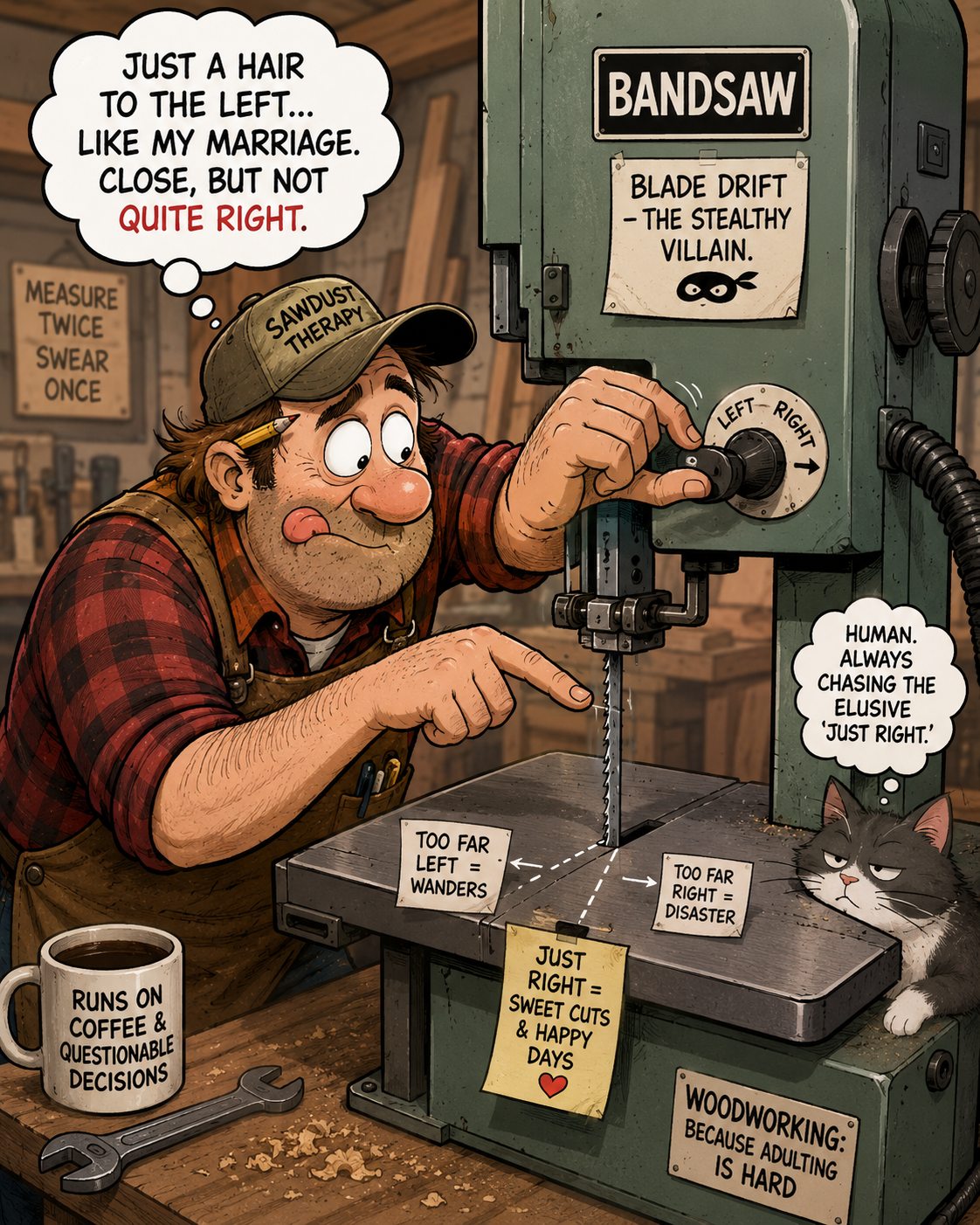
Aligning (or “tracking”) a band saw blade is one of the most important setup steps for clean, accurate cuts and long blade life. Here’s a clear, step-by-step guide that works for most 14″ and larger band saws.
Blade alignment
1. Safety first
- Unplug the saw.
- Wear safety glasses.
- Make sure the blade is properly installed and the teeth point downward.
2. Basic blade installation check
Before tracking, confirm a few quick items:
- The blade is seated in both the upper and lower tires.
- Tension is roughly correct (most saws have a tension scale or gauge).
- Thrust bearings and guide blocks are backed away from the blade so they don’t interfere while you track it.
3. Tracking the blade (the main alignment step)
- Open the wheel covers so you can clearly see both tires.
- Spin the upper wheel by hand (or turn the saw on at very low speed if your saw has variable speed).
- Adjust the tracking knob (usually a large knob or handle on the back of the upper wheel housing).
- If the blade is moving toward the front of the upper wheel, turn the knob so the top of the wheel tilts slightly backward.
- If the blade is moving toward the rear, tilt the top of the wheel slightly forward.
- Make very small adjustments (¼ turn or less) and watch how the blade reacts. The goal is for the blade to run centered on the crown of both tires.
- Once the blade tracks steadily in the center, lock the tracking adjustment.
Pro tip: Many woodworkers like the blade to run so the teeth are just slightly forward of the tire crown (about ⅛”–¼” depending on blade width). This helps the gullets clear dust better.
4. Set the thrust bearing (support)
- Turn the saw on.
- Slowly slide the thrust bearing (the round bearing behind the blade) forward until it just barely touches the back of the blade.
- The bearing should spin only when you’re actually cutting. If it spins constantly while the saw is idling, back it off slightly.
5. Adjust the side guides
- Upper and lower guide blocks (or bearings) should be set about 0.003″–0.005″ (the thickness of a piece of paper) away from the blade.
- The guides should be placed just behind the tooth gullets so they support the blade but don’t touch the teeth.
6. Final test cut
- Tension the blade properly for its width.
- Make a straight cut in scrap wood and check for drift.
- If the blade drifts left or right, you can compensate with a slight table tilt or by adjusting the fence, but first double-check tracking and guide settings.
Quick troubleshooting
- Blade keeps moving to one side → Re-check tension and make sure both tires are clean and crowned properly.
- Blade vibrates or “sings” → Increase tension slightly or check for a bent wheel.
- Burn marks on cut → Guides are too tight or thrust bearing is too far back.
Would you like a step-by-step guide tailored to a specific model (Delta 14″, Jet, Grizzly, etc.) or for a particular blade width (⅛”, ¼”, ½”, resaw, etc.)? Just let me know!
Blade drift
Blade drift (where the blade naturally pulls to one side during a cut) is one of the most common frustrations for bandsaw users. The good news is it’s almost always fixable with a systematic approach. Here’s the practical, step-by-step method that works for most woodworkers:
1. Start with the basics – check these first
- Blade condition: A dull, damaged, or improperly tensioned blade is the #1 cause of drift.
- Replace or sharpen if it’s worn.
- Make sure the blade is the correct width and type for the work (narrower blades drift more easily on thick stock).
- Tension: Proper tension is critical.
- Tension the blade according to the manufacturer’s recommendation (or until it “pings” like a guitar string when plucked).
- Re-check tension after 10–15 minutes of use as blades stretch.
2. Set your blade guides correctly
Proper guide setup often fixes most drift issues:
- Upper and lower thrust bearings: Set them so they just barely touch the back of the blade (about 0.003–0.005″ gap when the blade is not cutting). They should only engage when you’re actually cutting.
- Side guides (bearings or blocks): Position them so they lightly touch the blade but don’t pinch it. Leave about the thickness of a piece of paper on each side.
- Keep guides as close to the workpiece as possible (especially the upper guide).
3. Square the table to the blade
- Use a reliable square to check that the table is exactly 90° to the blade.
- If it’s off, adjust the table trunnions until it’s perfect. An out-of-square table is a hidden cause of apparent drift.
4. The “drift test” and table angle adjustment (the real fix)
This is the classic method that actually compensates for drift:
- Draw a straight pencil line down a scrap board (about ¾”–1″ thick).
- Cut along the line without any fence, letting the blade drift naturally.
- Stop halfway, turn the saw off, and carefully back the board out.
- Measure the angle between the cut edge and the edge of the board.
- Tilt your bandsaw table by that exact amount (usually 1–3°) in the direction that counteracts the drift.
- Lock the table in place.
Once the table is tilted to match the blade’s natural drift angle, the blade will cut straight when you use a fence or follow a line.
5. Use a good fence technique
- Never force the wood against a fence that’s set parallel to the table edge.
- After you’ve adjusted the table for drift, set your fence at a slight angle so it matches the blade’s path (or use a single-point fence).
Quick troubleshooting checklist
| Problem | Likely Cause | Fix |
|---|---|---|
| Sudden new drift | Dull blade or lost tension | Replace blade & re-tension |
| Drifts only on thick wood | Blade too narrow or dull | Use wider blade or fresh one |
| Consistent drift | Table not adjusted for drift | Perform drift test & tilt table |
| Blade wanders up/down | Incorrect tension or guides | Re-tension and reset guides |
Pro tips:
- Keep at least two or three sharp blades on hand and rotate them.
- For resawing, many woodworkers prefer a ¾” or 1″ blade with 3–4 TPI.
- Clean your tires regularly—gummed-up tires can cause tracking and drift problems.
Bonus woodworking fact: The slight crown on band saw tires is what makes tracking possible — without that gentle bulge in the middle, the blade would have no “reason” to stay centered.


