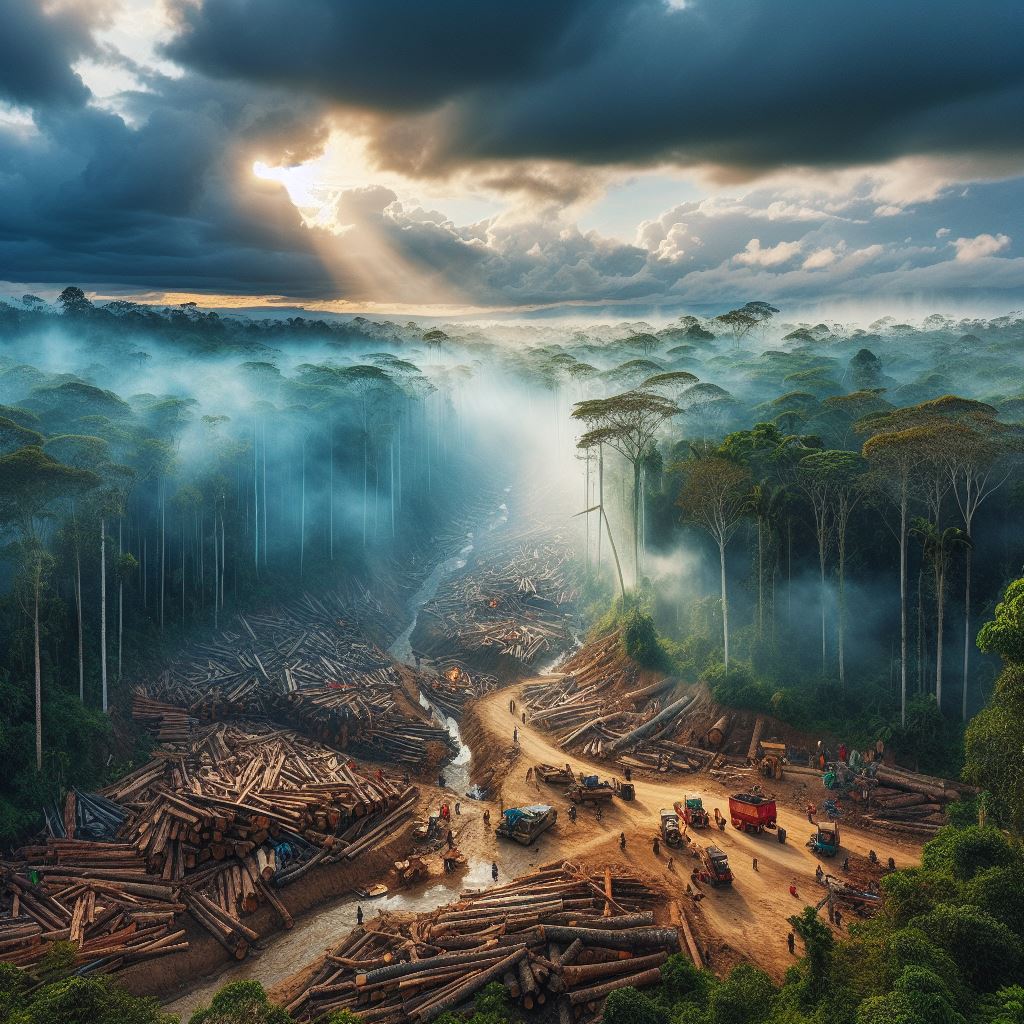
As most woodworkers are aware, the world is losing its tropical rain forests at an staggering rate. The primary causes are intensive logging and inefficient slash-and-burn agriculture in the overpopulated Third World countries, where most of these forests are located. This alarming situation has sparked a decades-long debate about what woodworkers can do to help preserve the rain forests and sustain the supply of exotic woods that grow there. An article in the New York Times on September 28, 2003 stated that as much as 90% of the Mahogany logged in Peru, the world’s leading supplier, is taken illegally from protected lands, with increasingly grave consequences for the native populations and the rain forest itself.
This article prompted a lively and occasionally passionate discussion on the WoodCentral Internet messageboard about Mahogany supplies in particular and whether a boycott of tropical woods would help or hurt the cause of rain forest conservation and related social and economic issues.
Some respondents endorsed an immediate boycott…
“I would say use it under no conditions other than as recycled wood. No demand, no supply; it’s the same as coca and opium. if there were no purchases, nobody would produce the stuff. I’m staying away from wood species not harvested sustainably.”
“A huge portion of the trade in Mahogany is illegal. Whatever rules have been set up by governments are being ignored, and our purchases of the wood are the reason. You may argue that we have no way of know ing if we are getting the 10% legitimately cut, but knowing the odds makes me pause.*
while others denounced it.
“If you boycott the lumber, it will mean the tree has no value. If the trees have no value, there is no incentive to grow them. Growing corn or cattle will be more profitable than growing timber, and that will put the Mahogany trees in the slash pile.”
“Not all Mahogany imported into this country is illegally harvested. Hardwood plantations are springing up in equatorial countries because the wood is valuable. Devaluing the lumber through a boycott will kill this movement.The answer is that countries in which illegal logging is taking place need to police themselves.”
“Local residents clear out a section of forest for farming, and with no use for the trees, burn them. This soil can only sustain a crop for a couple of years, then it is abandoned. This is the reason for the demise of this resource. So long as there is a demand for this species, there will be a supplier willing to fill the demand. I refuse to feel guilty about using any hardwood available.”
“I have always heard that small shop woodworkers account for such a tiny percentage of total consumption. A boycott would have no effect. except to make the timber worthless and to deny it to those who are most able to shape it into beautiful furniture.”
The issues surrounding the debate are complicated…
“The concept of sustainable’ logging in a rain forest is a cruel joke. Even if we could sustain the production of some valuable species, the rain forest’s diversity (gene pool) would collapse. So, if you’re buying into the Certification Programs, at least with respect to tropical timbers, you’re getting snowed. And, the amount of tropical timber used by individual cabinet makers is so minute as to be utterly insignificant. The core problem is population growth in the Third World.”
“If certification is a joke, then there is nothing a user can do. We should just blindly use up any wood at whatever price the market lets us pay, and trust the free market to allocate resources. This does not seem right; there must be something between abstinence and acting like nothing is wrong.”
“Maybe I can’t stop tropical rain forests from being deforested, but that doesn’t mean I’m obligated to contribute to trends I don’t like on the basis that it doesn’t matter anyway. If enough people can be bothered to care, the price differentials come down, and eventually it’s easier to get more people to care.”
“Boycotting tropical hardwoods is counter productive and hastens the destruction of the rain forest. Certification Programs are insidious in that they suggest that we can manage a rain forest. We can’t. The effort should be directed at stimulating plantation grown timber on already deforested land, and a more thoughtful strategy would be to use these woods so the trees that produce them have a perceived value in the Third World.”
“Certification may not be ideal, but it’s a first step toward getting information from the source of the wood to the consumer. Finding something between virgin untouched rain forest and plantations on deforested land seems the only way to have both forests and wood over the long term.”
“Keeping a representative, functional sample of the complete ecosystem intact is what really matters. The valuable cabinet wood species in a tropical rain forest represent only a small percentage of the total number of species critical to the ecosystem, and most are widely dispersed; i.e., they seldom grow in pure stands. The emphasis on forestry today should be placed on exploring what tropical species can be brought into cultivation. This is a manageable challenge. Trial and error experimentation with the ecosystems of entire rain forests is not.”
“The problem here isn’t that the ecosystem is beyond our abilities to work with. The problem is no one’s bothering. It’s cheaper to strip the valuable wood out, burn the rest, and let the no-longer-forest be someone else’s problem. In the end, we’re going to end up paying more for our wood no matter how we get it.”
“Our problems in any attempt to preserve the rain forests are virtually all related to over population and the Third World’s desperate need to feed itself. Today’s young woodworkers will likely witness the day when the only tropical hardwoods available will be from carefully managed tree farms. As woodworkers, we are helpless losers on this one. The Third World is going to do what it sweet well pleases with its resources. As have we.”
“If you want to see untouched forests and plantations on cut-overs, come to Maine. Paper mills are being closed because it’s cheaper for the paper to be produced overseas. Mill workers are forced onto new tree farms owned by the paper companies to cut pulpwood for export. If we can’t manage it at home, let’s not delude ourselves into thinking we can force other countries to do it.”
“As a frequent visitor to Brazil, Peru, Guatemala and other places where Mahogany grows, I have seen piles of high value timber being incinerated to make room for cattle grazing land. The greatest impact on these species comes from people simply trying to live, and I don’t fault them. Our only hope is that we can accelerate the development of these nations to reduce fuel wood consumption. Every woodworker in America staving off using Mahogany wouldn’t have the same impact as a rural electrical project in even one of Brazil’s states.”
and finally, a discussion about alternatives.
“I think it’s a matter of providing an alternative that pays as well. It’s hard to compete with slash and burn on price alone. I stick to buying local species or certified wood–the latter helps create a demand for forestry done the way I’d like to see it.”
“Demand drives up price which drives up supply. You are part of the problem or you’re not. I would pay high prices for sustainably harvested Mahogany if I felt it could be assured, but for now I need to find alternatives to using Mahogany.”
“Are there any domestic woods that have similar properties and are sustainable? ! agree we have a responsibility. A very true quote is: ‘We don’t inherit the world from our ancestors; we borrow it from our children.'”
“Guess I’ll have to quit woodworking to save the forests. If I had to kill what I eat, I’d be a veg-head, but nothing is like Mahogany in my book.”
“An extremely large amount of timber of all species in the world is made into pallets. In the U.S., pallets consume more trees than paper or the building industries. Another thing we can do is eat less beef. A lot of de forestation is made to raise cattle to consume locally and to sell to us. We should all go out and plant more trees, here and there.”
What are your thoughts on this? Add your comments below!


Use certified sustainable wood: Look for wood that is certified by organizations like the Forest Stewardship Council (FSC), which ensures that the wood comes from responsibly managed forests.
Opt for reclaimed or salvaged wood: Utilizing reclaimed wood from old structures, barns, or even urban trees can help reduce the demand for new wood from sensitive ecosystems.
Choose alternative materials: Consider using alternative materials like bamboo, which is a fast-growing and renewable resource, as a substitute for tropical woods.
Support conservation efforts: Stay informed about conservation initiatives and support organizations working to protect tropical rainforests through donations or advocacy.
Educate others: Spread awareness about the importance of sustainable forestry practices and the impact of deforestation on the environment.
By making conscious choices and advocating for sustainable practices within the woodworking community, we can all play a role in helping to preserve our precious tropical rainforests for future generations.