Monday - trusses
Gary Smyth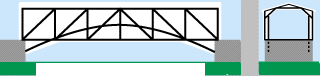
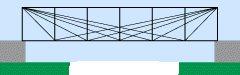
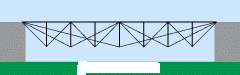
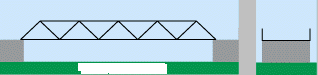
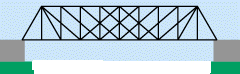
I have a fascination with bridges. One of the ways to span a distance is with a truss. Here are six examples of unique styles of truss. Each has a specific name. Today's task, name them.
Est. 1998 — 27 years of woodworking knowledge
Monday - trusses
Gary Smyth
I have a fascination with bridges. One of the ways to span a distance is with a truss. Here are six examples of unique styles of truss. Each has a specific name. Today's task, name them.
Re: Monday - trusses
Bill Earl
I recognize the Warren, and it looks like a variation on the Pratt next to it.
Don't know what to call the other ones.
Off to a start. I see where you're
Gary Smyth
heading. My answer differs but I get it.
Re: Monday answer - trusses
Gary Smyth
Today�s trivia was based on personal interest and perhaps a bit obscure. There are tens of variations on the basic truss span. These are some that are unique and recognizable. Bill started correctly and for his effort a gold star for his forehead.
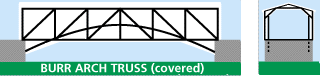
1.* Theodore Burr built a bridge spanning the Hudson River at Waterford, NY in 1804. By adding arch segments to a multiple kingpost truss, the Burr arch truss was able to attain longer spans. His truss design, patented in 1817, is not a true arch as it relies on the interaction of the arch segments with the truss members to carry the load. They are one of the most common type of truss on covered bridges. Many later covered bridge truss types used an added arch based on the success of the Burr truss.
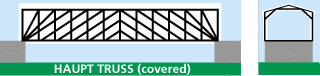
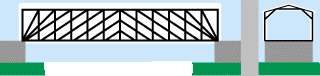
2.* Herman Haupt designed and patented his truss configuration in 1839. He was in engineering management for several railroads including the Pennsylvania Railroad (1848) and drafted as superintendent of military railroads for the Union Army during the Civil War. The Haupt truss concentrates much of its compressive forces through the end panels and onto the abutments.
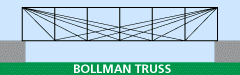
3.* The composite cast and wrought iron Bollman truss was common on the Baltimore and Ohio Railroad. Of the hundred or so following Wendell Bollman's design, the 1869 bridge at Savage, MD, is perhaps the only intact survivor. This diagram is not precisely accurate as some of the counter bracing inside the panels has been omitted from the drawing for clarity.
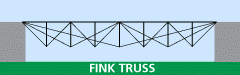
4.* Also somewhat common on early railroads, particularly the B&O, was the Fink truss - - designed by Albert Fink of Germany in the 1860s.
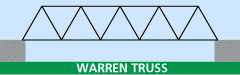
5.* A Warren truss, patented by James Warren and Willoughby Monzoni of Great Britain in 1848, can be identified by the presence of many equilateral or isoceles triangles formed by the web members which connect the top and bottom chords. These triangles may also be further subdivided. Warren truss may also be found in covered bridge designs. The configuration in the example is also known as the Pony truss.
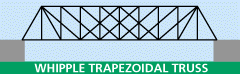
6.* The Whipple truss/Pratt truss was developed by Squire Whipple as stronger version of the Pratt truss. Patented in 1847, it was also known as the "Double-intersection Pratt" because the diagonal tension members cross two panels, while those on the Pratt cross one. The Indiana Historical Bureau notes one bridge as being a "Triple Whipple" -- possibly the only one -- built with the thought that if two are better than one, three must be stronger yet.
The Whipple truss was most commonly used in the trapezoidal form -- straight top and bottom chords -- although bowstring Whipple trusses were also built.
The Whipple truss gained immediate popularity with the railroads as it was stronger and more rigid than the Pratt. It was less common for highway use, but a few wrought iron examples survive. They were usually built where the span required was longer than was practical with a Pratt truss.
Further developments of the subdivided variations of the Pratt, including the Pennsylvania and Baltimore trusses, led to the decline of the Whipple truss.