WoodCentral Forums

Est. 1998 — 27 years of woodworking knowledge

Monday

Posts

Monday

#1

Monday

Gary Smyth

Not too difficult today. With fuel getting precious, what this world needs is a tree that produces something that can be used in autos/trucks by tapping it as you might a sugar maple. It turns out that such a tree exists and it can produce a liquid that is able to be burned directly without anything other than tapping and collecting it from the tree. A single tree can produce about 14 gallons per year.

It is a medium-sized tree usually reaching 12 meters in height, with white flowers and small, oily fruits. Bees are major visitors of the tree for pollen.

As you might guess, the wood burns readily.

The timber is highly resistant to natural decay and is used in carpentry.

The resin is used in lacquers, massage preparations, medicines, and paints.

The liquid contained within is thin and clear but on aging becomes thick and acquires a yellowish tinge.

It is also poisonous as it creates an irritant action on mucous membranes and causes an eruption resembling measles

Treated however, when made into medicine, taken in the proper dose it is stimulant, diuretic, and laxative; in larger doses it is purgative, causing nausea, vomiting, and fever.

This species is a folk remedy for dermatitis, eczema, and gonorrhea and mixed with honey is given to the newborns, to impart knowledge and ward off hexes.

Name the tree.
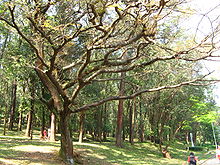


Re: Monday

#2

Dale Lenz

Re: Monday

Dale Lenz

Great trivia today, Gary. One of the english common name starts w/ d & t (two words). Thanks!

Re: Monday

#3

Yadone good.  Common name for it.


Re: Monday

#4

Re: Monday answer

Gary Smyth

Dale gets today�s gold star.

Copaifera langsdorfii, his D.T. = Diesel Tree.

Family: Fabaceae

Genus: Copaifera

Species: officinalis, langsdorffii, reticulata

Common Names: Copaiba, copal, balsam copaiba, copaiva, copaiba-verdadeira, Jesuit�s balsam, copaibeura-de-Minas, cobeni, Matidisguate, matisihuati, mal-dos-sete-dias, diesel tree

Parts Used: Sap, resin, bark

From The Healing Power of Rainforest Herbs:

Copaiba is a stimulant oleoresin obtained from the trunk of several pinnate-leaved South American leguminous trees (genus Copaifera). The thick, transparent exudate varies in color from light gold to dark brown, depending on the ratio of resin to essential oil. Copaiba is used in making varnishes and lacquers.

The tree is sub-tropical to tropical -- only suitable for South Florida, in the U.S. and tropical Africa and South America.

Uses

Copaiba is particularly interesting as a source of biodiesel. The resin is tapped from standing trees, with an individual tree yielding 40 liters per year. It can be used as a fuel straight from the tree in diesel vehicles.

Medicinally, copaiba has been used to treat stomach cancer and ulcers. It has demonstrated antifungal properties, among a wide variety of medicinal properties

Copaiba is also used as an artist material, especially in oil paint recipes and in ceramic decoration. Mineral painters use a medium made of copaiba, turpentine and lavender to mix with their minerals for adhesion to ceramic vessels before kiln firing. Copaiba makes a good medium for oils and helps with both adhesion and quality of shine.

👍 This page answered my questions

Your vote helps other woodworkers quickly find the answers and techniques that actually work in the shop.