Monday, baby it's cold outside
Gary Smyth
I promise that this is not as bad as it may sound but what is the origin of the saying �cold enough to freeze the balls off a brass monkey�?
Est. 1998 — 27 years of woodworking knowledge
Monday, baby it's cold outside
Gary Smyth
I promise that this is not as bad as it may sound but what is the origin of the saying �cold enough to freeze the balls off a brass monkey�?
Re: Monday, baby it's cold outside
Ken Oakley-Sunny St. Cloud, Fla
Ships, cannon balls and brass plates.
Drat, drat, drat
Gary Smyth
My apologies to Ken. But no star today. Ken got the correct answer but he fell into bad company as did I regarding this trivia. My error not his, but the question is moot. At WC trivia I regularly research wooden ships. While searching for a different item, I ran across this bit of info I thought would be interesting. Essentially it was sea lore that I checked with a supporting site. �Swear Like A Trooper: A Dictionary Of Military Terms & Phrases� by William L. Priest Published by Rockbridge Publishing, an imprint of Howell Press, Inc., 2000. Alas, I didn�t go far enough. While the story is interesting information, this one has no basis in fact.
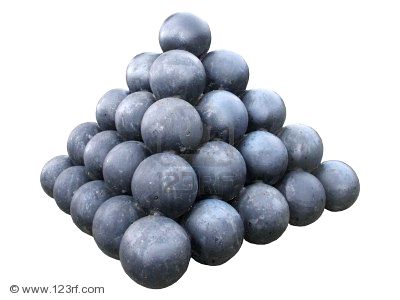
The story goes that on wooden ships there was a brass plate named for some unknown reason a �monkey� that had indentations in it that were made to hold cannon balls when they were stacked in a square or triangular pyramid. This wasn�t so unusual as wooden ships had several things named monkey, such as powder monkey (powder carrier-usually a young seaman), a small monkey cannon, monkey jacket (short waist), monkey island (where the officers stood on the upper deck), monkey boat, monkey pump (a straw). Anyway, the story goes brass didn�t rust so iron placed on it wouldn�t weld itself to the plate. The story contends that the contraction rate of brass is substantially different than the iron cannon balls it held. In extremely cold weather the cannon ball pyramid became unstable because the brass plate at the base of the pyramid contracted at a substantially different rate than the iron cannon balls and the base holding the cannon balls would lose its function and the cannon ball stack would collapse and the shot roll around the gun deck. Well, it makes for a nice story, but history rejects the claim. According to the United States Navy Historical Center, this is a legend of the sea without historical justification. The center has researched this because of the questions it gets and says the term "brass monkey" and a vulgar reference to the effect of cold on the monkey's extremities, appears to have originated in the book "Before the Mast" by C.A. Abbey. It was said that it was so cold that it would "freeze the balls off a brass monkey." The Navy says there is no evidence that the phrase had anything to do with ships or ships with cannon balls.
Sorry folks.
Other cannon ball info.
Gary Smyth
Sir Walter Raleigh asked mathematicians to determine the best way to stack cannonballs on ship decks. Intuition suggests the pyramid is the most efficient -- or densest -- way to stack cannonballs. For four centuries, mathematicians had been unable to prove famed astronomer and mathematician Johannes Kepler's 1611 conjecture that the pyramid is the best way to stack cannonballs.
In only 2006 University of Pittsburgh mathematician Thomas C. Hales, and his former graduate student, Samuel P. Ferguson, published their proof of one of mathematics' most famous puzzles. Although Dr. Hales completed the proof in 1998, it took eight years for a panel of 12 mathematics referees to confirm it to 99-percent certitude and then have the proof published. The proof is about 300 pages long -- not counting 40,000 lines of computer code and three billion bytes of data necessary to solve the puzzle that left mathematicians scratching their scalps for centuries. Dr. Hales started considering the conjecture in 1988 and had two things going for him -- computers and enjoyment of exhaustive mathematical problems to solve.
He and Dr. Ferguson studied 5,000 configurations of stacked spheres, which they reduced to 100 candidate configurations. Then after years of effort, the "eureka moment" occurred in November 1994, when Dr. Hales figured out the ideal geometric forms that best described the relationship between spheres and the space they occupied. Reducing the problem into creative geometry allowed a computer to do the calculations. But the computer had to run nonstop for three months to do many billions of calculations to complete the proof.
Read more: http://www.post-gazette.com/pg/07016/754107-115.stm#ixzz1FGQwDtI8