WoodCentral Forums

Est. 1998 — 27 years of woodworking knowledge

Tuesday Trivia

Posts

Tuesday Trivia

#1

Tuesday Trivia

Bill Earl

At the 'wet end' of a paper mill, the watery pulp is sprayed out into a continuous sheet. At this point in the process, the paper is about 90% water.

There are several steps in the process were water is removed. What is the first step? Wood used to play an essential role here - although it has been largely replaced by more high-tech solutions.

Re: Tuesday Trivia

#2

I'll start

Gary Smyth

If I understand the wet pulp is loose. I'm thinking that the first step is it has to be squeeged so the pulp drys. In Japan they use a sieve and slow rolling with a wood cylinder for custom paper. On big presses today they use screens and hot air.

Re: Tuesday Trivia

#3

Re: Tuesday Trivia

Thomas Skaggs, Foothills of Mount Level

They have monkeys perched above the pulp aiming wooden hair dryers. Now the old wooden hair dryers have been replaced with plastic ones. It was a Union issue with the monkeys.

T.

Re: Tuesday Trivia

#4

Hint

Bill Earl

As both Gary and Tom have suggested, air is involved - although not heated air (and not administered by monkeys).

The wooden devices used in this process have been largely replaced by ceramics and plastics.

Re: Tuesday Trivia

#5

Re: Hint

Gary Smyth

If I have to get rid of moisture and the sprayed pulp is on a table/screen/mat, and not heated air let me guess a suction box as the screen passes above to pull the water out.

Re: Tuesday Trivia

#6

Re: Hint

Thomas Skaggs, Foothills of Mount Level

Big ol' wooden fans?

Re: Tuesday Trivia

#7

Correct   Tuesday Answer

Bill Earl

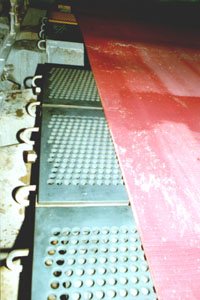
As Gary correctly answered, the first de-watering step is a suction box. The pulp is sprayed out on a screen which is pulled across a series of chambers with a perforated surface where centrifugal blowers create a vacuum.

The action of the screen and paper fibers moving across the surface of the suction-box is quite abrasive. So the perforated plates (called "Suction Box Covers") were made from wood so that they could be easily and economically replaced.

Modern suction box covers are made from ceramics (expensive, but very resistant to abrasion) or low-friction plastics (less expensive and less durable, but energy efficient too).

After the suction boxes, the water is further squeezed out with rollers before moving on to warm air dryers.

👍 This page answered my questions

Your vote helps other woodworkers quickly find the answers and techniques that actually work in the shop.