Re: Monday answer
Gary Smyth
Bill was dead on and earns a large gold star.
Many I believe had your Atlantis head under the sea. I wanted you to have your head in the clouds, actually quite a bit above the clouds.
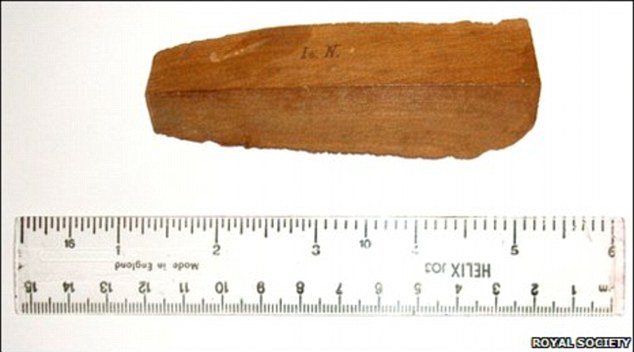
The answer is that this piece of wood is from the apple tree from whence Sir Isaac Newton is reported to have discovered gravity. In celebration of the space shuttle Atlantis� last scheduled flight (May 2010) Piers Sellers, a British mission specialist was allowed by the Britain�s Royal Society to take the Apple wood piece on the week long flight. The Society agreed that Sir Isaac (had he survived his untimely death) would have loved to have seen that his discovery was true, that the earth has a mass that attracts other less massive items.
The Royal Society, which is the UK's national academy of science, and is celebrating its now 351st year.
As part of the anniversary celebration, the society in January 2010 made available online the 18th-century document detailing Newton's account of the famous apple incident, which occurred in the mid-1660s.
"This is what William Stukeley wrote as told to him by Newton: 'It was occasion'd by the fall of an apple, as he sat in contemplative mood. Why should that apple always descend perpendicularly to the ground, thought he to himself... Why should it not go sideways, or upwards? But constantly to the Earth's centre?"
Read more: http://www.dailymail.co.uk/sciencetech/article-1276082/Space-shuttle-Atlantis-takes-Sir-Isaac-Newtons-apple-tree-orbit.html#ixzz1DHDS6pXd
As you may remember, Newton's first law of motion, one of three, states that an object at rest will stay at rest unless acted upon by an outside force. It also holds for an object in motion, which would stay in motion unless also confronted by an external force.
Newton's second law of motion describes the relationship between an object's force and its mass and acceleration, while the third law states that for every action there is an equal and opposite reaction.
When Atlantis arrived back to earth, the wood item which has Isaac Newton�s initials on it was again placed on display at the Royal Society.