Why delay. Answer
Gary Smyth
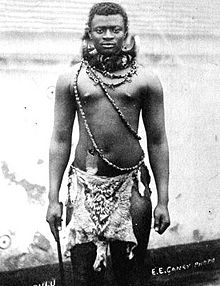
The origins of Wood Badge can be traced back to 1888, when Baden-Powell was on a military campaign in Zululand (now part of South Africa). He pursued Dinizulu, a Zulu king, for some time, but never managed to catch up with him. Dinizulu had a 12-foot (4 m)-long necklace with more than a thousand acacia beads. Baden-Powell is said to have found the necklace when he came to Dinizulu's deserted mountain stronghold. Such necklaces were known as iziQu in Zulu and were presented to brave warrior leaders.
Much later, Baden-Powell searched for a distinctive award for the participants in the first Gilwell course at the scouting facility. He constructed the first award using two beads from Dinizulu's necklace, and threaded them onto a leather thong given to him by an elderly South African in Mafikeng, calling it the Wood Badge.
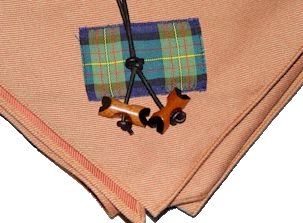
Wood Badge is a training course for Scouts which finally results in their receiving a certificate, a small neckerchief, a leather slide, and two small wooden beads on a leather thong. Lord Baden-Powell, the founder of Scouting, directed the first course in 1919 and gave each of the participants one of the beads which he had secured from the African chieftain Dinizulu. Thus did the course name develop, for its symbol was literally a badge of wood.
Wood Badge in one form or another is used throughout the Scouting world. Tens of thousands of Scouters proudly wear the Gilwell neckerchief, woggle, and beads of Wood Badge-trained leaders. Because it was begun by Baden-Powell in England in 1919, it is clearly backed by the finest thought and tradition of the founder and thus carries with it great prestige. Wood Badge is then, a great force for world brotherhood, for though it uses the local traditions in each country, it emphasizes the international aspects of the movement and the heritage of Baden-Powell and Gilwell Park.
________________________________________
Portions exerpted from the
History of Wood Badge BSA Publication # 3164
My understanding is that Lord Baden Powell as the originator of the scouts was awarded six beads and no one else could get more than five. Frederick pointed out other and I shall accede to him as more knowledgeable in this area. Six beads have been awarded to others as well as each of the Director of Training at Gilwell Park in England.
Frederick gets today�s gold star and John a smaller one.
Pictures: Dinzulu with the original beads. Current version of the wood badge