WoodCentral Forums

Est. 1998 — 27 years of woodworking knowledge

Monday

Posts

Monday

#1

Monday

Gary Smyth

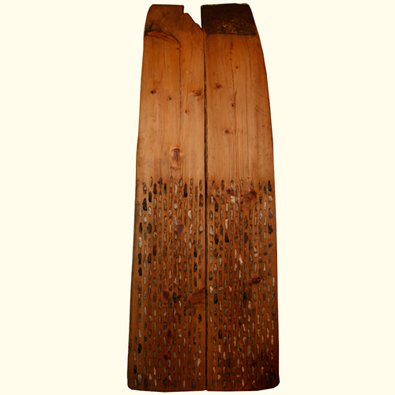
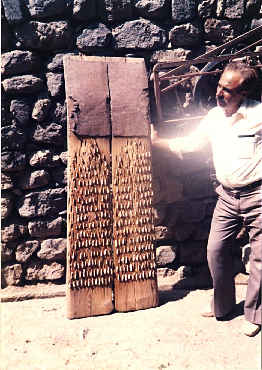
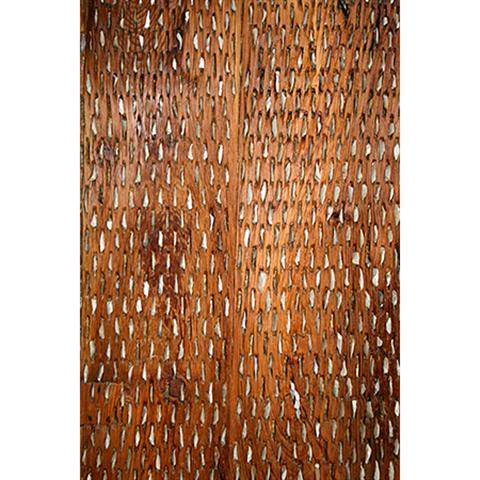
This item can be found the world around. It seems to have been discovered independently on several continents at relatively the same time and can be found in use still in parts of the world. The beginning may have been as early as 2500 years ago. The "holes" sometimes have pieces of quartz or flint wedged in.

What is it?

Re: Monday

#2

Re: Monday

Frederick Nelson

I recognize this! I saw it on the BBC Antiques Road Show about a month ago, so I'll refrain from answering at this time. The owner had hung it on his wall as a decoration, which was NOT its intended purpose, even if it was in a farmhouse.

Fred

done handing out candy in Eastern Missouri

Re: Monday

#3

Darn,  I was certain this was

Gary Smyth

different enough to provide more of a challenge. Very quick (you were careful of the box) and I appreciate you keeping today's trivia alive. Oh well, your response does show that these appear in different places. If I found one I would hang it (as opposed to using it for the intended purpose) too. A lot of work making these, what, with all the holes -- as what it does seems to me to have a relatively short lifespan

Re: Monday

#4

Re: Darn,  I was certain this was

John Veerkamp

AS Dale would say a WAG. I'm guessing that this might have come from a great White and be used in fine surfacing?

Re: Monday

#5

Re: Monday

Thomas Skaggs, Foothills of Mount Level

A "bear style" back scratcher?

T.

Re: Monday

#6

It is wood


Re: Monday

#7

Well, it did come from a tree


Re: Monday

#8

Re: Monday hint

Gary Smyth

It is man made.

It is used with animals but humans alone used similar items first.

A pattern is used when it is used.

In demand as decorative devices. This one is for sale at over $600.00

Approximate size is 20" x 60"

Most are flat, but with some one end might be turned up


Re: Monday

#9

Traction Devices????


Re: Monday

#10

Re: Traction Devices????

Jim Rutten

Paddles for people who like to go slow?

Re: Monday

#11

Not snow shoes or the like


Re: Monday

#12

Good idea but, no.

Gary Smyth

Also mildly inaccurate. For example, a rudder and wing with holes in it is far more efficient than a solid one at certain speeds and applications... laminar flow and all that.

Re: Monday

#13

Grooming devices?


Re: Monday

#14

Good thought but not today.


Re: Monday

#15

Re: Monday last hint before answer

Gary Smyth


It's an agrarian device. This one appears to have only stones but not the holes.

Re: Monday

#16

Dale Lenz

WAG

Dale Lenz

A ground scarafier(SP?) for small seeds????

Re: Monday

#17

Close

Gary Smyth

Close

Re: Monday

#18

Re: Monday answer

Gary Smyth

Frederick may have had the answer almost as soon as it was posted. If so, Gold Star! The item is a threshing board.

It�s sort of a keelhauler for grain. It is used like a sled in grain collecting areas to separate the grain from the stalk. First it is drawn around in a circle to knock down the plant as is done with a crop circle. People or animals pulling the boards do this. Once the area is flattened the boards are drawn up and down the patch first vertically then side to side, then on the diagonal to release the kernels. The stone, quartz, or flint helps by cutting into the stalks. The grain is then picked up by hand.

These have been around a very long time and are used today where power equipment is not handy. The yield can be inefficient if done in a field. It can be more efficient if the grain is cut first then taken to a hard flat area to be processed. Some farmers walk along side the boards and some �surf� adding their weight to the boards.

Threshing boards were used together with the flail which provides a cleaner yield.

One may note a document written in 1265, in which a woman named Do�a Mayor bequeaths a farm:

�And I, Do�a Mayor, leave on my death these two yokings (yokes to harness two draft animals) of country state above referred to the Cathedral Chapter, well preserved with 76 bushels of wheat, 38 bushels of rye, and 38 bushels of barley to seed each yoking and with ploughshares (sod precut knife before the plow.), and with plows, and with ploughbeams (heavy curved beam that is attached to and stretches in front of the plow to keep it into the ground), and with threshing-boards and with all the accoutrements that a well-laid-out property should have.�

�Threshing board� will get history and info on most browsers.

Don�t forget to vote Tuesday..
Re: Monday

#19

Re: Monday answer

Frederick Nelson

This question gave everyone a good thrashing, er, threshing.

During my studies I manage to accrete all sorts of otherwise useless information, although occasionally some things turn out to be useful.

Thanks for the question.

Fred

cool with widely scattered dark in Eastern Missouri

👍 This page answered my questions

Your vote helps other woodworkers quickly find the answers and techniques that actually work in the shop.