Re: Monday answer
Gary Smyth
Tom gets this Monday's gold star.
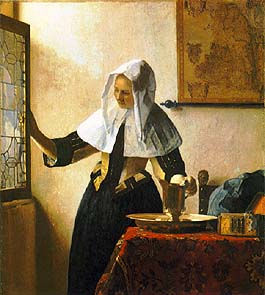
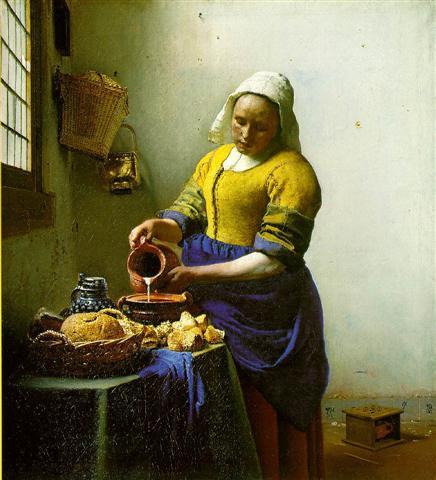
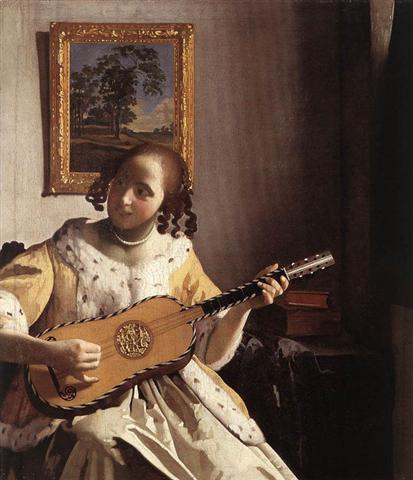
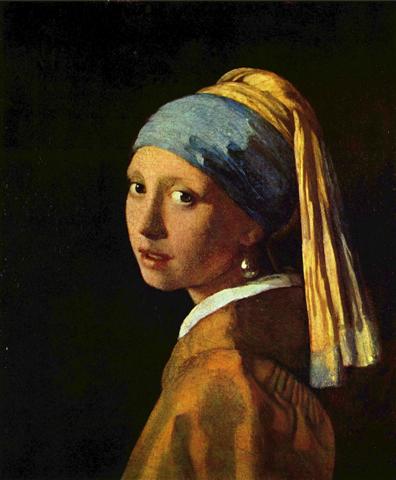
The artist is Johannes Vermeer.
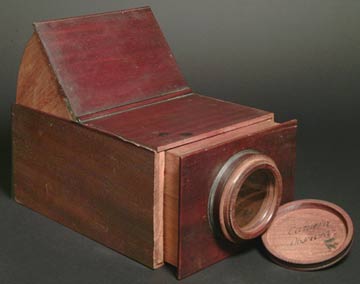
The box is a camera obscura or �pinhole� camera. The first mention of the principles behind the pinhole camera, a precursor to the camera obscura, belongs to Mo-Ti (470 BCE to 390 BCE), a Chinese philosopher. Mo-Ti referred to this camera as a "collecting plate"
The Greek philosopher Aristotle (384 to 322 BCE) understood the optical principle of the pinhole camera. He viewed the crescent shape of a partially eclipsed sun projected on the ground through the holes in a sieve, and the gaps between leaves of a palm tree.
However, it was mastered by the scientist Abu Ali Al-Hasan Ibn al-Haytham, born in Basra (965�1039 AD), known in the West as Alhacen or Alhazen, who carried out practical experiments on optics.
Several decades after Ibn al-Haytham's death, the Song Dynasty Chinese scientist Shen Kuo (1031�1095) experimented with camera obscura, and was the first to apply geometrical and quantitative attributes to it in his book of 1088 AD, the Dream Pool Essays.
The link between scientific observation and art did not appear to be made until some 600 years later.
In 13th-century England Roger Bacon described the use of a camera obscura for the safe observation of solar eclipses. Its potential as a drawing aid may have been familiar to artists by as early as the 15th century; Leonardo da Vinci (1452�1519 AD) described the camera obscura, however there is no information that he used that or a similar device for drawing. The term "camera obscura" appears to be first used by the German astronomer Johannes Kepler in 1604.
The Dutch Masters, such as Johannes Vermeer, who were hired painters in the 17th century, were known for their magnificent attention to detail. It has been widely speculated that some of these artists made use of a optical device, but the extent of their use by artists at this period remains a matter of considerable controversy, recently revived by the Hockney-Falco thesis, suggesting that advances in realism and accuracy in the history of Western art since the Renaissance were primarily the result of optical aids such as the camera obscura, dark rooms, and mirrors, rather than solely due the development of artistic technique and skill. In a 2001 book, Secret Knowledge: Rediscovering the Lost Techniques of the Old Masters, Hockney analyzed the work of the Old Masters and argued that the level of accuracy represented in their work is impossible to create by "eyeballing it". It is in no small part based on the accuracy and "bending" of reflections in surrounding objects that today can only be achieved by a camera or computer.. Pictures attached you decide.