Monday answer
Gary Smyth

Pine Tree shilling
There was also the Willow and Oak Coinage.
It was the beginning of using a local currency that replaced a bartering system using animal skins and wampum.
Taking matters into their own hands, Boston authorities allowed two settlers, John Hull and Robert Sanderson, to set up a mint in the capital in 1652. The two were soon striking silver coinage-in a number of stampings and denominations. During the first few years all of the new coins bore the same date: 1652.
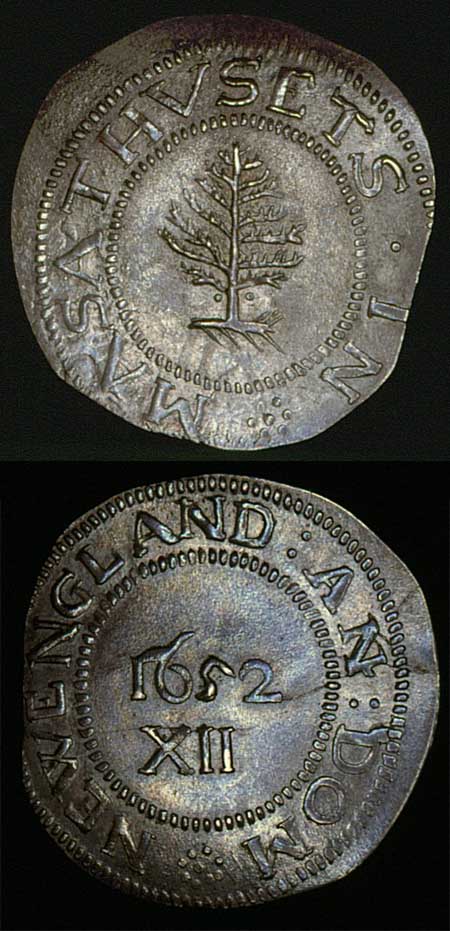
This was the origin of America's most famous colonial coin, the pine tree shilling. The name comes from the tree found on the obverse. It may symbolize one of the Bay Colony's prime exports, pine trees for ships' masts. Massachusetts coinage not only circulated within that colony, but was generally accepted throughout the Northeast, becoming a monetary standard in its own right. Even though coins from England continued to be used, the local coins saved time and storage space in a local economy. Fine for the coast but not the frontier which continued older barter.
Why the 1652 date? Some believe that it was intended to commemorate the founding of the Massachusetts mint, which did occur in 1652. Others believe the choice was a reflection of larger political events. Coinage was a prerogative of the King. In theory, these colonists had no right to strike their own coins, no matter how great their need.
The year 1652 is significant.
Charles, King of England, was moved to Hurst Castle at the end of 1648, and thereafter to Windsor Castle. In January 1649, in response to Charles' defiance of Parliament even after a Civil War defeat, and his encouraging the second Civil War while in captivity, the House of Commons passed an Act of Parliament creating a court for Charles' trial. After the first Civil War, the parliamentarians accepted the premise that the king, although wrong, had been able to justify his fight, and that he would still be entitled to limited powers as King under a new constitutional settlement. It was now felt that by provoking the second Civil War even while defeated and in captivity, Charles showed himself responsible for unjustifiable bloodshed. The secret treaty with the Scots was considered particularly unpardonable; "a more prodigious treason," said Cromwell, "than any that had been perfected before; because the former quarrel was that Englishmen might rule over one another; this to vassalize us to a foreign nation." Charles, King of England, was beheaded Tuesday the 30th of January 1649.
Given the circumstances in England, in 1652, there was no king. King Charles had been beheaded three years previously, and England was a republic. The people in Massachusetts may have cleverly decided to put that date on their coinage so that they could deny any illegality when and if the monarchy were reestablished. (It was). Defying the charter from England's king, the Massachusetts Bay Colony set up a mint in Boston in 1652. Its output consisted mostly of silver shillings, coins valued at twelve pence. The Massachusetts Mint later produced smaller silver coins valued at six pence, three pence and two pence. Except for the twopence pieces, which were dated 1662, all of the coins minted at Boston carried the date 1652. The colonists had to do this, since a NEW English king had come to the throne in 1660, and he was angry that his exclusive right to coin money had been violated. The colonists successfully maintained their deception that all of the silver pieces had been minted in 1652 by continuing to use that date for a little over thirty years.
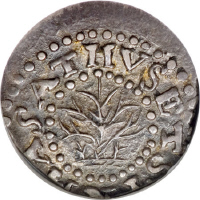
The mint�s first silver shillings bore simply the letters NE (for New England) on the obverse and the values XII (12 in Roman numerals), VI (6) or III (3) on the reverse. Easily counterfeited or clipped, these coins were quickly replaced by ones featuring a tree on their obverse. Three styles of trees were used over the thirty years of production: a willow (1652-60)(picture #2), an oak (1660-67)(#3) and, most familiar of all, a pine (1667-82)(#1).