Re: Monday answer
Gary Smyth
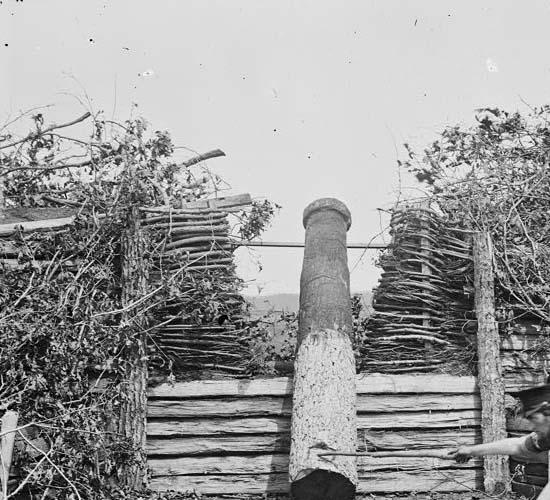
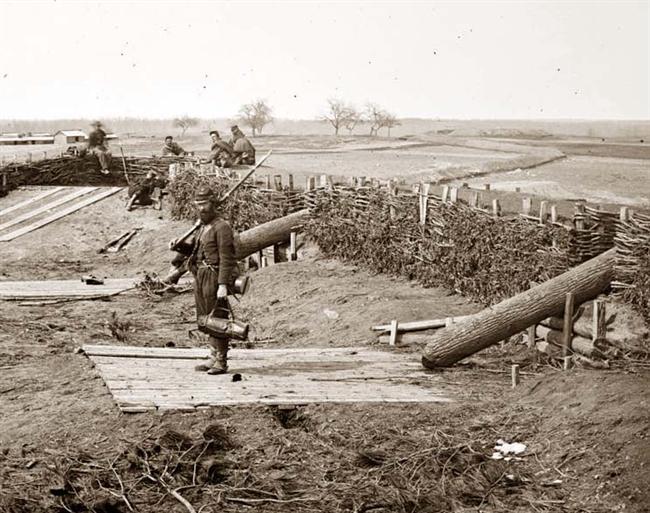
Stuart gets today's gold star.
The answer is Quaker guns. During the American War of Independence, after nearly a year of brutal backcountry conflict between American Colonel William Washington (General George Washington's second cousin, once removed) and the fierce British commander Lieutenant Colonel Banastre Tarleton, Colonel Washington had retreated to North Carolina in October 1780.
Washington was ordered by Brigadier General Daniel Morgan to return to fighting and to lead an irregular force of colonial dragoons in the South Carolina theater, Colonel Washington lacked the proper artillery to dislodge the Loyalists. On December 4, the Americans, with luck on their side, were able to trap the Loyalist Colonel Rowland Rugeley and his company of 125 or so men in Rugeley�s house and barn near Camden, South Carolina. While out of Rugeley�s sight, Washington�s men fabricated a pine log to resemble a cannon.
This so-called �Quaker Gun Trick� worked marvelously. Colonel Washington faced the �cannon� toward the buildings in which the Loyalists had barricaded themselves and threatened bombardment if they did not surrender. Shortly afterwards, Rugeley surrendered his entire force without a single shot being fired.
More:
The term Quaker gun (cannon), actually comes from an even earlier period when certain Quaker merchants whose ships had to operate in areas frequented by privateers or pirates (at times interchangeable) had their ships fitted with realistic wooden cannon as a ruse to ward off would be attackers. Pennsylvania Quakers being avowed pacifists. The name derives from the Religious Society of Friends or "Quakers", who have traditionally held a religious opposition to war and violence in the Peace Testimony.
Later, during the civil war, it is a matter of record that so-called "Quaker guns," false cannon made of fire-blackened tree trunks mounted on wagon wheels, were used at Fort Turnbull. Quaker guns were used by both the Northern and Southern sides in the American Civil War. The Confederate States Army frequently used them to compensate for a shortage of artillery. They were painted black at the "muzzle", and positioned behind fortifications to delay Union assaults on those positions. On occasion, real gun carriages were used to complete the deception.
Perhaps the most famous use of Quaker Guns was by Confederate General Joseph E. Johnston who placed Quaker Guns in his field works around Centreville, Virginia in March 1862, to indicate that the works were still occupied while, in fact, the Confederates were withdrawing to the Rappahannock River.
Another major example occurred during the Siege of Corinth: �During the night of May 29, the Confederate army moved out. They used the Mobile and Ohio Railroad to carry the sick and wounded, the heavy artillery, and tons of supplies. When a train arrived, the troops cheered as though reinforcements were arriving. They set up dummy Quaker Guns along the defensive earthworks. Camp fires were kept burning, and buglers and drummers played. The rest of the men slipped away undetected...� (I especially like the soldier holding what appears to be a 1990's "Boom Box" in photo 2)
Quaker Guns were also used to �bolster� numerous Confederate fortifications during the Siege of Petersburg and greatly assisted in lengthening the amount of time the Rebels were able to hold their positions against the overwhelmingly superior and overbearing Union troops.
World War II
A similar idea was employed during the Doolittle Raid, which occurred in the early stages of the Pacific War of World War II, where Lieutenant Colonel Jimmy Doolittle led a squadron of B-25 Mitchells to bomb Tokyo. In order to reduce the weight of the B-25s (thus allowing greater range), some of the aircraft's machine guns were replaced by broomsticks painted black.
Similarly, while preparing for the coming invasion of France, the German forces on Pointe du Hoc moved their artillery battery and replaced it with upturned logs and barrels in order to fool the invading Allied forces.
Sources all over the web "Quaker Guns"