Re: Monday Answer
Gary Smyth
For about two thousand years the two tools are:
Ink pot (string line) 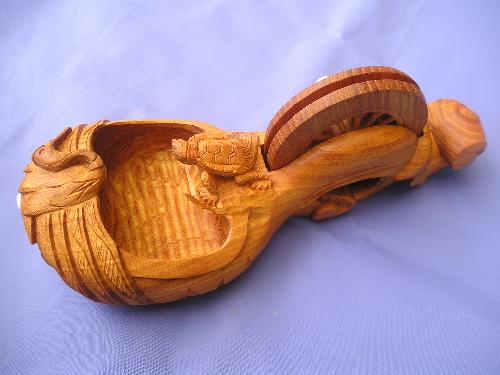
First a Shinwakaba sumitsubo. If you have a copy of �Japanese Woodworking Tools� by Toshio Odate, then flip to page 13, if Henry Lanz�s book, page 141. The tool is well known in Japan. The tool is �traditional�, it is mainly so in concept because these tools were usually craftsman made, and ranged from the most basic device to incredibly elaborate objet d�art. The basics of the tool are very simple. A reel for holding a string, a method of applying ink to the string and a body to keep it all together.
Often the wooden parts are made of keyaki (Zelkova Serrata, Japanese elm), a wood prized for its durability and beauty and comprise of a reel, a body with a place to hold the reel and a large bowl shape to hold the wadding. Regularly there is also a small porcelain insert for the string to pass through to reduce wear. The wadding (not shown in the bowl) is a silk or cotton, the line (not present) is made of silk and the bowl normally is coated with some sort of sealant to prevent the wood becoming warped from the ink.
Square
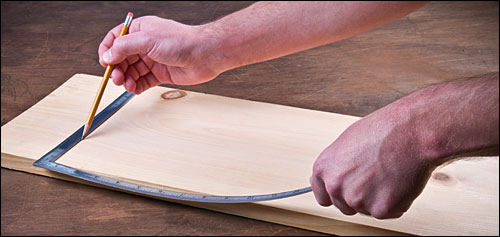
Different than the typical American may, or may not, be square, square the Japanese version is made with greater respect for accuracy when it is manufactured and sold. Sashigane is approximately 6˝ x 12˝ and is used similarly to a Western framing square. However, it is very flexible and much more convenient for marking out complex joinery. The blade is beveled and hollowed on both sides, and the apex is thicker for stability. Like a good Western drafting T square the bevel can easily guide a knife or pen to a mark on the blade without parallax and so that an ink line can be laid down without smearing.
