Monday answer
Gary Smyth
 Didn't last long today. Gary got there first, Frederick not far behind. I'm going to have to move to Oregon as Gary always seems to identify a link related to my questions.
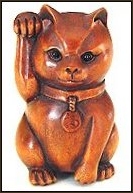
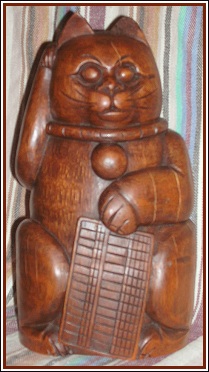
The opening pictures are of carved wood Japanese welcoming cats.
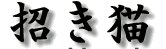
As mentioned by Frederick the endearing form of a Japanese welcoming or beckoning cat ("maneki (meneke) neko") is ideally hand carved. They often sport a carved collar and bell around its neck (did Dan read the writing on the cat collar for his answer? The characters he showed did not match up with my understanding of a Japanese translated "welcome" though), the cat is seated with its right paw raised to beckon customers and fortune into shops. Sometimes boards are placed in front with an auspicious saying like "Good Luck" or "Happiness" carved in or placed on them.
Also known as �neko-men jizo� or �jizo with a cat face,� the welcoming cat has a long history which can be traced to an early legend involving a Tokyo area temple called Jisho-in. According to documents held at the temple, sometime during the mid-16th century there was an intense fight between two individuals: Toshima and Ota. While fighting, Ota became disoriented and stumbled upon a black cat which led him to the temple where he could recuperate. Upon regaining his strength, Ota was able to defeat Toshima. In gratitude for the little black cat which saved his life, Ota ordered that a stone jizo (a Buddhist saint) be fashioned in the shape of a cat.
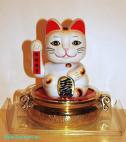
Since then cats with a raised paw have been made of every material including ceramic, metal, stone, molded paper, ivory, as well as wood. Originally the term maneki neko referred to a cat�s supposed ability to charm and bewitch passersby. This connotation gave way to an auspicious interpretation, and today the maneki neko symbolizes a merchant�s success in attracting customers as well as a householder�s financial good fortune. Such cats sit upright, with one paw lifted in a welcoming gesture. Some pictures have the left paw raised --but the picture negative might have been reversed or the maker of the cat may not know the tradition) to �beckon in� customers or good fortune. These representational creatures exhibit a raw individuality that makes them completely unpredictable. Whatever sells best is how they appear.