Monday, Olympics over. On to other.
Gary Smyth
This small grouping of furniture has significant value based on how and where they were assembled. What is unique about these pieces? 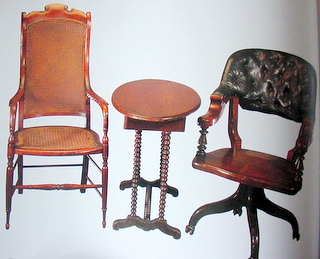
Est. 1998 — 27 years of woodworking knowledge
Monday, Olympics over. On to other.
Gary Smyth
This small grouping of furniture has significant value based on how and where they were assembled. What is unique about these pieces?
Re: Monday, Olympics over. On to other.
Thomas Skaggs, Foothills of Mount Level
They are noteworthy as they are the very first examples of furniture made by children in an Indonesian sweat shop?
T.
hint
Gary Smyth
American
Generally low key considering typical accommodations
Reunited as a grouping in 1915
In the Smithsonian
Re: Monday, Olympics over. On to other.
Thomas Skaggs, Foothills of Mount Level
Strange group there. All from different time periods...Federal to Victorian. White House pieces?
T.
Not White House, think more like
Gary Smyth
a journalist. Who, What, Where, Why! Narrow America down to Mid-Atlantic.
Maybe....
Thomas Skaggs, Foothills of Mount Level
Perhaps Edward R. Murrow's furniture?
Tom
Re: Monday, Olympics over. On to other.
Dan Donaldson
Long ago, in a small shop hidden from prying eyes in the Bavarian alps, lived a woodworker named Memer. He was not, however, just any woodworker, he was the greatest counterfeiter that the world had ever known. He was retired, but decided that it was time to pass on his legacy. He picked three of the star pupils from the best woodworking schools in the World and brought them to his shop.
There, over a period of many years, he taught them the techniques that he had learned over his lifetime, and at the end of the time, he assigned each a final project to demonstrate what they had learned. Two were to copy famous chairs, and the third was to do a table. Each did his best work and all were masterpieces and totally indistinguishable from the originals. The pieces were separated and spread across the world and no one was the wiser.
Unfortunately for them, modern techniques were finally able to detect small anomalies in the pieces and it was finally discovered that they were, in fact, fakes.
The picture was taken at the Smithsonian and is the first time that the pieces had been together in one spot since their construction in the little hidden shop. Unfortunately for us, these were discovered by accident, and since no one knows what became of the three pupils, it is unknown ho many more counterfeit pieces there may be out in the wild.
So, the next time you look at a piece in a museum, you can ask yourself, is it real, or is it from a Memer ex pupil.
Answer Monday. WOW
Gary Smyth
I like Dan's story a lot, it does not answer this question and I'm hoping that this is his journalistic approach. A quick check found no truth to it in this case. Tommy tried to assess the furniture styles. He reasoned a good idea but for this Monday question chose an incorrect tack.
The trivia answer is it is the furniture from Appomattox Court House, Virginia, 1865.
The chairs used by Generals Robert E. Lee and Ulysses S. Grant as well as the table on which Grant signed the terms of surrender to end the Civil War were quickly taken as souvenirs by Union officers. In the early twentieth century these relics (with some arm twisting) were reunited in the Smithsonian. Grant's chair (right) was bequeathed in 1906, the table arrived in 1912, and Lee's chair (left) was "donated" in 1915.
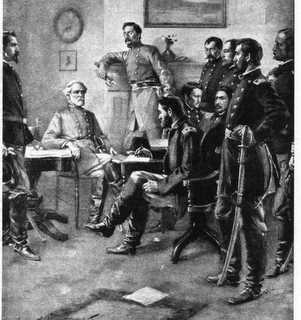
The location of the meeting was left to Lee's discretion. After aides rejected different sites, the McLean (the same McLean who moved from near where the CIA is now in Washington D.C., to get out of the way of the war) home was volunteered by Mr. McLean. Lee arrived at the McLean house about one o'clock. A half hour later, General Grant. Entering the house, Grant greeted Lee; Lee in a new uniform and Grant in his mud-spattered field uniform. Grant, who remembered meeting Lee once during the Mexican War, asked the Confederate general if he recalled their meeting. Lee replied that he did, and the two conversed for approximately 25 minutes. The subject had not yet gotten around to surrender until finally, Lee, brought Grant's attention to it. Grant, who later confessed to being embarrassed at having to ask for the surrender from Lee, said simply that the terms would be just as he had outlined them in a previous letter.
The terms would parole officers and enlisted men but required that all Confederate military equipment be relinquished. Lee, once again taking the lead, asked Grant to put his terms in writing. When Grant finished, he handed the terms to his former adversary, and Lee (perhaps remembering what happened to George Washington with Jumonville) quietly looked them over. When he finished reading, Lee remarked "This will have a very happy effect on my army." Lee asked if the terms allowed his men to keep their horses, for in the Confederate army men owned their mounts. Lee explained that his men would need these animals to farm once they returned to civilian life. Grant responded that he would not change the terms as written (which had no provisions allowing soldiers to keep their mounts) but would order his officers to allow any Confederate claiming a horse or a mule to keep it. General Lee agreed that this concession would go a long way toward promoting healing. When Lee mentioned that his men had been without rations for several days, the Union commander arranged for 25,000 rations to be sent to the hungry Confederates. After formal copies of the surrender terms, and Lee's acceptance, had been drafted and exchanged, the meeting ended.
Re: Answer Monday. Illustration
Gary Smyth