Monday Answer
Gary Smyth
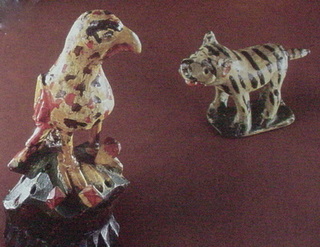
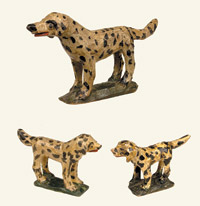
I'm guessing that Dan got his answer by tracing back hint "John Bastian" to wood carver Wilhelm Schimmel. Schimmel may have been considered a tramp in his time, but today his pieces are popular among collectors of folk art carvings.
The Cumberland County carver wandered around Central Pennsylvania in the late 19th Century carving his animals, according to Jan Gilliam, Manager of Exhibit Planning at Colonial Williamsburg. Gilliam said his work is considered traditional folk art rather than tramp art.
Over a dozen Schimmel carvings can be found in Colonial Williamsburg�s Abby Aldrich Folk Art Museum, which opened in 1957.
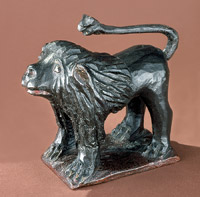
Note: Even though not from the 1800�s, the John Bastian reproductions carvings in the Schimmel style are also growing in value.
History: (American Museum of Folk Art, New York)� The surviving body of brightly painted, carved birds, animals, and other figures attributed to German immigrant carver Wilhelm Schimmel represents one of the best known groups of American folk carving. By all accounts irascible, unpredictable in temperament, and �a big, raw-boned ugly man,� Schimmel arrived around 1860 in Pennsylvania�s Cumberland Valley and endeared himself to several families living along the Conodoguinet Creek, about six miles west of the town of Carlisle. John Greider, a miller and farmer, befriended and trusted Schimmel, provided him lodging in the loft of his wash house, and defended him from those less appreciative of his loud behavior and habitual drunkenness during journeys undertaken to sell his carvings. Despite his behavior, Schimmel was supported within the close-knit community of Pennsylvania German and Scotch-Irish farmers of the valley who, by tradition, felt a mutual responsibility to shelter and care for even the most marginal among them. Schimmel knew on whom he could rely for kindness or shelter along the route of his wanderings, where he would be allowed to scavenge for the wood scraps to make his carvings, and who might buy or trade food, drink, or lodging for his work.
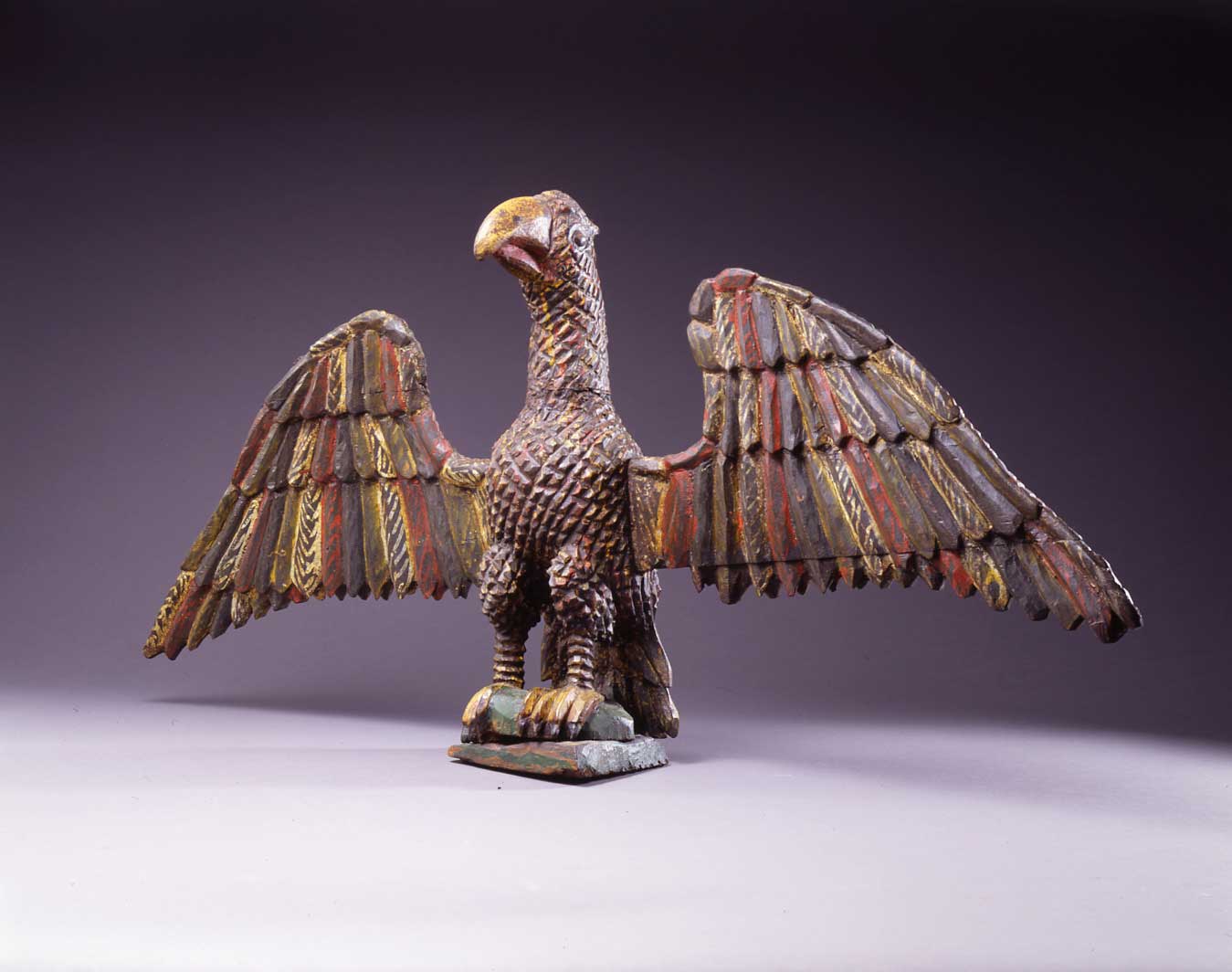
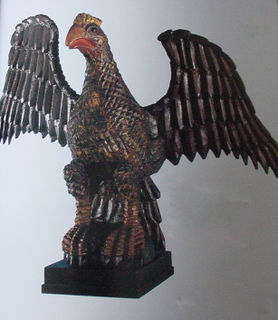
Similarly, the carvings Schimmel produced gained a widespread appreciation among the inhabitants around Carlisle as a result of their fascination with the maker, a charitable effort to support him, or a genuine appreciation for their bright aesthetic character; his fanciful animals and birds suggested in their irregular carving and direct stance the personality of Schimmel himself. The saloons and taverns the carver frequented displayed numerous examples of his work, which he traded for spirits and food; other residents regularly bought his figures for ten to twenty-five cents�or more, for larger figures such as this eagle, which Schimmel referred to in the German, Vogel. Oral histories suggest that several of his larger eagles with full wingspans were displayed on the tops of flagpoles, as exterior architectural ornaments on the crests of gables, or in gardens. The last example shown here at the end has a 42" wingspan.
Remarkably, Schimmel�s only tool was a common folding pocket knife. He worked directly and confidently and seems to have rarely bothered to smooth or refine the broad facets left from the blade on the surface of his carvings. This eagle demonstrates Schimmel�s method of constructing his forms and delineating their surface details. All the known eagles with spread wings have a central body, head, leg, and base section into which the separate wings are shallowly mortised and glued in place. The wing feathers are depicted by deep, angular cuts, gouged out and projecting separately on the frontal, inner face and cross-hatched on the rear. The angular cuts of the body, neck, and tail sections of the form complete this bold appearance of irregular, ruffled feathers. Once carved and assembled, the eagles received a coating of white gesso-like plaster, similar to a thick whitewash primer, which filled in the areas around the joints of the wings and prepared the surface for painting. The paints he used to further ornament his carvings tended to be common house paints and the range of colors utilized on any form were most likely those the carver had found or been given by a neighbor sympathetic to his work and efforts.
�