Just finished a new wishing jar for a friend's kid's wedding gift.
I have long adhered to the Kintsugi view, as most of my jars display cracks and "defects" that give the wood character and uniqueness.
This one is Red Maple 12" by 9" wide. Hollowed to a shade more than 1/4".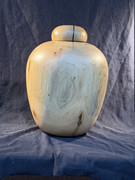
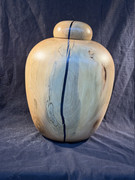
The blue staining is from Ambrosia beetles.
Finished with a coat of Waterlox sealer followed by Krylon spray and rubbed up with my treasured yellow-can Johnson's paste wax.
Comments welcome
Not Quite Kintsugi
Posts
Re: Not Quite Kintsugi
#2

I embrace the concept of wabi-sabi (侘寂) because I'm a terrible woodworker and it allows me to create things like this and call them bespoke. 
Re: Not Quite Kintsugi
#3Kintsugi and wabi-sabi are Japanese concepts that I'm not sure transfer to Chinese. The wishing jar is an amplification of small Chinese "wishing pots".
The story goes::
An old Buddhist monk in China, after preforming wedding ceremonies, would present each new couple with a ginger jar. He’d get the jars from a local pottery’s “reject” pile where items were discarded because of damage and defects.
The monk would then give the couple instructions:
“As your lives together proceed, each of you are to write your sincere wishes and hopes on small pieces of rice paper, then date and put them in this jar. Neither of you are to look at the contents except once every 7 years when you will lay out the little slips for both of you to read. Wishes that came true are to be marked with a dot of blue ink, and then all of the slips, marked or not, are to be put back in the jar. On your 50th year together, you are to break the jar and lay out all of the wishes with the blue dots on the left and all the others to the right side. You will then have a measure of the life you’ve lived together.”
The monk was asked: “Why do you give a defective jar?”
He answered:
“No thing and no one is perfect. You have pledged to each other and your marriage, but if you ask for perfection from your partner, your love will not last as you’ll always be disappointed, never satisfied, and will soon to be alone wondering what happened to your dreams and happiness. The jar’s defects, large and small, are to remind you. Its defects also make the jar quite fragile and easily broken, but remember, it holds your most precious possessions, your hopes, goals, and dreams, so keep it safe in a place of honor.”
I pass the story along with a jar. They have been well received by the newlyweds, but I won't be around to see if they actually follow through.
Re: Not Quite Kintsugi
Edited #4
Kintsugi gets invoked a lot for pieces like this, but I think wabi-sabi is the closer fit. Kintsugi is about the visible repair of a break, wabi-sabi is the broader appreciation of imperfection itself. IOW, the story is about building a life worth living starting from the fact that beauty if often found in imperfections as opposed to something broken but fixed.
Why are we often attracted to things with imperfections? I think what's happening is that we're extremely tuned pattern-detectors, and perfection is a pattern anomaly just as much as damage is. Almost nothing in the natural world is truly symmetrical or flawless — faces, trees, stones, even the "identical" grain in two boards from the same log. So when we encounter something that is flawless, some part of us reads it as artificial before we've consciously figured out why. Robotics researchers coined "uncanny valley" for the specific version of this -- a robot or CGI face that's almost-but-not-quite human doesn't read as impressive, it reads as wrong, because it's close enough to trigger our human-recognition circuitry but off in ways we can't always name. I think a "too perfect" object does something similar on a smaller scale -- it doesn't look handmade or lived-in, it looks like it's performing handmade-ness, and we feel that gap even when we can't articulate it.
There's also probably an economic layer to it -- in a world of injection-molded, laser-cut, machine-sanded everything, flawless has become cheap. Perfection used to be a sign of skill; now it's a sign of a CNC machine. Imperfection has become the tell that a human hand and a specific piece of wood were actually involved, which is maybe why we've started to prize it rather than hide it.
Re comments on your containers. I like them, and the story. In fact, I have a couple in mind where I think that would be an appropriate gift, and story. I can't make something like that, but I think I still have a covered vase given to to me while I was in Japan that was chipped during shipment to the states. That was a bummer, but not near so much as the thousands of slides I took while there that were lost when submitted for developing and never found. Shyt.
Re: Not Quite Kintsugi
#5All I can say is wow. Well done. Thanks for sharing.
Ron
Re: Not Quite Kintsugi
#6Peter Martin wrote:lost when submitted for developing and never found. Shyt.
When I shot film, I always used Extachrome that I developed myself; same for b&w.
Still have my OM-1, but it stays home when I go out with the D800


