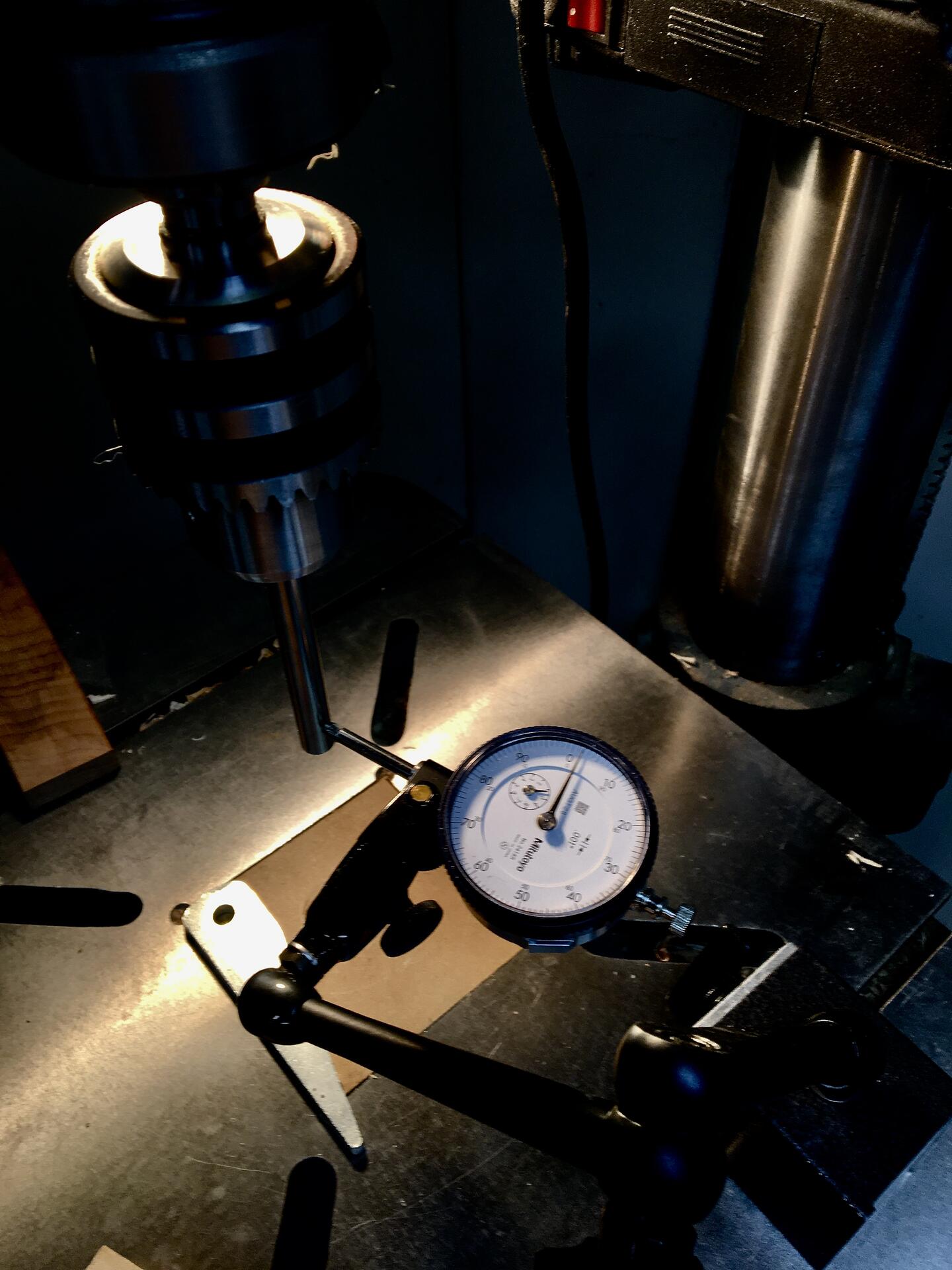
The chuck and arbor fell from the spindle as they occasionally do. When I reassembled them, I got a measured run-out of .003" using a trusted 5" long 13/32 drill blank with the original keyed chuck. I measured this ~ 2 1/2" from the jaws. It was the best I could achieve, similar to my previous best values. I have found this satisfactory, even using a substantial Milwaukee hole dozer. Still, I noticed that the dial indicator needle moved .005-.007 accompanied by a mechanical click when I moved the quill/spindle assembly back and forth or side to side. I have read that Delta and many similar drill presses no longer had user-adjustable quill collars. However, I found some observations from owners that the slotted bolt just in front of the spindle return spring could be used to snug the quill/spindle assembly. The Delta manual shows this bolt in the photo but does not address its function. My OCD kicked in and I had the time to address this, so I loosened the nut, expecting to free the bolt. The bolt turned freely but limitedly, no more than 15-20°. It didn't affect the waggle. When I retightened the nut against the two split washers, I noted that excessive tightening prevented the spindle and chuck from rising when I released the feed lever. It seemed an unintended and unusable distortion.
Subsequently, I found a YouTube video of an owner adjusting his Porter Cable drill press. He had the same slotted bolt with limited rotation and no evident function.
https://youtu.be/fMh7OossC_4?si=uXDCcsp-xZmOIWgC&t=67
Finally, I found this piece on correcting radial quill play. The writer operated on his press, taking it to a milling table where the housing was split, allowing it to be tightened around the errant quill.
https://www.instructables.com/Drill-Press-Quill-Play-Fix/I'm not proposing surgery nor interested in acquiring a vertical mill to turn my cheap Forstners. I want only to know the purpose of the slotted bolt. You may have one in your unit too :-)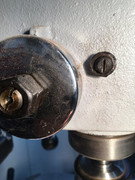
[2025-01-09 12:05:09 Edited for formatting - admin]
Added later 5 h 15 min 06 s:
I guess no one knows or cares about this bolt, and now I don't either. I reduced the run-out to .002 by removing the chuck with its attached Morse taper and gently tapping it back into place. The drill is well-built, still made in the USA when I bought it in the early 2000s. The run-out was measured at full belt tension and also with the belt removed from the drive pulley. It stayed the same. It's my favorite machine.