WoodCentral Forums

Est. 1998 — 27 years of woodworking knowledge

Kickback. A sobering lesson.

Posts

Kickback. A sobering lesson.

#1

Maurice

First year at the London College of Furniture.
Ground floor mill. First unit on using machinery safely. 
Technician gives us all a piece of pine to go through the steps. 
" This is the thicknesser" and demonstrates how to turn it on, adjust height and feed.
It's a very well known machine. Wadkin BAO 12". 
" Now whatever you do, never feed more than one piece at once or it will fire it back out" 
So as soon as his back is turned one of the Goth chick's grabs her piece and her friend's and puts them both through. Bang ! Throws the second piece clear across the mill and it hits the wall. HARD. Nobody expected it to fly like that. 
So during my time at LCF a lot of those older machines were unplugged or replaced.
The other machine that was banned from use was De Walt radial arm saws. To many finger's and hands being removed.
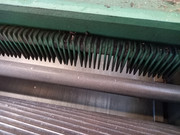
Antikickback fingers pretty much eliminate any chance of that happening. If your machine doesn't have them don't feed multiples. Now some people believe that segmented rolls are the exception to that rule. As did I until my old General 24" did it too. You think thickness planers are safe. It's all covered up. But no. 
So anyway, just a little note for anyone who wasn't aware. 
If a roll segment gums up and sticks or it has a broken spring inside ? Boom. 
So always stand out of the firing line or better still just feed one at a time. Breaking a glass door isn't the end of the world. Breaking your balls ? Not so nice.
Take it or leave it. Picture below of my Wadkins kickback finger's. You can tell it's stopped kickback a few time's. The finger's are bent. I blow them off when I change the knives and check they aren't sticking. 
A 10 hp motor running a head that heavy ? 
Nasty. My head is larger than standard spec and two knife to give a smoother finish. Like glass with fresh knives.
Do be aware that four knife heads result in more back pressure. Blunt knives increase back pressure exponentially and increase the risk of violent kickback. As does back bevelling with a grinder attachment.
Head speed is another factor of course.
Applying to much down pressure on the feed roll springs increases bed friction and can cause snipe, not reduce it. 
Check your manual for the recommended specs. Some old machines are kinda lethal if you don't know what to check for. 20240823-073938.jpg
Re: Kickback. A sobering lesson.

#2

Got my first taste of kickback about 1 year or less into woodworking. PM 66, Englishman who got me into woodworking. No guard, thin panel. I'd make that by hand these days and it would be uneventful. Pulled the panel into the blade as soon as it started to lift, made the trademark curved cut winding toward 90 degrees from feed direction and sent the board right into my belt line. Lucky i'm not 6'7" or so - heard a bang and ring, saw the panel going sideways hitting a wall after it frisbeed off of my waist and right at the belt line had a lump for months. Guess that's scars. 

I was lucky enough, and odds on 95 times out of 100 the kickback in my case occurred before hands would've gotten to the blade laterally due to the size of the panel - but had the board been shorter and my fingers cut, I'd have had no chance to avoid it. I didn't even gather it hit me while first viewing it flying sideways at a high rate of speed and it took a couple of seconds to start feeling the pain. 

Not sure how often you've been on forums, but reddit as dead as it's become still has some regular discussion about a new manbun type woodworker who is going to  "quit their job and make cutting boards and charcuterie boards" asking why their end grain cutting boards are trigging a bang and destruction as they feed them through the planer. 

An amish trim carpenter I know will always say "you can use my tools, but remember, they don't have brains" (so you'd better). 

Oh....the other kicker with the kickback. Someone at a store or catalogue had recommended a fine finish blade for most work to my friend. It was a forrest 60 tooth blade and burned just about everything we put through it and it always seemed to offer a great deal of resistance. Turns out, someone gave him or recommended a blade for radial arm saws with negative rake. fighting that piece of crap probably had some to do with the thin panel I was cutting getting away from the board. Splitter on a saw at least for me since then, and TS use is infrequent for me at this point as a hobbyist.

Re: Kickback. A sobering lesson.

Edited #3

Maurice

Yeah mate, nice post.
I know the pm 66. Trouble with the left tilting blade is that it does not trap the panel under the blade and if that panel grabs it will kick back and slap you so fing hard.
I worked in a shop where NOBODY liked using the pm 66 for that exact reason. 
The favourite table saw was a really really old unisaw. Smooth as silk trunnions.
Cut like a dream.
Kickback is a scary MFer eh ?
Was it the PM with the really shiny finish table ? Looks pretty but it creates vacuum under the panel. Pain in the ass.

Added later 18 min 57 s:

Re the negative rake Forrest. You nailed it right there. Negative rake is for chops.
Never use it on a table saw.
Forrest makes excellent blades. I don't use them downunder anymore. Lietz, Leuco etc.
Rake is something many Woody's don't have a good angle on, excuse pun.
But even with the right blade you can still get in trouble. 
Some guys use high tooth count blades for panel's but I don't find they Necessarily cut smoother. To much heat build up and back pressure. 
Triple chip teeth ? Never liked them myself.
Just regular ATB. 
That's great that you got to work with the Amish. Smart guy's. Cool culture.
I lived near Amish in Ohio for a while. 
Loved the vibe. 
Cheers 🍻

Added later 12 min 05 s:

Seriously ? Feeding end grain through a thicknesser  ? Lol.
You have to really know your sh!t to pull off a stunt like that. 
Have I done it ? 
Once, with a very thick block of Poplar made up for punching leather.
Fresh sharp knives set for a very very light cut. Useful tip for planing end grain.
Wet it. With water. A spray bottle works well.
Dramatically improves hand planing. Turns tough end grain soft as butter.
Trippy. 
Your welcome. 
Cheers 🍻

Added later 1 h 15 min 09 s:

Lol. Those man bun guy's.
I don't do reddit but my daughter has told me it's a giant woke fest for weekenders and pretenders.
Offended ? I can only imagine the warp speed at which I would get banned.
Hanging on by a thread.
FYI. This is the only forum I post on having been life banned from the geriatric ward at vintage machinery and the mummies bots at UK. 
The hipster thing. Gonna have to put that thread in the controversial section along with my machinery porn. Filthy filthy boy !
Love the stories. That's the solid gold right there.

Re: Kickback. A sobering lesson.

#4

Shiny topped 5 horsepower PM66, just as you're saying. interesting top surface compared to other things but can be a bit sticky like you say if something dead flat goes on it. Very dead on TS otherwise aside from the owner (not me) complaining that one corner of the Table fell off 6 thousandths. I see those numbers, and you can observe the lack of dead flatness easily, but it's not something that strikes me as worth worrying about at all as a hand tool user for the most part. if I am using power tools, then whatever I'm making doesn't have much value. Not a generalized statement for others, but for me now. Carve out metal grinding equipment and an induction forge  - i'm quite fond of toolmaking. 

At any rate, the aforementioned saw had zero observed runout with a dial indicator. The saw I had at the time, a mid level delta saw, had .008 at the gullet of a 10 inch sawblade (!!!!!!). 

There is nothing good about runout like that other than that it makes it very hard to burn edges. I ditched that whole hobbyist mid level tool thing long ago and just went to mostly hand tools instead. One could've learned to set the blade angle with a square by knowing how much compensation was needed, but jeez. other tuning fixes could've mitigated a lot of it. Whatever the case, I remember the PM had none of it and was super accurate, but the habit of the owner to use it with no splitter and the difficulty feeding wood into it at the same time - not a huge fan. 

5 horsepower of motor probably just gives it more momentum to put into the flying wood vs. a 3 horsepower saw. 

never thought about right tilt making it harder to get that rise, but you're right - hard for a board to climb when it's trapped - but no experience otherwise. Not much fear of kickback in my case at the time, and the whole ordeal was over before I could figure out what was going on, other than the bruise and under-skin knot later. It hurt enough for me to set priorities, but not enough to do anything permanent. A gift of sorts.

Re: Kickback. A sobering lesson.

#5

Maurice

I used an Oliver table saw for a while. Direct drive beast of a thing. It had run-out and I got it fixed by a local engineer. Never liked it though. 
I often run my Felder without the riving knife because I use it to cut tenon shoulders and the knife gets in the way. I do most of my ripping on the bandsaw. I only rip to final on the table when necessary. I rarely if ever use panel product. So I rely heavily on the accuracy of my Wadkin Jointer and thicknesser rather than the saw. 
I've only had kickback from Felder once. Threw the piece right through the window.
But rule no 1. Stay out of the firing line. So no harm done to me.
There was I noticed in America often a culture of trying to get the table saw to do as much as possible. I'm the opposite. I hate dado set's. Mongrel bastard thing's.
America loves dado set's. They are banned in most European countries. 
So unfortunately there is a quite large rift between American methods and my English training. This has been a cause of tension..
Unfortunately.
The face frame thing is another very American fad that really doesn't fly elsewhere. I associate face frame with clunky cheap hinges and trailer park kitchens. 
Of course the Shakers did semi face frame on their cupboards as do the Amish.
That's not so bad. But probably more a matter of economy and increasing the stiffness of the carcass. The French method of thick pillar corners is far better though. Imho. 
Therein lies the process methods of American woodshops. Often rather inefficient.

👍 This page answered my questions

Your vote helps other woodworkers quickly find the answers and techniques that actually work in the shop.