WoodCentral Forums

Est. 1998 — 27 years of woodworking knowledge

How much do you Bench ?

Posts

How much do you Bench ?

#1

Maurice

Chunky legs. Thicker is better eh ? No.
Balance and proportion is what makes for a strong user friendly bench. 
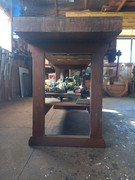
20240910-145951.jpg
This is a working man's bench. It's not a show pony to impress Fine woodwanking magazines editor's.
Follow the logic not the glam spam.
Two identical tenoned frames at either end held together by two long wide stretchers low down for maximum rigidity and support of the storage shelf. The power tools etc are easy to hand and provide ballast.
The lower end rail acts like a sled making it easy to slide the bench around the floor.
The upper rail carries one simple heavy duty bolt to hold down the top. 
So despite the heavy weight the bench can be moved easily. 
Through tenons all round secured with wedges. Easy. Super stiff and strong.
It is in fact and practice a double trestle. 
No upper skirt rail. Don't do that. It gets in the way of using the bench top as a  clamping and gluing caul. Make the top out of 2x4 stock laminated together with epoxy glue. Edge up, quarter sawn. 
Remember. It's a flat reference surface that will stay flat even if the floor is not perfectly level. Why ? Because the top is only held by one bolt in the middle. This allows the end frames to twist slightly without twisting the bench top. Clever eh ?
Four leg's can't do that. 
There will be times when you need that room under the bench top for clamps. Don't make that under surface redundant by putting tool chests etc under it. Keep it clear.
Rubio benches have been bastardised in to a fashion statement not a practical user friendly WORKING bench. 
It's your gig if you want to go that route. I save my best work for the customers and my home. Besides which I work my bench hard and it gets glue snot, paint and oil finish splats on it. 
It's not a piece of furniture. I can't work fast and efficiently if I'm worried about scratching it, getting it dirty or damaging the inlays. Plus you don't want your chisels banging around underneath when your hammering something on top. Its bound to damage them. 
Copy it by all means. Then get it doing what a proper bench is supposed to do. 
How long did it take me to make this one ?
Four day's. 
Is it still beautiful and impressive  ? 
Fk yeah ! IMHO. 

PS. Give your self generous over hangs at the main vice end. You will be amazed at how often you end up clamping to it.
You are most welcome. 
Cheers m'dears. 🍻

Re: How much do you Bench ?

#2
No upper skirt rail. Don't do that. It gets in the way of using the bench top as a  clamping and gluing caul. Make the top out of 2x4 stock laminated together with epoxy glue. Edge up, quarter sawn. wrote:

Remember. It's a flat reference surface that will stay flat even if the floor is not perfectly level. Why ? Because the top is only held by one bolt in the middle. This allows the end frames to twist slightly without twisting the bench top. Clever eh ?

Good solid bench by the look of it, but it seems to me that the top is cupped. Maybe the apparent cupping is just lens distortion, but if the top is cupped a bit of levelling may be in order. Slainte.

Re: How much do you Bench ?

#3

Maurice

No. It's my cheap, nasty mobile phone and the wide angle lens distortion. I only take quality photos on my Olympus for customers and personal records. 
My wife's phone takes much better pictures than this clapped out old oyster shucker.

Re: How much do you Bench ?

#4

Why epoxy glue? With all the gluing surface I would think a simple gluing with Elmers gives more gluing strength then needed.

Re: How much do you Bench ?

#5

Most informative! Thanks for the design logic. 

My one pleasure with using a Rube Goldie (Roubo) inspired timber mess is watching no bounce, no vibration. It's a feeling thing as well.

Re: How much do you Bench ?

Edited #6

Maurice

Ralph Lipeles wrote:

Why epoxy glue? With all the gluing surface I would think a simple gluing with Elmers gives more gluing strength then needed.

Elmer's would work. The only slight problem is it introduces a lot of moisture in to a very large lamination and may take a while to stabilise. I glued my top in two main  widths then glued them together. 
Ordinarily im not a big fan of epoxy. It's expensive and messy. But for hard Australian timbers that are very dense it's a better glue for this particular job. 
I remember Elmer's. We tended to use the Franklin yellow glue in the organ trade.
I prefer hide glue for some thing's.
Gluing a top like this with hide ? Not impossible but time consuming.
The top is quite a lot of work because you have to cut the dog holes then glue them to the main lam. But it's worth the extra time and effort because you get a self stable slab that cannot twist. 
I would give the glue lams at least two weeks to dry before finish jointing and thickness planing if I used a water based glue. With epoxy you don't need to worry about that. I used resin but the paste type works okay. Resin gives you better penetration and strength I suspect.
Expensive and messy but worth the extra for this application. 
🍻 cheers. Good question. Perfectly valid.

Added later 18 min 57 s:

No bounce with this type I assure you. Far from it. Much depends on the stretchers and how they attatch to the legs. The stretchers need to be nice and wide and low. 
The real problem with the Ruobo type is that moving it is very hard. The legs tend to grab and chatter on the floor.
If the floor isn't level it transmits up through the legs and stresses the joints and top. 
So the bench ends up stuck in one spot to get it level by shimming the leg's  ! 
I don't have to worry about that you see ?
I do understand the romantic attachment to that old style. It looks the part but in 
practice ? They end up against the wall and that's the worst place for a bench.
It means you can only get to your project from one side instead of both.
It's not healthy or practical to stare at a wall.
We always tended to face our benches to the middle of the shop so we could see each other and talk to each other while we worked. Bench placement is VERY important. 
Light is vital. Try looking at a wall all day and see how quickly it gets you down ! Not good.
Guys go mad staring at walls. It's like being in prison.
Anyway, thank you for your input. It's valid, it's a good question and yes, solidity is very important. I totally hear you there.
🍻

Added later 11 min 56 s:

Bruce McCrory wrote:

Most informative! Thanks for the design logic. 

My one pleasure with using a Rube Goldie (Roubo) inspired timber mess is watching no bounce, no vibration. It's a feeling thing as well.

Sorry Bruce, I screwed up. My reply to you is directly below the other one. 
I've worked on many old Roubo benches. They tend to get wobbly in old age because they don't like being moved around and moving damages the joints and twists the top. Often the top is two wide planks with a well. I never liked that style. Just gathers crap and dust. 
The cross frame style is basically a door frame but with the rails extending past the legs. Those angled horns make the joint much much tougher. Trust me. I've flogged this bench. I've jointed 8×10 " beams on it.
I've got to do another thread on the dogs and tail vice.

👍 This page answered my questions

Your vote helps other woodworkers quickly find the answers and techniques that actually work in the shop.