Ming-Style Table (Gary Radice)
#1

Knowledge You Can Build On — Est. 1998
Gary, you did a wonderful rendition of this complex design/construction technique. And, Madrone fits the material perfectly. The piece has been a favorite of mine for years.
I checked the library copy of the current Fine Woodworking issue. The Ming copy (Part 2) is a direct copy of the 400 year-old source table for Gary's rendition. It's nice to see the comparison of Chris Hall's design--your work--and John Cameron's copy in the same issue.
Thanks, Bruce. I emailed Cameron about his table and we had a nice back and forth about building them and what we learned doing it.
Although they are both Ming designs there are some differences. His would be called a jiuzhuo or wine table, which was used for serving wine or food. The tops are rectangular and rather compact. They usually have inset and round legs. Mine is small tiaozhuo which means "long rectangular table" (although mine is not so long) and also used for serving food. These usually have corner legs that are round or square in section and if square often have hoofed feet.
But the differences are probably important only to furniture historians or interior designers. To my mind it's like the differences between a console, a side board, and a buffet table. Different designs but similar functions.
It was nice to have the opportunity to give something back to Chris's widow in appreciation for her keeping his blog alive.

@Gary Radice,
Gary, since you're more of a Chinese furniture scholar than I, maybe you can tell me where this low table fits in historically. I made it about 40 years ago for a friend who owned the Chinese original. The top on the original was 1/2" thick thuya burl, with sliding dovetail pine battens underneath. I duplicated all the molding profiles (on the legs, top and lattice elements by approximating the profiles as much as possible with the tablesaw and then hand scraping to the exact final shape with a card scraper that I filed to the correct shapes. The original was huanghuali rosewood and thuya burl; mine was Indian rosewood and (I seem to recall) madrone burl veneer on a thin plywood substrate, but also with pine battens. The corners were through-tenoned miters. The gallery joinery was a mix of through and blind tenons. I did use hide glue sparingly, so the joinery was not completely mechanical.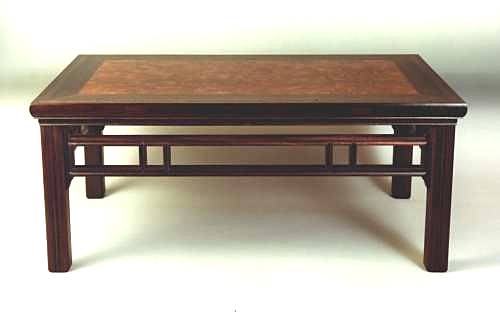

I thought this was a Ming-era design, but now I'm not so sure. Does it ring any bells with you?
That is lovely, Ellis.
Almost everything I know about Ming furniture is what I have read in Wang Shixang's two volume Connoisseurship of Chinese Furniture." According to him, your table is called a kang table or (kangzhuo). 
He has a picture of one that is nearly identical in form to your table. (The apparent splay to the legs is photographic artefact). 
Wang describes the kang table as "...a low table with a wide top which is wider than half the size of its length. It was designed fore use next to a bed [kang means "bed"].... In northern China, during the warm summer months, families would sit on folding stools indoors or outdoors and place the kang table on the ground and serve meals off of it. When used as a dining table, it is called a fanzhuo, literally "an eating table."....The kang table can be divided into waisted and waistless type. Waistless ones have straight legs joined by straight or humpbacked stretchers much like rectangular and square tables, and stools with the same construction."
Of the example in the picture, Wang describes it as having "a lattice design between the straight stretcher and the top rails, in a well-lattice pattern called a jingzi or fengcheshi. The legs are reeded with large reeding on the outer edge and smaller reeding on the inner edge." He goes on to describe variations in lattice leg designs and shows some alternate forms. So it seems your table and the one it was based are definitely Ming designs. 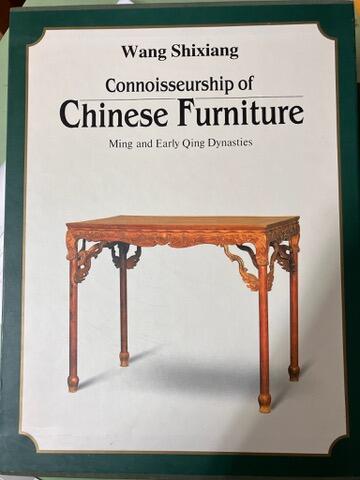

This could be a useful addition to your library.
China tenon-and-mortise. Structural analysis, 81 methods of the tenon-and-mortise structure of classical furniture
https://www.aliexpress.us/item/2251832696297182.html
Hello together!
I just registered for some questions because its so hard to get decent information on this topic.
First of all thanks for your contribution.
I have just discovered couple of days ago such a construction of tabletops (etc...), with a mitered and grooved frame and the panel.
I have seen some newer constructions and on those older ones...that there is very often little to no gap between (raised part of the) panel and frame.
Is it possible to leave no or just a minimal gap between the raised part of the panel and the frame and swelling is neglectable? (because the thickness of the raised part is so low that expansions wont move the frame`and the lower part of the panel is free to float (where is more force)?
My second question is, does it make sense to glue the frame (of the tabletop) on the top of a frame and panel base? (without turnbuttons and other hardware)? I already constructed the frame and panel cabinet, just the top is missing. I work with hide glue.
I assume that the tenon, groove and the edge of the groove to the outer part of the frame are about the half of the thickness? (regarding the proportions of the constructions.
Thanks in advance for some answers and the effort you put in.
Wish you all a lovely day. ( :
The mitered frame and panel construction has puzzled me as well. I agree that is seems to be unwise since the seasonal movement of the solid wood panel should compromise the miters and cause them to open in a humid season or crack the panel in a dry season. For that reason I divided my panel into two parts with an intentional gap betwee them. But I agree there are examples in books and in auction sale pictures of antique tables with solid tops and no gaps or splits. Maybe those old pieces used unusually stable wood.
I'm not sure what you mean in your second question. If you are asking about simply gluing a frame and panel top onto any kind of base, I don't think that is wise. I would want some kind of mechanical connection between the top and the base.
Hello Gary.
Thanks for your reply.
Great that I am not the only one, who was and is curious about the gapless constructions, because on all the researches before there were never words lost on this "gap issue". I have made some more researches but havent got any clear answer until now.
But your way of dividing the panel adds some interesting perspective on this topic.
Yes, its simply about gluing the frame & panel top to (any) base.
Mhh. In general and theory I undoubtably understand the problem of gluing solid wood to any base, but I thought in this case, where my frame is wide as 1 inch 3/8 and just a fraction of it is glued to the base there wouldnt be any issues.


