I know this is routing 101 but, I am old and getting forgetful. I am making two desk, one for each of my adult children. The desk tops are curved on each side, two convex and, two concave. The wood is highly figured cherry. I want to break the sharp edge with a small roundover. Should I use a smaller roundover bit first to avoid blowout then, change to the final larger bit size? Do I route up hill on the curves or, downhill? Should I treat the wood just before routing with something like denatured alcohol?
I am all but done and don't want a disaster this late in the game.
It pays to ask the questions before forging ahead into the unknown. My answer is conditional: If the wood will tear out with normal left-to-right router feed (facing the edge), don't do it. And, the only way you'll have a reasonable guess is to try it on some scraps of the same wood cut in similar curves.
You didn't discuss the final radius you're after. To me, a small radius is 1/8", in which case it would be hard to come up with a smaller radius to try in advance. So, I'm assuming you want to end up at 1/4" or so (which I consider fairly large for the edge of a desk top). Do a trial run on scrap as I suggested using the finish roundover radius you want-- one single pass at full depth -- and then, if the tearout is unacceptable, try this: Raise the bit by half the radius of the roundover and see if it still tears out. If it looks okay, follow up with a second pass at the full depth of the round. If that also looks okay, go ahead and rout the actual pieces using the two-depth method.
Two other things are worth mentioning: First, I've not had much trouble with cherry splintering when edge-routing, so I suspect you will have no trouble just doing it. Second, make sure your bit is sharp. Cherry edges burn quite easily compared with a lot of woods, so you need to use sharp cutters and you need to keep the router itself moving at the fastest speed that produces an acceptable edge. If you have a variable speed router, you may find you get better burn-free edges at less than top speed.
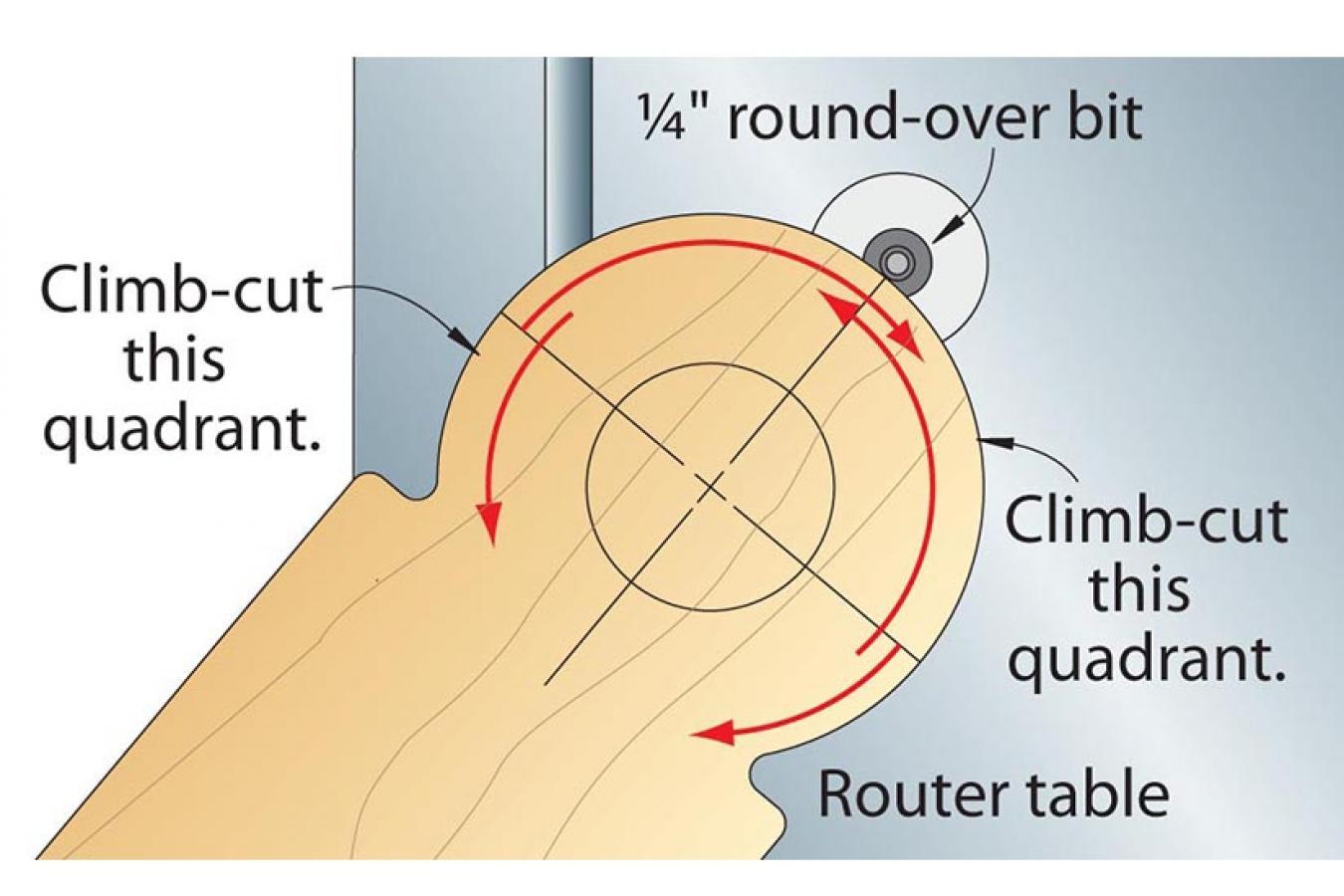
Finally, if for some reason you get smooth results routing "downhill" on the grain (on the curved edges of the desk tops) but not when continuing "uphill", you can climb cut on the offending parts of the curve to remove most of the waste, then finish up with a final pass in the normal feed direction. Climb cutting shouldn't be intimidating with tiny cutters like this, but do keep a firm grip on the router in case it wants to feed itself.
Let us know how it works out. And, post pics of the finished desks.
When in doubt, practice on scrap. Unless you're planning on a molded profile for the edges, hand sanding is the safest and doesn't give you the possibility of burnt edges.
I recently had to route a convex curve into table aprons. The only way I found to avoid tearout was to route half of the curve with a hand held router, then flip the piece over and route the other half on the router table. If your desk is already assembled, that won't be possible, but if not, and if not too unwieldy, it avoids tearout.
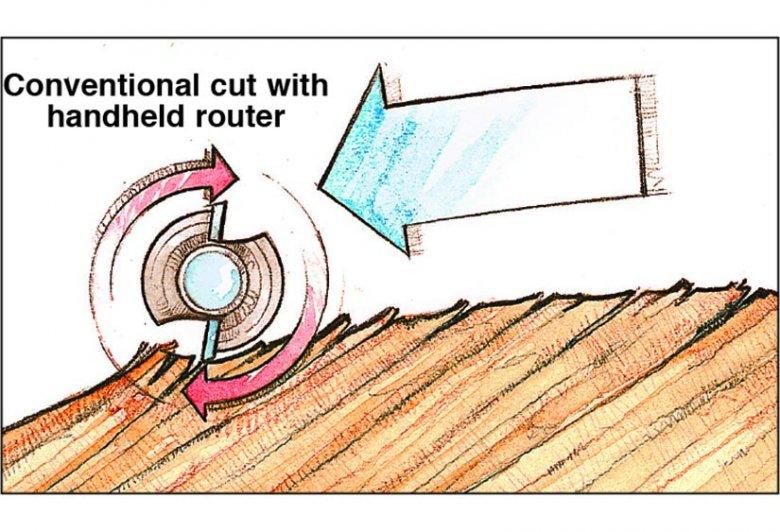
When using a router to add a decorative touch to the curved edge of a piece of wood, tear out can occur in certain areas. In those areas, you can often avoid tear out by climb cutting with your router. This is one case where climb cutting instead of conventional cutting is advised. Here is what can happen when routing curves with conventional cutting.
This photo shows how to address curves on a router table. See the explanations here and here.