WoodCentral Forums

Est. 1998 — 27 years of woodworking knowledge

Tensegrity table

Posts

Tensegrity table

#1

Peter Martin

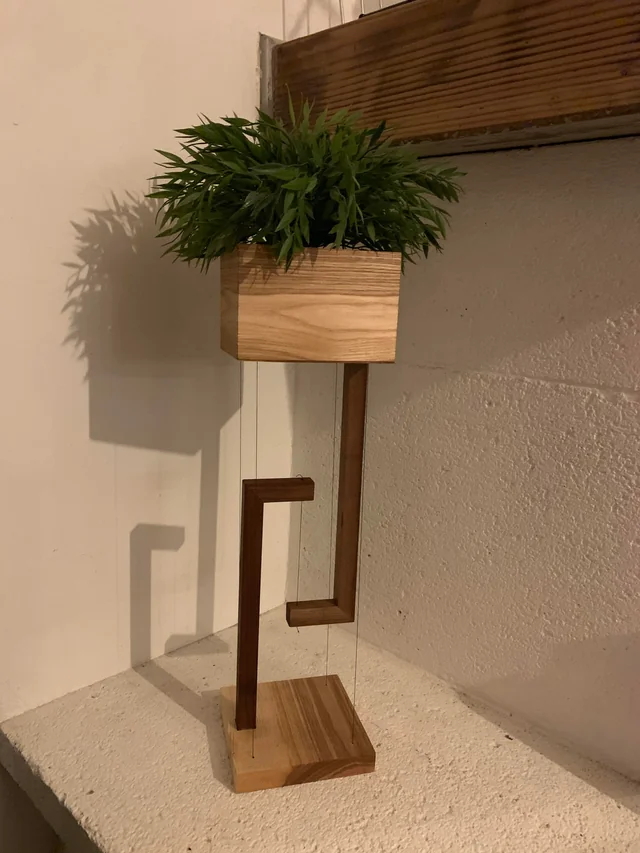
Has anyone made one of these? How would you make a way to tension the cables without using turnbuckles which would ruin the illusion?

8c62dt39tqhb1.webp
https://www.reddit.com/r/woodworking/comments/15pfcnc/i_made_this_tensegrity_pot_but_totally_unstable/

Re: Tensegrity table

#2

tensioners would be hidden in the box

Re: Tensegrity table

#3

ebd

Unstable because there is only stability provided in a single plane along the center by the L shapes. You need to provide for stability in both planes through the center.

Re: Tensegrity table

#4
ebd wrote:

Unstable because there is only stability provided in a single plane along the center by the L shapes. You need to provide for stability in both planes through the center. Otherwise the slightest offset in center of balance will collapse the entire thing.

I thought the same thing initially, but looking closely, there are wires on all 4 corners. I say wire because if there is any stretch at all in them it will collapse as you suspect.

Re: Tensegrity table

#5

ebd

Yeah, I saw the corner wires. But the OP mentioned it was "totally unstable". Any twist/torque will likely collapse the thing. I'm not sure even adding the second plane through the center, perpendicular to the one that's there would solve that. Neat idea. Lot's of challenge to get it to work. Especially trying to minimize the visibility of the wire supports.

Re: Tensegrity table

#6
Peter Martin wrote:

The four corner wires are easily tensioned from inside the box and/or the base. The center support wire in this case is an odd situation in that there are clearly loops of cable showing at top and bottom. What is in the middle? I don't know but these ends could certainly have been totally hidden with a bit of plug/veneer work.

Re: Tensegrity table

Edited #7

You might find this discussion about a build of a tensegrity table useful. Slainte.
Tensegrity build.

Re: Tensegrity table

#8

ebd

Thanks for the link. I guess I'm wrong about stability. Wish there was some clear strand material that has absolutely no stretch.

Re: Tensegrity table

#9

Peter Martin

I wasn't sure what these tensgrity tables were, so I asked Claude. Its response was good and helped me better understand what is going on with all these tensions and compressions and how it creates an illusion of floating.

Claude AI wrote:

A tensgrity table (also sometimes called a tensegrity table) is a type of table that utilizes tensgrity structural principles to support its weight.
The key features of a tensgrity table design are:

  • It uses isolated rigid elements (such as metal rods or wooden struts) that do not actually touch each other. They are held in position by a continuous network of flexible tension elements (cables, ropes, etc).

  • The compression components (rods/struts) are discontinuous, floating in a sea of tension elements. It's the continuous tension network that provides integrity and transfers forces.

  • It achieves stability through the balance of opposing forces and self-tensioning. The rigid compressive elements press out against the tension network.

  • There are no shear forces transferred between elements and no mechanical connection between the rigid parts.

  • The result is a table that appears to magically float in mid-air, with the top supported by an intricate web of cables and rods that are in tension vs. compression.

Tensgrity structures distribute stresses smoothly and have an anti-fragile resilience. But they require careful engineering to balance the forces properly. When done well, tensgrity tables seem to defy gravity through structural balance.
👍 This page answered my questions

Your vote helps other woodworkers quickly find the answers and techniques that actually work in the shop.