In the final stage of finishing a bookmatched pair of walnut end tables. They started out as 11/4 pieces milled from a walnut crotch. After sitting and drying in the shop for 4+ years, I finally decided to tackle them. Using a router plane rig (w/ a 2-1/4" spoil board bit) I got them thicknessed at 2". I had originally thought to use a two post 
under-carriage like this but decided to go with my previous Torri gate design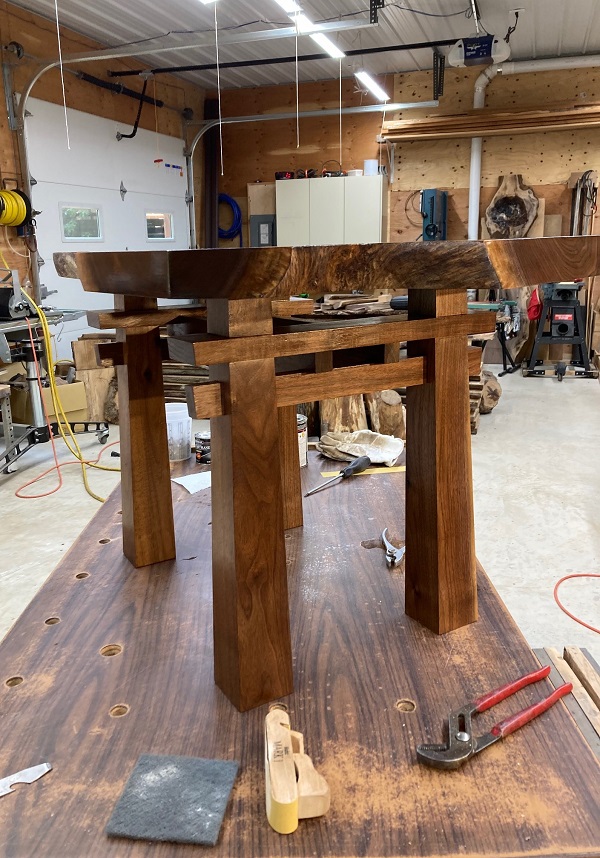
so now in the final stage of finishing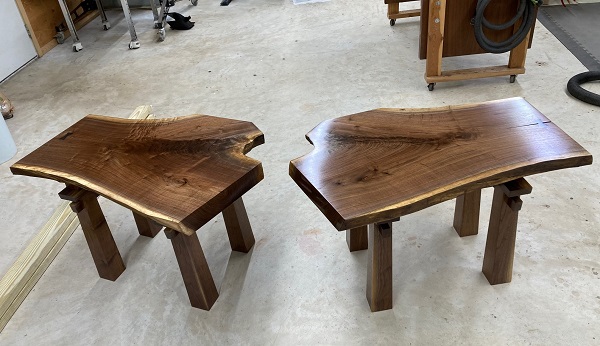
Speaking of Slabs
Posts
Re: Speaking of Slabs
#2Much prefer the Torri gate design. Very nice.
How tall are legs?
Re: Speaking of Slabs
#3Hi Carlos,
Thanks for the comment.
Legs are 20" to make the table top sit at 22" high. A bit lower than "standard" side tables, but better design-wise given the weight of the slab top. I settled on the torri design when I did SWMBO's Nakashima-style slab coffee table so these will complement that piece.
m
Re: Speaking of Slabs
#4Really nice looking tables! Some questions: 1) Our end tables take a lot of abuse. What finish did you use to help prevent water stains? 2) How is the top fastended to the legs? 3) Those legs aren't solid are they?
Re: Speaking of Slabs
Edited #5Hi Pat,
The finish: Tops are sanded to 150, then a coat of Waterlox sealer is applied as a sanding sealer and allowed to dry for a day or two. Then sanded to 180, vac'd well, and a coat of oil poly, thinned with 20% naptha, is applied. Let dry for 2 days then sand with 220. Hand-apply 1 coat of full strength poly with a foam brush. Let dry for 2 days, then final sand with 400 Abranet, vac, and apply final coat of full strength oil poly. Let sit for a week before use to allow the oil to polymerize and harden. Note this is not a filled pore finish; I want the finish film to shrink down to reveal the wood grain and pores; otherwise it'll look like plastic.
Legs: Legs are solid (milled from 4x4 stock) except for the top 6". They are center-drilled with 1/2" and a 6" piece of 1/2" all-thread rod is epoxied in to reinforce the stack section. The top of each leg is cut as a 1" tenon. Since these slabs are walnut and cut from either side of the pith, they are quartersawn and will be very stable for seasonal movement. Thus a 1" square mortise is routed in the slab to take the legs that are pre-assembled and finished and then glued in.
Added later 3 h 03 s:
Pat,
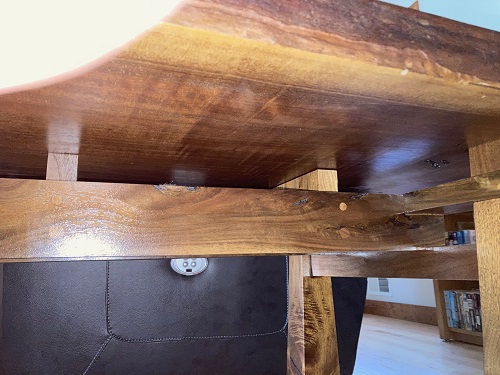
If you don't have quarter-sawn walnut to work with, fixing the top to the leg set gets a bit more work.
The leg set gets made as before but 2 things have to change; leg sockets and mechanical joining.
My design incorporates a double stretcher. So what would have been the tenons are eliminated and the sockets are routed to have a half inch on either side of the leg. Two blocks are then placed between the stretchers to meet the top. The whole assembly is then fixed with a pair of Timber-tech bolts into the top at the center line. This plus the leg slots hold the top but allows it to expand of contract across the width of the board like this
Hope this helps