The simplest threading jig I've ever seen *LINK*
David Walser
It's so simple, it doesn't even require a lathe!
Woodsmith Threading Jig
Est. 1998 — 27 years of woodworking knowledge
The simplest threading jig I've ever seen *LINK*
David Walser
It's so simple, it doesn't even require a lathe!
Woodsmith Threading Jig
Re: The simplest threading jig I've ever seen
john lucas
That was in their magazine a few years back. I built something similar and it worked OK. Here is a photo of the one I use now. It has the Baxter threader from Bestwoodtools mounted on it. My Baxter threader was set up for a Jet mini lathe which I later sold and stepped up to a Delta Midi. Rather than pay to have mine modified to fit the Midi or the Powermatic I built this. This allows me to instantly be set up to do threading and I can take it with me when I demo. 
Re: The simplest threading jig I've ever seen
John K Jordan
>>>It has the Baxter threader from Bestwoodtools mounted on it....Rather than pay to have mine modified to fit the Midi or the Powermatic I built this. This allows me to instantly be set up to do threading and I can take it with me when I demo.
I like that idea. My Baxter is set up for my Jet 1642 which is great since I can turn on the PM and thread on the Jet. But your idea is better. What speed do you turn the cutter, or does it matter?
JKJ

Re: The simplest threading jig I've ever seen
Dennis in Southern Oregon
He seems to have evaded the sticky point of how do you mount your work piece to the platform and get it perfectly centered and not tilted. I made this jig several years ago to cut 5 TPI threads using a cross-feed from an old Bonnie Klein jig that was intended for a much smaller lathe and which produced very fine-pitched threads. My approach to the mounting problem was to make an adapter to connect the all-rod to a chuck. Lacking a screw-cutting metal lathe, I fashioned an adapter consisting of a nut to fit the all-rod, brazed to a large flat washer, mounted to a threaded wooden spindle. The spindle was hand treaded to fit my 33mm chucks. It took a bit of fussing around to get the wooden spindle centered and aligned with the all-rod, but it works well.


Re: The simplest threading jig I've ever seen
John lucas
Speed.doesnt matter. I thought it would and thought my router running at 23000 rpm would cut better than my lathe at 3000. Nope. The higher speed does leave a burn mark on cherry if you pause any while rotating the chuck by hand but most woods it makes no difference.
Now you can buy metric all thread rod
Re: The simplest threading jig I've ever seen
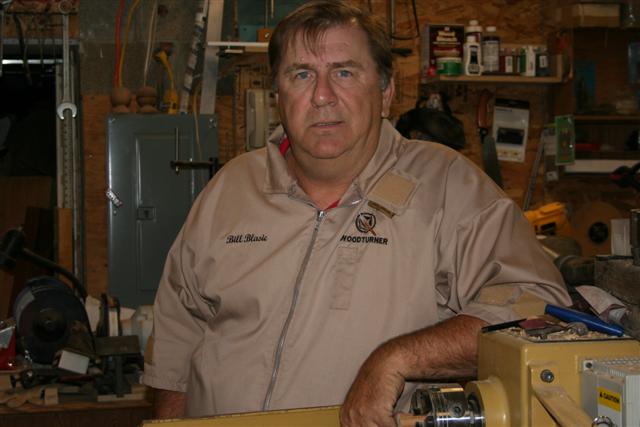
Bill Blasic
Dependent on the wood is where speed comes in for me. A hardwood can take slower speeds but the say using pine I use all the speed I can get, now 5000 rpm on my DVR in combo with the Baxter.
Questions
jorge
Where do you get that cutter?
Re: Questions
William Duffield
Search Google for "60 degree double angle cutter"
Thank you!
jorge
Thank you!
The video said 90º
Keith Newton
I'm sure that either would work, because the same bit cuts both sides, but the steepness of a 60º might make the fine peaks more fragile to breaking.
Re: The video said 90º
William Duffield
First, a disclaimer: I have no personal experience cutting threads in hardwood.
I do have a couple of data points that might help inform Jorge's decision. Both Lake Erie Toolworks and Acer-Ferrous Toolworks cut the threads of their hard maple vise screw components at 60°, not 90°.
no sharp peaks
John K Jordan
>>>I'm sure that either would work, because the same bit cuts both sides, but the steepness of a 60º might make the fine peaks more fragile to breaking.
My jig cutter is 60-deg. I don't think the peaks are more fragile at 60-deg since wood threads usually don't have sharp peaks.
The sources I learned from said to cut both the male and female threads so there is more of a flat at the peaks then there is with metal threads, mostly I think to avoid breaking and chipping the peaks. I sand very lightly with fine paper to round over the corners. I sometimes douse the wood with CA glue before cutting with either the cutter or a tap/die.
Sharp peaks don't seem to matter with some strong, fine-grained species such as boxwood, ebony, and dogwood. Some others will probably chip anyway! Fortunately, wood threads don't typically need precision and close tolerances.
JKJ
Re: no sharp peaks
Bill Blasic
All my cutters for the Baxter are 60 degrees and no problems with the threads.
Re: no sharp peaks
john lucas
I purchased a 90 degree bit for another reason but I tried it on threads. They seem too shallow so to my way of thinking you would need a much courser thread like 8TPI to take advantage of this. In that case I would rather go with an ACME thread. I've thought about it because I do have an ACME threaded rod but haven't measured the teeth to see if I have anything in my stash that would cut the threads.
I would like Acme too,
Keith Newton
While I was doing a search for the cutters, I was thinking that it would be pretty easy to grind the points off of the HHS 60º if I couldn't find that already on the market.
I don't know....Acme never worked....
Mike Stafford
out well for the Coyote. 
Re: The video said 90º
jorge
Thank you William,
I have no intention to get in the market with threaded boxes, but last year a local person that made his living painting houses, died, and we found out that he had another side we never saw: art , like in posters, and turned or machined wood. He died suddenly and his girlfriend made an exhibit and at some point gave me a box of cut outs, apricot, dogwood, box elder and others I have not identified, and as I have known his daughter since she was born, and now she has a toddler, I thought of making a couple boxes with threads, a couple mirrors and toys for the little girl I always enjoy tackling a new task.
Mike you got me. I thought I needed to defend Acme
Keith Newton
That was funny. I was just thinking, that Dick Tracy cartoons predicted the wristwatch I-phone, but hadn't thought about Roadrunner predicting drone deliver.