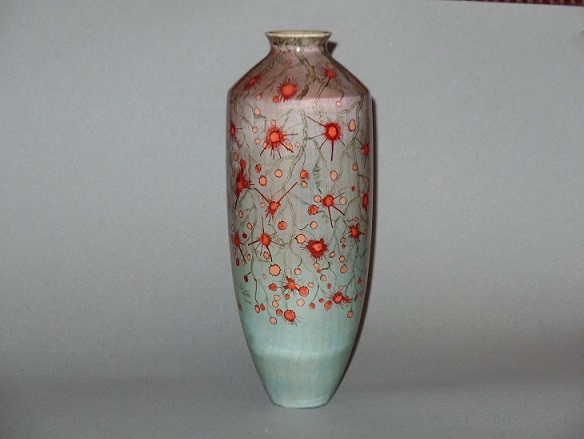
This piece is 10 inches in diameter by 23 inches tall. The foot is rosewood. I put a foot on it because I intended to use a rosewood and boxelder finial... It's pretty imposing already, I'm wondering if a finial might be overkill, so your impressions/opinions would be greatly appreciated and strongly considered.
As a side note, it's the tallest piece I've ever done. It's the first piece that I used the Kobra deep hollowing system that I recently acquired. I don't see how I could turn anything taller on my Mustard Monster... I don't have room in my shop for an extension.
......John Jordan used to finish off with textured caps that were slightly larger in diameter than the opening. They were either matching or contrasting wood, often had a center button of contrasting material like Pink Ivory, and really provided resolution to the shoulder profile without adding any significant height to the form.
I hadn't really considered that, but I just started working with a guy who has some magnificent rose engine lathes (that he has enticed me to play with)
This one is the third try. It fits, pretty exactly, but it doesn't look right... I haven't given up on the idea though, so doing something magic as a cap might be an excellent idea.
I've actually switched to all finials. My greatest concern on it's design is to have the base of the finial flow into the form of the vessel. I don't get carried away with a giant finial, but I think it really elevates the look. I've seen work with smaller vessels, where the vessel looks more like a base for the finial when it's overdone, so scale is very important.
A very nice piece, but I don't think adding a finial would look right for this piece (IMO). I do like the idea of adding an accent collar out of the rosewood around the top opening of the piece. I think it finishes off the top of the vessel.
You could certainly turn a test finial out of pine or popular to determine if you like it or not, before committing to one out of rosewood.
The responses to this post seem to strongly favor "no finial". I wonder what the responses would have been had the piece not been shown tightly framed but instead had been presented with a much taller frame that would allow one to visualize a finial in place.
Further, what if it had been initially presented with a finial, and an ambiguous question, "What about the finial?" Would anyone have suggested that the finial be thrown away?
I prefer to sketch out the piece ahead of time and decide on things like finial/foot/lid before I start. If I don't, adding one or not later might look like an afterthought or omission.
At this point, I would sketch the outline then try out several toppings with a pencil. Alternatively, try several quick shapes from practice wood, spray black or something, and see what they look like from various perspectives and settings.
I sometime use graph paper, sometimes plain. I sketch one side of a shape while imagining both. (Some people hold a rectangular mirror on the centerline to envision the entire shape.) Then I transfer one side to the other by counting squares if graph paper, perhaps by folding and tracing if it is plain paper. I put the sketches in a 3-ring binder and perhaps look at them much later.
I sometimes sketch a bunch of variations as small drawings then make some full-sized before deciding to turn the wood. The last lidded box I turned was after maybe six sketch variations.
The other way works for me too. If I turn something
The larger the piece, the more perspective and viewing distance affects the shape. Even photographing is a challenge. Fortunately I don't do many large pieces.
BTW, don't get me wrong - I often mount a chunk of wood and just turn. Often that works well too.
I watched an episode on Craft in America. The segment on Bernard Leach and Shoji Hamada was wonderful. Two men, one from England and another from Japan, credited with starting contemporary artistic pottery in America.
Leach drew everything out and worked to those prints, Hamada never drew anything. For many of the students that apprenticed under them, most were more complimentary of Hamada's artistic spirit, but respected both equally.
I just love that series, should get the DVDs someday.
A finial on a very elongated piece like this might be too emphatic -- I'd like to see some options -- but I think there needs to be something at the top to resolve the overall appearance, perhaps a low-rise collar of some sort, raised slightly from the top shoulder, and probably of the same wood as the foot.
Apropos of this finial discussion, I was reminded of one we had about 6 years ago, in the context of a piece I made for CharlieB's pay-it-forward redwood project. See link below.
And, on a total tangent, regarding different styles and methods of work -- and probably worth another discussion -- I was always struck by how coherent systems of thought and workmanship are each self-contained, internally consistent and capable of producing the finest quality of work. As evidenced by Toshio Odate in the Japanese tradition, Frank Klausz in the Eastern European tradition, Alan Peters or Ian Kirby or Edward Barnsley in the British Arts & Crafts tradition, all were masters and they all approached design, craftsmanship and tooling differently, yet totally effectively. Then there are modern masters who follow no particular tradition but borrow from any that inform their vision.
I'm an antique dealer. I actually owned three Hamada pieces. Two of them had the original boxes...
I bought them from Harold Chang the drummer for Arthur Lyman. Harold studied at the University of Hawaii where Leach and Hamada did some teaching. The University produced a hard cover book about the courses and the people involved. There was a picture in the book with Harold and Shoji. Since Hamada never signed his work, having that kind of identification was invaluable.
Sorry to go on, but that was a high point of my antique dealing life.
AND, it all came together because of Harold's wife/ex-wife/housemate Robin Savoy (Isaacson) a stunning AWESOME story by herself.
This all just reminded me how lucky I have been in my life.
Ellis, thank you for the "Finials" link. I remember it. At the time I had nothing to add and everything to learn about finials. Not all that much further ahead now, but my review of it was an incredible tutorial.
And for the reminder that there is more than one way to get to "done."
The fact that you felt the need to ask the question maybe the answer to your question. An indication that you felt something was missing, whether it be a finial, collar or cap. Or maybe not!
You ask 5 woodturners, and you'll get 20 answers. Ask several hundred woodturners and the number of answers could only get so confusing I would never be able to make a decision from that.
>>>You ask 5 woodturners, and you'll get 20 answers. Ask several hundred woodturners and the number of answers could only get so confusing I would never be able to make a decision from that.
Your basic premise seems unrealistic. Ask two hundred turners and you probably won't get eight hundred different answers. What you are more likely to get is opinions that coalesce into a few reasonable viewpoints.
I consider even opposing viewpoints valuable to provoke thought.
I would never consider such a question as a poll to direct me to the one "correct" decision.