WoodCentral Forums

Est. 1998 — 27 years of woodworking knowledge

thread cutting with jigs

Posts

thread cutting with jigs

#1

thread cutting with jigs

john lucas

This is to answer JJ's post. I usually have 2 difficulty's when cutting threads with the various threading jigs. I have the Baxter threader and one of the EZ threading jigs from Chefwarekits.com Both have the same problem. Well actually it's not the jigs. I had Vic who makes the Baxter threader check my jig and it was dead on accurate.

The problem according to Vic is that wood lathe spindles aren't dead on accurate like high quality metal lathes are. There are 3 problems that lead to the inaccuracies I'll list below. One is the lathe spindles aren't parallel to the bed in all axis. The second is most of us use dial calipers to measure the box. Dial calipers simply aren't as accurate as other tools and most of us aren't trained machinists and throw in a little more inaccuracy by the way we measure with the calipers. OK there is a 4th. Wood movement. It's simply not as stable as metal and when you remove wood it often moves a little.

Now here are the problems I have and how I deal with them. The first is starting the thread. Here is another area for some inaccuracy. What you do is move the box lip up to the cutter and then adjust the jig until the cutter just touches the wood. As you rotate the box with one tooth of the cutter perpendicular to the box you adjust the jig until the cutter just touches the wood. What you will often notice is it won't touch the wood all the way around. Sometimes I will run the cutter as I do this to take away the one variable of the tooth not being perpendicular. After the cutter just touches the wood just for interest I adjust the cutter about .005" and make a pass. What I notice is that quite often it won't cut all the way around. Sometimes it takes as much a .010" before it will cut all the way around. I thought it might be the threading jig which is why I took it back to Vic and found out it was my lathe, the wood, and me that was inaccurate. At this point I cut my thread from the first setting of barelly touching the wood. I use .032" Not sure where I got that, maybe a book on metal threads but it seems to work.

to cut the other thread I again measure as accurate as I can and then adjust the jig to just touch the wood. Then I make a cut about .020". then I check the fit. If you don't have one of the jig positioning plates that Vic sells with the new ones get one. This locks to the bed after you move the jig into position. Now you can unlock the jig and slide it back to test the fit, then move it back up to the plate that is bolted to the lathe and lock it down it will align perfectly for the next cut. With the EZ jig you just rotate it out of the cut to check it. Then I might take of just another .050" and sneak up on the fit I want. If it's summer I can make a fairly snug fitting lid. It will loosen up in the winter. If it's winter I sort of guess how loose I want it. Rarely do I do the full .035".

With the Baxter threader the knob is calibrated to thousandths so you can really sneak up on the fit you want. With the EZ threader it's a little less accurate but still does a good job.

What I do notice with each jig is that when I get the fit I want (lets say I cut the male first and then have to fit the female thread) the second thread will often have flats on the top on one side of the box. This is because of the inaccuracies I mentioned at the beginning of this article. Doesn't seem to hurt a thing as far as fit it's just obnoxious for those of us used to working with a metal lathe where you can make things fit perfectly.
Re: thread cutting with jigs

#2

Re: thread cutting with jigs

John K Jordan

That's good information, thanks!

I noticed issues from the wood moving on my first try. Remembering what Raffan said about making boxes, on the second one I shaped the outside then the inside (where the threads would be) most of the way then let it sit overnight. This evidently allows any residual moisture that was inside the blank to escape through the thin walls. It also allows stresses to relax. Then I turned it round again the next day.

More than once once on "normal" boxes I noticed that the perfect turning from the day before had gone out of round overnight. On the second threaded box I made it round again on the inside and lightly sanded with 600 to smooth the transition. The thread cutter scratched all the way around on this one.

I wonder if relaxing the piece overnight might be a good reason to turn and thread the bottom, or larger section first before the smaller lid. I also partially hollowed the lid and let it rest but there was not nearly as much wood and it didn't move as much. (Maybe also because it was Gaboon Ebony.) Having enough chucks to keep each part chucked until finished is a big plus. The hard part was test fitting with both pieces still in the chuck.

BTW, at one place after making the .020 cut you mentioned that you might take of just another .050" and sneak up on the fit - I assume this should have been .005 instead of .050.

As for aligning the jig: The Baxter jig fits pretty well into the gap in the ways but there is a tiny bit of play. I didn't think of it until you mentioned it but I could easily machine a metal stop to fasten to the ways in front of the jig. Maybe hold it with magnetic clamps. Then I could slide the jig away from the cutter to more easily do a test fit then register it exactly into place for another cut.

I bought the jig to fit the Jet 1642. It sure is nice to have the second lathe set up! I turn the pieces on the PM and kept the jig set up on the Jet.

I have tried threading wood with a tap before and it was awful! The threads worked but looked horribly chipped and broken. I too don't like the flats on the top of the threads but they sure beat chips. I have three different books that discuss threading with a jig and all of them mention the flats can prevent chipping on some coarser or softer species.

Do you have guidelines for the height of the threaded tenon and the number of threads to shoot for? Do you tend to use the same number of threads on everything?

Oh, one more question - when you did the threaded box ornaments did you jam chuck 1/2 to turn the finials? I thought about turning a throw-away "threaded chuck" from scrap wood to screw on half to hold it for finish turning. Do you see any problems with this other than it being extra work? (I finish turned the lids this way, screwed on to the base still in the chuck.)

Thanks for writing this. When I get time, probably not until Saturday, I want to try a larger box about 2.5" diameter, also from B&W Ebony. I may have more questions!

JKJ

Re: thread cutting with jigs

#3

Re: thread cutting with jigs

robo hippy

For threaded boxes, I don't make them much over about 1 1/4 inch diameter because of wood movement. It may have been Allen Batty who said to keep it in that range. I always rough turn my box blanks, even with kiln dried pieces because the wood will adjust to having bulk removed. I went to the Symposium in Phoenix some years back, and some of my tools still have loose ferules....

robo hippy

Re: thread cutting with jigs

#4

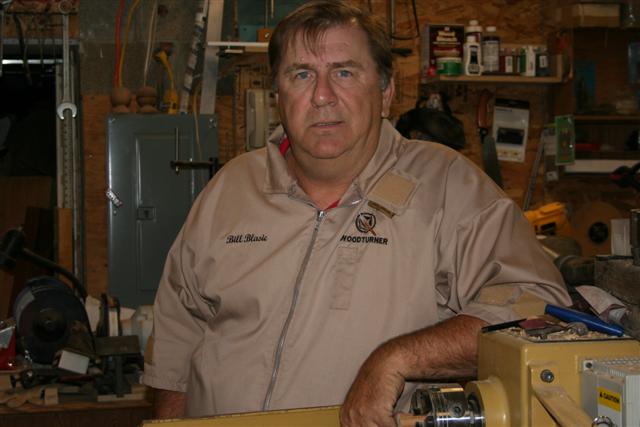
Bill Blasic

Re: thread cutting with jigs

Bill Blasic

There is an article (I believe it comes with your threader) Step-By-Step Threading An Acorn. On page 4 is a chart of depth of cuts for the different heads. While Victor (who is a Master Machinest) does not find these figures exact I have found them more than accurate enough to give me great threads with the different heads I have. I have a machining backround having worked at GE running various lathe and mill type machines for over 30 years. I myself have no problem using dial calipers as I'm making threads in wood (yes wood moves). I position the jig by making sure I put pressure on the jig to sit against the ways of the lathe closest to me. With the 16 pitch that I use the most I touch the wood then back off and move in .018 and take my first cut. After backing out of the cut I then move it in another .017 (that is the .035 total on a side from that chart for the 16 pitch) and take my second cut. Now if you have made the size of the second piece correctly and do the same procedure you will have a pair of threads that work today, tomorrow and hopefully forever. I have not had a problem with the pieces going out of round or being bothered by a little wood movement. I use dry wood. I think you will find that anyone that owns the Baxter Threader will tell you it is a fine piece of machinery that has no match (again you get what you pay for).

Re: thread cutting with jigs

#5

Re: thread cutting with jigs

John C Lucas

I try to use ery few threads although i dont always. You get tired of unscrewing the lid if you have a long set of threads. According to engineering specs you only need 3 threads to get full strength. We definitely dont need strength for our box lids.

I do use scrap threaded pieces to help with some lids or finials. They work so much better than jam chucks.

Re: thread cutting with jigs

#6

Re: thread cutting with jigs

John C Lucas

Bill. I wrote the instructions for Vic. He had originally paid a photographer/turner to write instructions. He wanted them.redone a few years later a nd the guy wanted $500 to update it. I did it as a favor a simple machine job i couldnt do my self. Vic made me an adaptor for my mini lathe. 1" x8tpi on the inside and 1 1/4 x 8tpi on the outside. This way i dont have the extension you have when you buy the other adaptors.

Re: thread cutting with jigs

#7

Bill Blasic

Re: thread cutting with jigs

Bill Blasic

John I should have written Step-By-Step Threading An Acorn by Willard Baxter Edited by John Lucas And Victor Arrighi. It is a great 4 page intro for getting up to speed with the Baxter Thread Master.

👍 This page answered my questions

Your vote helps other woodworkers quickly find the answers and techniques that actually work in the shop.